


 (Illustration by iStock/diane555)
In 2024, the average global temperature increase exceeded the 1.5 degrees Celsius threshold specified in the Paris Agreement for the first time—a stark reminder that the climate crisis is one of the most urgent and complex challenges facing humanity in the 21st century. Its impacts are already transforming ecosystems and societies globally, but some regions are suffering the effects more than others. Mexico, for example, is experiencing more accelerated warming than the global average, according to a recent Universidad Nacional Autónoma de México report. Temperatures have risen 1.8 degrees Celsius from the pre-industrial era to 2024, compared to the global increase of 1.2 degrees Celsius in the same period. What’s more, the country’s average annual temperature is projected to increase between 2.9 degrees Celsius and 5.3 degrees Celsius by the end of the 21st century, putting its agricultural systems, water accessibility, human health and well-being, and the national economy at great risk.
In Mexico and other disproportionately affected regions, there’s an especially pressing need to increase the ambition and scope of local and regional climate action so that it includes all sectors and organizational types—and universities are particularly well-poised to meet this need. UNESCO estimated that in 2022 more than 256 million people were enrolled in universities worldwide, including about 56 million in Latin America and the Caribbean. This vast reach means universities can be strategic change agents, as each student has the potential to drive structural transformations and promote sustainable solutions within their fields and communities.
For Tecnológico de Monterrey—a private, nonprofit university in Mexico—this reality raised an inspiring question: What would happen if all the universities around the world put their strengths in service of climate action and graduated students with comprehensive sustainability awareness and the necessary skills to act in the face of climate emergencies? Many universities have begun to integrate sustainability more robustly into their academic programs and operations and have even adopted international commitments to decarbonization. For example, more than 1,000 universities worldwide, including 95 in Latin America and the Caribbean, have signed the Race to Zero pledge to achieve net zero emissions in the coming decades. Yet Tecnológico de Monterrey was inspired to try an even more transversal and integral approach, beyond carbon reduction.
In 2021, it launched Ruta Azul, Tec de Monterrey’s sustainability and climate action plan. The plan aimed to advance policies and programs to promote sustainability and climate action by embedding sustainability across all university functions—not just the academic or operational ones—and across all its campuses. The university knew this system-wide approach would be difficult to operationalize because it relied on cross departmental and interdisciplinary collaboration, but ultimately, it helped build awareness, capacity, and sustainability expertise beyond dedicated sustainability staff and make climate action a strategic front for the university. In addition to achieving milestones such as integrating sustainable development into university curricula and reducing the university’s carbon footprint, the plan helped Tecnológico de Monterrey take a leading role in promoting university-led climate action in its region, creating opportunities for dialogue and sharing best practices, and promoting spaces for the education sector to have a voice.
For other universities looking to accelerate sustainability within and beyond their institutions, Ruta Azul offers some valuable insights on how institutions can effectively catalyze climate action.
What It Means to Be a Catalyst
Founded in 1943, today Tecnológico de Monterrey is a private nonprofit university with a presence in 20 Mexican states. It serves more than 87,000 students in high school, college, and graduate education, and has a faculty of more than 11,000 teachers and 32,000 staff members. Given its size, implementing a sustainability strategy across all its 26 campuses presented a significant challenge. Each campus has its own unique circumstances and a population that varies in size, culture, customs, and work styles, and each has its own local policies, social dynamics, and/or faces different climate risks and sustainability concerns.
The development of Ruta Azul began with a diagnosis of the climate crisis in 2021 and a statement outlining the leadership role that universities should assume in this context. As one of Latin America’s largest private university systems, Tecnológico de Monterrey’s multi-campus footprint and extensive community network offered a rare opportunity to test, scale, and accelerate climate solutions at a national level. With this in mind, a dedicated team of sustainability leaders at the university—including Inés Sáenz Negrete, Cynthia Villarreal Muraira, José Antonio Torre, Luis Fernández Carril, and Martín Sánchez Gutiérrez—created a roadmap for the next four years, with concrete actions and goals organized around six areas of action: culture, mitigation, adaptation, education, research, and outreach.
In the years that followed, the plan guided and facilitated progress in these areas, defining baseline metrics, developing new policies and guidelines, and testing pilots. Sustainability also became a recurring topic on the institutional agenda, with the university prioritizing Ruta Azul as one of its 2025 strategic projects.
The recent decision to extend Ruta Azul to 2030 prompted the team to reflect on which of the plan’s elements and actions truly catalyzed climate action. While the term “catalyze” may seem curious in this context, it’s very intentional. In chemistry, “catalysis” refers to the increase of a reaction’s speed through the presence of a catalyst. This phenomenon is fundamental to life. Essential biological processes such as digestion and energy production depend on enzymes—catalytic molecules that speed up biochemical reactions to occur in milliseconds. Without enzymes, these reactions would be too slow to sustain life.
Higher education institutions can similarly serve as catalysts; they can accelerate the transition to sustainability and climate action before the impacts of the climate crisis become irreversible. In fact, the four core mechanisms by which enzymes operate closely align with some of the most important insights from Ruta Azul’s first few years.
1. Activating the First Action
Triggering action and mobilization around any cause or initiative requires significant momentum, especially at the beginning. And while collaboration and co-responsibility reduce barriers that traditionally hinder systemic change within large organizations, they require that institutions find a common goal that unites their community first—a spark that triggers collaboration and makes it meaningful and worth the effort amid uncertainty.
Ruta Azul started by joining important international sustainability commitments. In 2019, Tecnológico de Monterrey signed the Declaration of Climate Emergency and Institutions of Higher Education, a three-point commitment signed by universities and colleges on all seven continents that includes:
- Becoming carbon neutral by 2050 (which later evolved into the Race to Zero commitment to be a “net zero emissions” organization by 2040)
- Mobilizing more resources for climate change research and skills creation
- Promoting climate change and sustainable development education on campuses and in communities
This served as a kind of gateway for collaboration within the institution, and highlighted the need for different departments and groups to work in a coordinated and transversal manner.
A later momentum-building effort was adding Ruta Azul to Tecnológico de Monterrey’s 2025 portfolio of strategic projects. This designation positioned Ruta Azul as an institutional priority and opened the door to more-effective collaborations, including working with academics to make sustainable development a pillar of the new curricula. Today, sustainability is a structural part of students’ education, strengthening both their professional competencies and their commitment to the future of the planet.
It’s important to emphasize that sustainability actions are not an end in themselves, but a means by which to endorse a university’s societal role through science-based climate action, with co-responsibility and growing ambition.
2. Addressing Diversity
Mobilizing different types of people, areas, audiences, or organizations represents a challenge very similar to one that enzymes face. Every individual and group carries unique perspectives, knowledge, ideologies, motivations, and needs around sustainability. Challenges include aligning diverse interests and timelines, limited sustainability knowledge, resistance to change, and maintaining inclusive, consistent communication. The key is to build shared understanding and technical knowledge about sustainability, and then co-create with and tailor strategies for each group.
Being flexible allows institutions to design initiatives that resonate with the realities of each group and build bridges rather than impose solutions. A clear example is Tecnológico de Monterrey’s campus-specific sustainability plans, which reflect the priorities and conditions of each of its campuses and include empowered, local, decision-making committees. Rather than having the central Ruta Azul team outline these plans, the university based them on analyses that local committees carried out. This ensured that local objectives aligned with Ruta Azul but that there was enough space for individual campuses to define their own strategy. Local sustainability committees, each led by a campus director, continue to support the implementation of these plans with resources, instruments, policies, trainings, advice, and constant recognition from the central Ruta Azul team. The university also hosts meetings between local committees and the central Ruta Azul team to share best practices, experiences, and challenges.
Flexibility is also important when it comes to skill development. Ruta Azul provides relevant, useful, and contextualized content and tools that respect each group’s roles and possibilities for action. For example, facilities team trainings cover environmental regulations, processes, and sustainable practices, while teacher trainings focus on sustainable development in their teaching practice and educational trends (in this case, via courses managed by the Center for Teaching Development and Educational Innovation, or CEDDIE). This tailored approach not only improves implementation, but also strengthens each group’s sense of belonging and co-responsibility.
There is also enormous scope for connecting with students. Ruta Azul has collaborated with the Tec 21 educational model, which invites students to resolve challenges linked to real problems like sustainability. It has also introduced multidisciplinary academic challenges—blending areas like marketing, entrepreneurship, and engineering—that address sustainability or climate change issues. One challenge brought together 30 students to design solutions addressing climate risks at the Monterrey campus. Over one week, they proposed initiatives to boost community resilience to floods, droughts, heat and cold waves, and heavy rains—including documentaries with community testimonies, hackathons, climate action committees, and sustainability activities for new students.
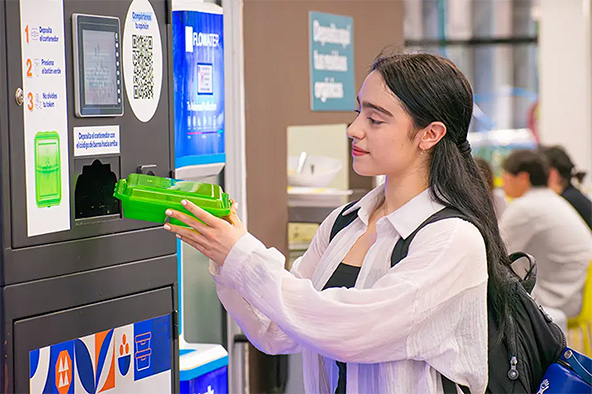 TecFood2Go is a circular system of reusable containers that aims to reduce the use of disposable items in food service operated by Tec de Monterrey. (Photo courtesy of Tec de Monterrey)
So far, Ruta Azul has reached more than 690 students through collaborations involving 26 courses from different disciplines at four campuses. These initiatives communicate that sustainability work is not exclusive to a single discipline and that collaboration is important to success. As student Georgina Martinez explained: "Student participation is essential to foster and promote a culture of sustainability in our environments, not only by creating meaningful spaces for advocacy, but also measurable actions to address the climate crisis. Multi-stakeholder action allows for strengthening and feeding back into existing institutional plans, as well as connecting the student community to collective solutions."
3. Foster the Ideal Environment
Enzymes require a specific environment—the right temperature or pH—to function optimally and catalyze a successful reaction. So do sustainability efforts. Specifically, they need a strong organizational culture that fosters the knowledge, attitudes, values, and behaviors needed to drive change. Only then can sustainability move beyond discourse and become a living, shared practice.
To help create this environment, Tecnológico de Monterrey faculty developed the Sustainability Culture Index (SCI), a proprietary measurement instrument that monitors the culture of sustainability (including appropriation, understanding, and action) among students, staff, and teachers. More than a diagnosis, the SCI is a compass that guides Ruta Azul’s decisions and allows it to design more precise, relevant, and effective initiatives.
Academic Manager Luis Fernández explains, "The inspiration to create this instrument and drive work on sustainability culture came from a reflection by [environmental lawyer] James Gustave Speth. He says that he used to think that the biggest environmental problems were the loss of biodiversity, the collapse of ecosystems, and climate change. But over time, he concluded that the real challenges were selfishness, greed, and apathy, and that addressing them requires a cultural and spiritual transformation—something that science alone does not know how to achieve."
The SCI is based on consolidated conceptual frameworks—including the New Ecological Paradigm, Pro-Environmental Behavior Scale, and ABC Model (Attitude-Behavior-Context—and is structured around four pillars:
- Knowledge on topics like climate change, environment, and sustainable development
- Attitudes toward socio-environmental issues, such as limits to growth or rejection of anthropocentrism
- Ideologies that collectively influence actions, such as greenwashing, scientism, or the myth of overpopulation
- Behaviors such as responsible consumption, sustainable mobility, and environmental education
This structure helps Ruta Azul understand what people know and think, and how they act. Following the initial measurement, the team outlined concrete actions to strengthen the university community’s knowledge base. These included offering online training related to basic climate change and sustainability concepts, which more than 4,000 teachers and employees have attended, and creating a seminar in which the Ruta Azul core team strategically integrated the SCI findings into the priorities. This included the integration of sustainability training and operational initiatives—for example, training university staff to use landscaping as not only decoration but also an eco-resilience and adaptation strategy.
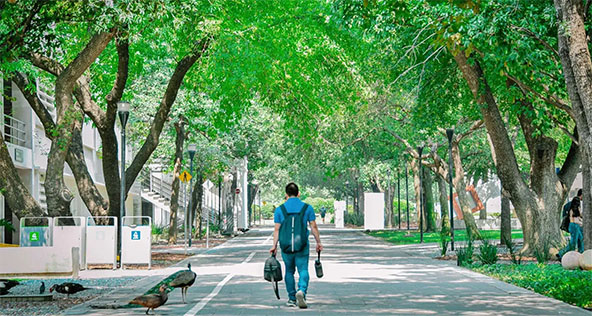 A student walks through Campus Monterrey, Tec de Monterrey’s main campus in the north of Mexico, where sustainability has progressively permeated daily life. (Photo courtesy of Tec de Monterrey)
In 2025, the SCI won an International Sustainable Campus Network Excellence Award in the “cultural change for sustainability” category. Its latest iteration includes new dimensions of analysis, such as pro-environmental attitudes and ideologies, and behavior change in the local context. Ruta Azul also participated in working sessions with the University of Michigan, the Pontificia Universidad Católica de Chile, and other partners that have created similar tools to enrich the design.
4. Learning to Let Go
Finally, catalysts only enable biochemical processes to accelerate; they don’t become part of the final product. Along the same lines, Ruta Azul’s role is to drive and facilitate action, not centralize it, so that sustainability takes root in processes, decisions, and organizational culture. This involves not only leading, but also transforming, delegating, empowering, and trusting different teams and groups of people to make the mission their own, reinterpret the common objectives from their reality, and grow their impact.
Ruta Azul has embedded itself into the university’s two main missions through decentralization—by permanently integrating sustainability into the teaching curriculum and fostering transdisciplinary applied research that treats the campus itself as a living lab.
On the curricula side, for example, Ruta Azul acted mainly as a strategic consultant, collaborating with the Academic Vice Rector's Office, the CEDDIE, and academic departments on a two-phase plan for making sure all students learned about climate change and sustainability. Phase 1 involved integrating climate change into existing courses; starting in 2023, all degree programs included at least one mandatory course on climate change. Phase 2 focused on integrating a methodology for how to teach sustainability into course design. The methodology, called Education for Sustainable Development (ESD), equips learners with the knowledge, skills, values, and agency to address global challenges, and as of August 2026, approximately 20 percent of all study plans will include ESD-designed courses. Ruta Azul followed and facilitated the design of guides, guidelines, and training, but trusted that both the design teams and the teachers themselves, experts in their pedagogical work, would develop and integrate the academic plans and structures.
Toward a Global Movement
Perhaps the biggest and most persistent challenge facing organizations of all kinds is gaining a shared understanding of what sustainability and climate action actually mean—thinking about it beyond trees, water, and garbage, as a broader concept that involves community engagement and decision making.
Universities can assume a leading role using concrete, catalytic mechanisms that enhance and drive change larger than themselves. While the process may be different for each institution, depending on size, location, or specialty, if every university committed to reducing emissions; fostered a culture of sustainability among its students, faculty, and staff; and made sustainable development education a priority, the university system would become one of the most powerful climate action networks on the planet. In this hypothetical—but entirely possible—scenario, a global alliance of sustainable universities could drive more ambitious public policies, accelerate green technological innovation and, above all, train generations of citizens who are aware of, prepared for, and committed to a transition to regenerative economic and social models. The university would cease to be just a teaching space and would consolidate itself as an agent of change capable of transforming society from its roots.
The multiplier effect of these actions would be immense: Each graduate would take with him or her not only technical knowledge, but also an ethical and sustainable vision that would influence his or her work, family, and community environment. Faculty members who teach by example, students and researchers who seek applicable solutions, and staff members who operate with environmental criteria could create a living network of sustainability on and off campus.
Ruta Azul is an invitation, an example of what can happen when higher education assumes its historical responsibility and decides to be an active part of the solution. The future of the planet may well begin in the classroom, the laboratory, or a student project, and multiply until it becomes a global movement that transforms our way of living, producing, and coexisting with the environment.
Read the Spanish version of this article, edited by Carla Aguilar.
Read more stories by Paola Visconti & Sandra Reyes.