


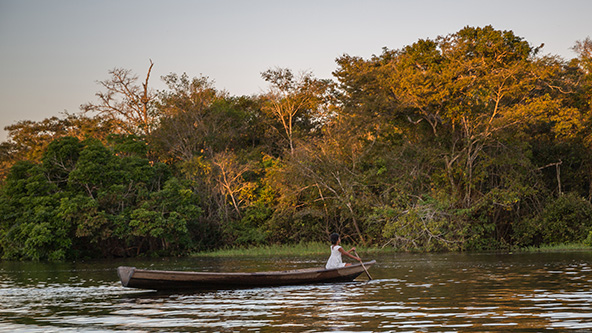
 (Photo by iStock/Shawn Eastman Photography)
“If we want to survive, we’ll have to work for them.” Pedro (not his real name) is a member of a riverside community in Amazonas, talking about criminal enterprises that are turning the forests into arid cattle pastures. A few years ago, Pedro’s community could depend on harvesting forest products, fishing, and hunting; these days, they struggle against lethal forces, both local and global. The loggers are encircling, cutting roads through the nearby forests, whilst global warming heats up the rivers, disrupts the seasons, and turns their forest to tinder and ashes. With no other livelihood, Pedro may be pulled into slave labor, turning the chainsaw on the very forests that are so vital for his community’s survival.
A variety of research studies have established the intersection between climate change and modern-day slavery. Poverty, social exclusion, and a lack of worker rights have long been drivers of trafficking and bonded labor, but the ecological damage wreaked by climate change not only supercharges those forms of vulnerability but, in turn, leads desperate workers to carry out further destruction. We see this with bonded laborers across the South Asia brick kiln belt burning dirty fuels to turn precious topsoil into bricks, with children trafficked for illegal fishing enterprises in the protected Sundarbans mangrove forests of Bangladesh, and with young, exploited miners in the Democratic Republic of Congo. Around the world, as workers like Pedro are pushed to the margins of survival—increasingly, by the effects of our changing climate—they risk being drawn into slave labor in industries that actually accelerate climate change itself.
This vicious cycle provides a point of intervention. Because climate change is too often treated as if trees make their own way to the sawmills, funders working against global warming rarely think of the enslavement of workers as part of the problem. Yet “A tree doesn’t just fall by itself,” as the Freedom Fund’s local partner organization, RETA—which works in the Brazilian Amazon—puts it. A powerful way to slow or stop deforestation is to strengthen the communities whose laborers otherwise have few other options.
International climate initiatives urgently need to support communities who are often positioned in just the right places, whose witness, their reporting, their action, and their liberation can help to save some of the most vital carbon stores around the world. The Brazilian Amazon is a perfect example. Deep in the forest, laborers shelter in makeshift tent camps for twelve-hour workdays, without protection; as a worker named João explained, “I just wear regular clothes, long sleeves, long trousers, and boots. I know of people who had serious accidents. Sometimes they get hit [by a machete], sometimes it’s a snakebite. Everything happens because you’re walking in the rough forest.”
For generations, these riverine communities have cultivated the techniques to manage forest products like Brazil nuts and açaí, crops that require the forests remaining intact and healthy. Yet as the scorching heat associated with climate change causes crops to fail, mass deaths of fish in the overheated rivers, wildfires in the forest, and a scarcity of drinking water, vulnerable workers must find other ways to survive. Stopping the advancing encirclement of clearances and cattle ranches is a life and death priority for these communities. In the last five years, 1,500 kilometers of illegal side roads have been constructed off the major highway intersecting the forest in southern Amazonas state, in the loggers’ quest to reach precious woods and carve out areas for cattle ranching. As Valdino Mota, a member of one of 400 families whose plots were destroyed, explained: “Our Brazil nut grove is gone. Wherever we used to walk, there was water, and we encountered animals of all kinds. Today, we can’t even find game to kill, to eat.”
The Freedom Fund’s Brazil program seeks to bridge the gap between anti-slavery and climate change work. Our community-led partners help people avoid exploitation while also finding ways to promote climate adaptation and use local knowledge to restore biodiversity and viable forests.
What does it take for communities like these to exercise power against slavery and deforestation?
In remote places where criminal activities encroach on carbon reserves, frontline organizations play a vital role. As a Brazilian government Labor Inspector, Magno Pimenta Riga, explained, “Considering the absence of the state in large swathes of the Amazon, the role of local organizations in investigating evidence and cases of enslavement is fundamental”:
“It is in the identification of cases of super-exploitation while they are actually taking place that community action is most urgent, so that there can be effective enforcement against those who practise these behaviours, and out of this, other public policies can be activated, the conditions that lead to such crimes become better known and then transformed.”
In Amazonas state, the Freedom Fund is learning how to support communities in raising the alarm about forest destruction and slave labor:
- Communities need to trust a local organization. Residents need to be able to reach out to fieldworkers, people whose names and faces are well-known to them, and who have helped them during other crises. Having this confidence in the organization allows community members to denounce activities that are happening, even despite powerful local politicians and officials.
- Faced with recruitment into slave labor in industries that also unleash climate havoc, workers need to form their own understanding of what slavery is and how to avoid and resist it, thereby protecting themselves and the environment on which they depend.
- Having additional support for livelihoods—for processing their sustainable products and accessing fairer markets—bolsters this resistance and the ability of communities to blow the whistle.
Concentrating on shifting power in these ways will help create further successful climate adaptation programs. As gaps and failures become more evident in the delivery of adaptation programs, the locally led adaptation movement has grown as a broad coalition of agencies aiming for a higher proportion of climate finance to come under local ownership, while fostering participatory approaches. However, within this important framework, if we want to combine climate adaptation with preventing slavery (and disrupting the carbon-heavy illegal enterprises they work for), then we need a set of skills and relationships that go one step beyond localization, towards more concerted transfers of power in favour of the most disadvantaged groups within those communities.
The good news is that these approaches are already found at the heart of effective anti-slavery work, many frontline anti-slavery NGOs have been honing these practices, sometimes for decades. In regions and communities where dominant groups capture resources for development, marginalized people—whether landless, dalit, Indigenous, discriminated ethnic groups, and/or women—have few pathways for gaining actual influence. If people are to dislodge exploitative relationships or access mainstream rights, they need to build their collective power. If they are to gain access to climate adaptation resources, the same collective bargaining power will be needed.
What do these strategies look like?
The processes used by anti-slavery NGOs include helping groups to:
- Gather local information about their immediate issues. This can give a new perspective, and what they find out together may differ from what society has told them.
- Figure out what to do if and when they face threats or violence.
- Take small collective actions, building confidence that things can change and how it happens. Help them connect with other groups or unions that are doing the same.
- Manage their own decision-making and support community leaders to gain experience.
- Learn the vocabulary of legal provisions and policies affecting their rights and entitlements, so they are equipped to engage with decision-makers.
This is work that relies on building trust and a deep understanding of the relationships and risks within the context. Through organizing together along these lines, some of the most exploited communities can make public schemes and social protection much more inclusive and successful.
This type of approach is also vital for climate adaptation. In areas where anti-slavery groups have been working for years, efforts for climate justice can build much more effectively and rapidly. For example, in Southeastern Nepal, in the communities where people are coming out of the Harawa-Charawa bonded labor system, equitable climate adaptation is desperately needed to bolster their movement for freedom: the inter-generational Harawa-Charawa system has trapped dalit communities working in agriculture for little or no pay, facing relentless humiliations based on their caste status, and affecting 70,000 households in the region. Since 2014, with support from the Freedom Fund, frontline organizations have worked with hundreds of village groups, enabling collective actions, economic alternatives, savings groups, women’s empowerment, and children’s school enrollment—above all changing people’s views about what was inevitable. The Freed Harawa-Charawa Rights Forum emerged, working together with the united movement of all bonded labor networks in Nepal, to advocate for the government to collect evidence of bonded labor, finally resulting in the Declaration of Emancipation of Harawa-Charawa households (2022), as well as the development of rehabilitation guidelines, focusing on land, housing and education.
This deeply rooted struggle risks being overwhelmed by the impact of climate change in the region. The Harawa-Charawa households live in highly flood-prone areas where unpredictable rainfall means they lose the meagre income they would have earned. These factors push families to take on more loans, forcing them to allow their children to become laborers or to be trafficked to India. Likewise, health issues are exacerbated by poor water quality, food shortages, heat exhaustion, cold waves, and air pollution, with the need for money for medical support a leading factor in trapping them in bonded labor.
Efforts for effective adaptation to address these challenges can build on years of work by local anti-slavery organizations. Harawa-Charawa communities are now ready to participate from a position of organized strength. Local groups working with the communities have recommended how to undertake the work, in alliance with climate adaptation experts.
The movement against climate change and the global efforts against slavery urgently need each other. We can move faster, more reliably, and more equitably towards the right kind of transition if we work together.
Read more stories by Ginny Baumann.