


 (Photo by Flickr/USAID)
When Community Health Impact Coalition won the 2025 Skoll Award for Social Innovation, we danced. Not for the accolade, but for what it meant: Health care for all—including those who provide it—is not only possible, it’s happening.
But even as the music played, the room carried tension: a sense that celebration now comes with a caveat. The US administration’s sudden freeze of billions in foreign aid triggered a humanitarian crisis: food programs halted, clinics shuttered, safe water deliveries interrupted. It also endangered long-term progress in our work: Disruptions in health services are now nearly as severe as during the COVID-19 pandemic.
Yet, unlike the swift philanthropic surge seen during COVID, this time the cavalry is quieter.
During COVID, philanthropy showed what it could be at its best: nimble, coordinated, unusually brave. In just six months, over $10 billion was mobilized—more than $20 billion by the end of 2020. Grant restrictions lifted. Frontline workers prioritized. Foundations, so often chided for sluggishness, moved with a kind of moral velocity.
Today, nearly four months into the USAID shutdown, no rapid mobilization effort—from the Foreign Aid Bridge Fund to the Rapid Response Fund—has reported raising more than $3 million. A few bold leaders—like the Skoll Foundation, Rippleworks, and the John D. and Catherine T. MacArthur Foundation—have boosted support with new funds or higher payouts. These are timely moves, and they matter. But they are still exceptions in a philanthropic landscape now marked by restraint.
We understand from allies in philanthropy that funders, for their part, don’t see themselves as retreating. You feel besieged—by political uncertainty, legal threats, a potentially long-term shift in the aid funding landscape, and the long shadow of financial risk. You speak with us in the language of fiduciary duty and sustainability, fearing boldness today might jeopardize giving tomorrow. Some of you are cautious of making public statements, worried political backlash could freeze assets, as has already happened to others. You are understandably careful, not because you want to hoard capital, but because you want to keep it flowing.
Yet for civil society, this restraint feels indistinguishable from abandonment. Because it leaves those working closest to the challenge bearing most of the risk. Community health workers (CHWs) are facing drug shortages and are being asked to “work” as volunteers while their pay is suspended. Leaders are burning out, some working without pay or covering expenses from their own pockets to keep essential services alive. Meanwhile, we’re being asked to “pivot,” to consolidate, to have answers, to show resilience. The unspoken message is that now is not the time for vision but for caution. And that is deeply disillusioning, as this is exactly the kind of moment many believed philanthropy was meant for.
The result is a quiet emotional erosion. Everyone feels they are doing their best in impossible conditions, yet frustration prevails—at the system, at each other. The unity of COVID has dissolved into a kind of fatalistic fog.
A Better Way Forward
The answer is a return to the essential infrastructure of crisis response: trust.
The COVID-19 response proved trust isn’t merely generous, it’s strategic. When funders cut red tape, grantees adapted fast, saved lives, and sparked long-term change. At Community Health Impact Coalition, that trust helped create the world’s third-largest PPE procurement mechanism, publish game-changing research on how professional CHWs ensured uninterrupted care for millions in a sea of disruption, and powered new policy commitments—turning emergency response into lasting reform.
Those breakthroughs were possible not because the situation was clear, but because funders agreed to share risk and trusted grantees to act amid uncertainty. Trust-based funding remains the best bet for impact during uncertainty.
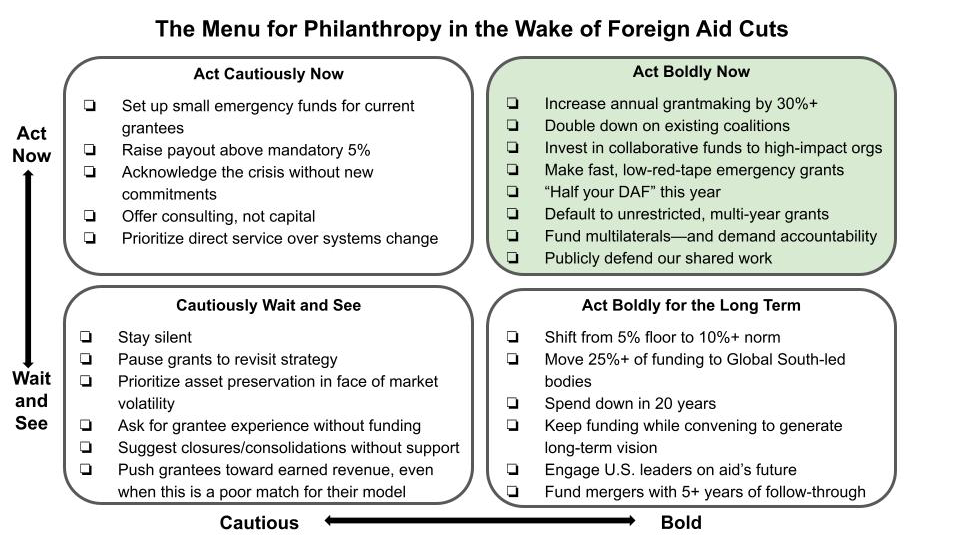
We propose a 2x2 matrix of actions shaped by conversations with funders, based on two axes: timing (immediate vs. delayed) and risk posture (cautious vs. bold). This framework offers four quadrants where philanthropy can place themselves and meaningfully move toward shouldering risk with us. What matters is movement—because in a crisis, risk is inevitable. The only question is who bears it.
 (Click to Enlarge)
Act Boldly Now
Waiting to see how the political winds blow doesn’t mitigate danger—it shifts it. Away from portfolios and toward patients.
At the Skoll World Forum, one refrain echoed from the dais to the dinner table: “We can’t fill a $68 billion gap.” That may be true. Yet the global economic burden of COVID-19 was $2.7 trillion. Capital moved then not because the road was clear, but because the need was clear.
Today’s crisis is different in origin but identical in urgency. The World Health Organization reports 70 percent of countries are experiencing serious health system disruptions: Over half report job losses, half face medicine shortages, and nearly a third can no longer guarantee emergency care. CHWs are the occupation most frequently affected—nearly two-thirds of countries have reduced or canceled community-based services. In this context, there are a number of bold actions philanthropy can take right now that would make a meaningful impact.
Raising payouts by 30 percent could unlock critical capital early before systems collapse. Large, flexible, multi-year grants aren’t reckless—they’re proven strategies from the last crisis that will work in this one. If your philanthropy rests in a donor-advised fund, this is a timely moment to “half your DAF.” Crowd your funds with other donors into existing collaborative funds, like Co-Impact or the newly launched Beginnings Fund, to support high-impact organizations. Double down by funding existing coalitions that are prepositioned to advocate and activate right now. Fund multilaterals, like the Global Fund for HIV, TB, and Malaria, which are well positioned to step in. We have seen philanthropy effectively leverage matching funds from these institutions, demand accountability, and multiply real-time problem-solving.
Yes, the risk profile today is different from COVID. But navigating repression, volatility, and instability has long been part of the landscape for many grantees. CHWs are still serving patients, now with fewer resources than we had six months ago and without the luxury of pausing to contemplate the new world order. Research shows our impact can be greatest in crisis. Let’s trade notes and move—together.
Act Boldly for the Long Term
What’s unfolding is not a fiscal crisis—it’s a moral one. Lives are being lost in clinics, homes, and hospitals, and some of the most effective things humanity has ever done for one another are being dismantled in real time.
Shocks can entrench injustice, or drive progress. During COVID, bold partnerships and government action fast-tracked changes that once took decades. Governments that once hesitated embraced professional CHWs. That wasn’t a fluke—it was a blueprint for what’s possible.
As a coalition, we knew closing the health care delivery gap would require us to move beyond the old rules of NGO competition, silos, and duplication. We were built for systems change—because that’s what was needed then, and it’s even more urgent now.
Philanthropy can likewise build something bigger, more lasting, than any one crisis. What if this moment could prompt a durable shift in your giving? Make a bold commitment to spend down in 20 years, just as the Gates Foundation recently announced. Increase your grantmaking from a 5 percent annual distribution to a 10 percent+ norm, or insist your giving be greater than returns generated by your endowment investments. Team up and engage networks of influence to stand up for aid’s future, in the United States and elsewhere. Move together in a more just direction by funding Global South-led organizations or, if they don’t exist, by helping Global South leaders build them. If consolidations are necessary and inevitable, fund the hard work of nonprofit mergers and stick with these ventures for at least five years of follow-through investment.
We Are in This Together
The abrupt foreign aid freeze revealed a rift—not one of values, but of vantage. Philanthropists and frontline leaders are each making difficult calculations about risk, sustainability, and the urgency of saving lives. What looks like prudence from above feels like retreat from below.
The task now is to re-ground our partnership in trust, urgency, and shared accountability—not as charity, but as strategy.
If we do, the legacy of this moment won’t be defined by what was frozen, but what was thawed: a renewed commitment to collaboration, dignity, and the steady work of justice.
During COVID, we glimpsed what it could look like: fast action, bold commitments, and trust that flowed both ways. That moment wasn’t just a response, it was a rehearsal.
The world we want is still within reach. But only if we build it—together, and now.
Read more stories by Madeleine Ballard, James Nardella, Jeff Jacobs, Ash Rogers, Daniel Palazuelos, Ari Johnson, Margaret Odera, Joe Ernst, Alexander Wheeler, Theebika Shanmugarasa, Mallika Raghavan, Victoria Ward, Lennie Bazira, Rachel Hofmann, Riccardo Lampariello, Nan Chen, Zeus Aranda, Emily Bancroft, Walter Kerr, Amanda Arch, Liz Diebold, Jane Leu & Doug Galen.