


 (Illustration by iStock/studiostockart)
At the 2024 Annual Meeting of the Global Future Council of the World Economic Forum, speakers expressed concerns that most people worldwide are not optimistic about the future. The hope that our children would enjoy a better life than ours seems shattered. There is widespread apprehension about the accumulation of complex societal and environmental issues. Philanthropic and development organizations too often find themselves falling behind in a relentless and exhausting race to catch up. Is it possible to change this trajectory and to innovate our way to a healthier future? We think so.
Innovative efforts could be more effective if they aimed not just to solve problems that have manifested but also to reduce the problem supply itself. By focusing on reducing the prevalence of problems, not just supplying solutions, innovations for a healthy context can significantly support the work of organizations in the philanthropic and development sectors in realizing the more equitable and resilient world reflected in the United Nations’ Sustainable Development Goals and in the recent Pact for the Future, which represents a moment of hope and opportunity. New thinking in global development is much needed because, in the words of the pact: “If we do not change course, we risk tipping into a future of persistent crisis and breakdown.”
Escaping the Deficiency Focus
When the WHO and UNICEF co-organized the landmark health conference in Alma-Ata, USSR, in 1978, 134 countries and 67 international organizations endorsed the WHO’s pioneering perspective on health as “a state of complete physical, mental and social well-being and not merely the absence of disease or infirmity.” Yet even today, almost 50 years later, our global approach to health operates primarily through a medical model that emphasizes treating diseases rather than fostering comprehensive health and well-being. Similarly, global philanthropic and development organizations mainly invest in innovations from a problem-solving perspective—treating societal “diseases” rather than creating and sustaining societal health and well-being.
One of us (Seelos) recently sketched out in another SSIR article an alternative focus for philanthropy that shifts away from a deficiency focus of constant problem-solving to a generative focus on building a healthy context that does not create so many problems. We believe this future-oriented focus on what we call Innovations for a Healthy Context (I4HC) is a significant strategic opportunity for development organizations such as UNICEF, where the other two of us (Accone and Campo) have spent much of our careers shaping innovation practice.
Bending the Problem Supply Curve
Both donors and development actors share a common understanding of innovation’s role in development: to address the challenges hindering the achievement of the Sustainable Development Goals by identifying new and improved solutions more rapidly and scaling them effectively. By focusing so intensively on being better problem solvers, this perspective has largely missed the corresponding strategy that development objectives can also be achieved by reducing the occurrence of problems in the first place.
Put another way, do we want to scale up innovations and solutions forever? Or should our work instead eventually lead to scaling up productive assets that sustain health and well-being and support people in realizing their ambitions? We need innovations that help bend the slope of the problem supply curve down and that, over time, build more resilient and prosperous societies.
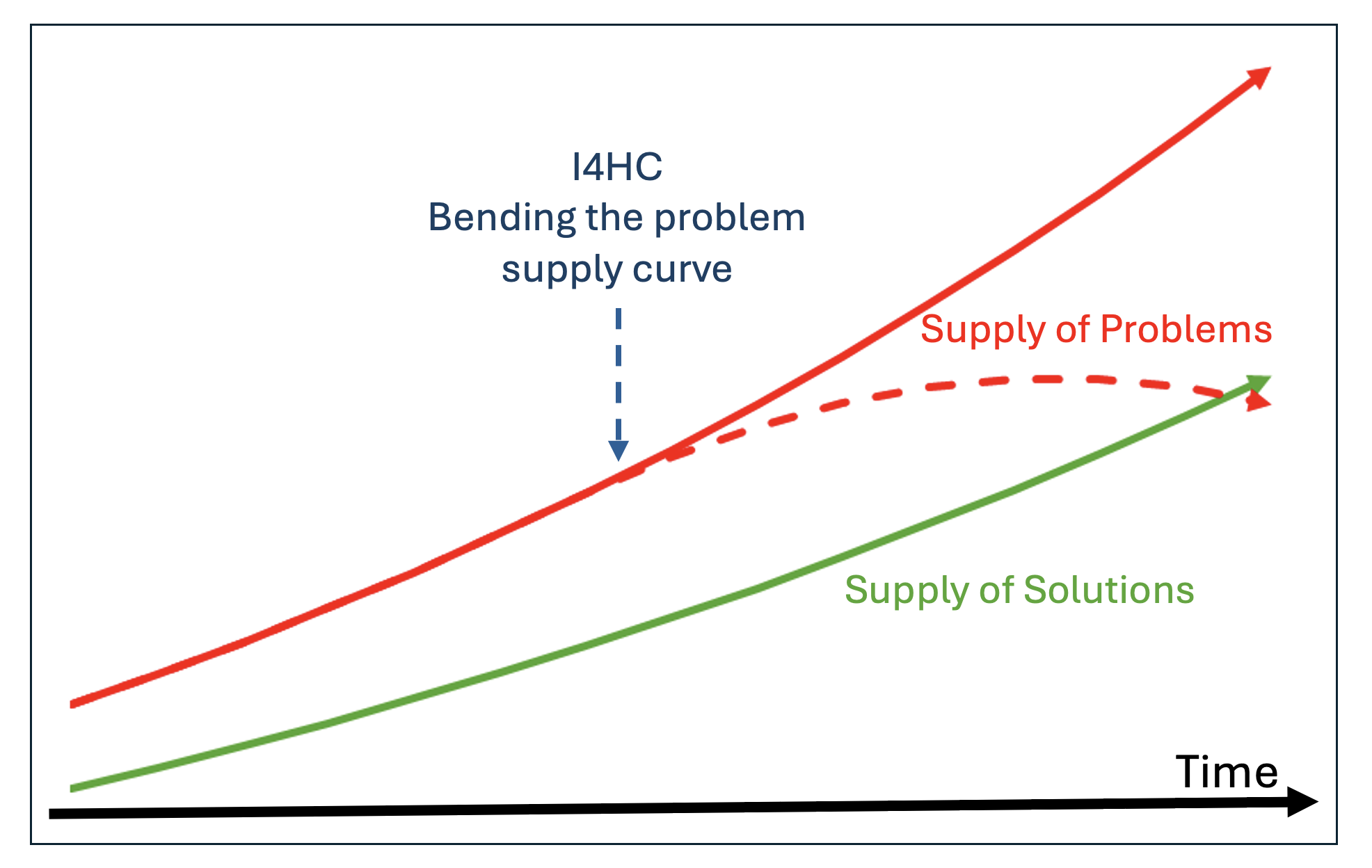
By bending the problem supply curve, I4HC also stands to dramatically improve the effectiveness of current approaches to problem-solving. When we succeed in lowering the supply of problems, our solutions and innovations can improve people’s lives without the feeling that the scale-up of solutions lags behind the scale of the problems. Freeing up problem-solving resources for I4HC work can create a virtuous cycle that shifts our focus from making people's lives less difficult to the question: What inspiring future do we want to build together? I4HC can, therefore, help to develop a context that enables people to flourish, a future-oriented approach to innovation that embraces the power of the possible.
Unrealized Impact of Problem-focused Innovation Approaches
I4HC can sometimes build from where traditional innovation initiatives define success. A UNICEF project in Mongolia illustrates this potential. Ulaanbaatar, Mongolia, is the coldest capital on Earth. Many of the population here and throughout the country live in traditional domed dwellings called gers that rely on coal-burning stoves for heating and cooking. As a result, daily air pollution levels in winter have been recorded at 30 times higher than what the World Health Organization considers safe. An estimated 42 percent of Mongolia’s children suffer health effects related to air pollution, manifesting as high rates of asthma and respiratory infections such as pneumonia and bronchitis, as well as higher risks of stillbirth, preterm birth, and lower birth weight.
The 21st-century ger initiative applied a transdisciplinary approach to understanding the context, bringing together community members, experts, and various organizations from the private and public sectors. Data collection spanned three years and included ethnographic surveys, participant observations, research into construction materials, health-related data, and extensive sensor-based data gathered both from families that volunteered to have thermal and air quality monitoring equipment installed in their gers as well as from a set of experimental gers. The initiative sought to address the air pollution problem by designing and structuring an effective cooking, heating, and insulation package—the CHIP package—to replace coal-burning stoves with electric ones and to improve the insulation of the gers. The CHIP package has since been installed in thousands of individual households and ger kindergartens and continues to be scaled up.
The project achieved its intended objectives, but the project scope itself means that there remain many significant opportunities that arose during its implementation that have yet to be fully harnessed. The ger initiative demonstrates how establishing a technical boundary around a problematic situation can create focus, momentum, and success. However, this problem-focused approach overlooks opportunities for achieving an even greater impact. The tangible improvements in air quality and convenience fostered trust, rapport, and goodwill from the communities. Face-to-face conversations helped uncover valuable insights into other aspects of social health and well-being. Had this project been implemented using an I4HC approach, these valuable project outcomes would have been identified and leveraged as potential entry points to widen the ger initiative’s boundary towards a focus on healthy context and the central question by which we evaluate it: What kind of life can people lead in a community? Amartya Sen and Martha Nussbaum believe this question can create a focus on the larger set of possibilities that enable people to live long, healthy, dignified lives. An advanced ger effectively decreases the level of threats to people’s health. The effectiveness of an I4HC initiative would be evaluated against a much broader set of possibilities for people to access comprehensive physical and mental health care; the quality and accessibility of education and skill development; their ability to engage in dignified, rewarding labor; their freedom to engage in political life, in social and political relations of their choosing, and how family-, social-, and economic relations are structured and governed across sexes and social strata. This focus on living with dignity creates a broad scope for innovations in the dimensions of health and well-being, education and skills, economic activities, and governance.
Sen and Nussbaum also remind us that a focus on healthy context as a precondition for well-being and a dignified life is not just a technical project delivering a broad set of solutions and measures to isolated problems: “We need, perhaps above all, to know how people are enabled by the society in question to imagine, to wonder, to feel emotions such as love and gratitude, that presuppose that life is more than a set of commercial relations […], we seem to need a kind of rich and complex description of what people are able to do and to be.” I4HC is, therefore, a longer-term engagement to support communities in discovering and steering a pathway to a healthy future defined by a plentitude of possibilities and not an abundance of constraining problems. The community in Ulaanbaatar provides a powerful illustration of this. Coming out of the ger initiative, the community identified the need for a multipurpose community space that could serve the needs of a creche, vocational training, educational and skills-building workshops, and a space to support families making the rural-urban transitions. This was out of the initiative’s scope, and the community mobilized to establish the Ger Innovation Centre themselves—a space of many possibilities.
The Dimensions of Possibility-Led Innovation for a Healthy Context
We argue that I4HC, by focusing on innovations in four key dimensions of a healthy context—economics, education and skills, physical and mental health, and governance—can create a possibility space for more sustainable development impacts over time. Although these dimensions may seem similar to traditional sectoral or programmatic focuses in international development, they aim to provide a distinct, multifaceted, and interlocking set of enablers. Development is inherently multidimensional, with each dimension influencing and reinforcing the others. Over time, the layering of innovations in all four dimensions can develop people, neighborhoods, or communities into a healthy context. By reducing the prevalence of problems, I4HC can dramatically improve the effectiveness of innovations that focus on solving specific societal problems. While I4HC eventually evolves into work in all four dimensions, a crucial question is: How to get started?

Entry Points for Investing in Possibility
Choosing the right entry point can significantly influence the success of I4HC efforts. Prior assets such as a deeper understanding of a local context, trusted relations, or earned goodwill, and the presence of existing enablers may facilitate this choice. For instance, the ger initiative naturally allows for an expansion into a wider range of health enablers. A focus on health can quickly provide tangible benefits for households, which in turn can generate enough support and goodwill to facilitate further expansion into other dimensions of a community’s possibility space.
Pragmatism can be a useful guide for selecting entry points. For example, entering a community with significant social stratification may be facilitated by initiatives that do not require high levels of community participation. Parallel initiatives for individual social groups that identify and develop important assets within a community may be a better initial choice. Identifying entry points may also depend on an initiative’s philosophical principles. Sen, for example, argues that identifying and prioritizing focus areas often depends on enabling public debate and making the value judgments of communities explicit. Alternatively, a focus on assessing concrete local needs may unearth uncontested areas for implementing initial problem-oriented innovation projects that a community finds highly desirable. Such an entry point can quickly build trust and rapport as a basis for further expansion of an initiative.
Gram Vikas, an NGO dedicated to addressing the inequalities that restrict possibility spaces for Indian villagers, identified various entry points in villages where it lacked deep understanding and trust. Initiatives such as medical treatments for infectious diseases (health), biogas implementations to produce local electricity (economic, skills), and the creation of local jobs to build water and sanitation infrastructure (economic, skills, and health) all worked well to build the levels of understanding and trust required for expanding the program into a genuine I4HC effort. The organization also learned how to create governance enablers by implementing several formal and informal structures within villages to facilitate and stabilize intermediate stages of progress.
Sekem in Egypt, an initiative with a vision of sustainable development that enables individuals and society to thrive in harmony with the natural environment, started its context development ambitions with investments in local infrastructure, roads, buildings, fertile land, and electricity. These economic enablers were then expanded into other dimensions. Health and well-being, by establishing a medical center and promoting organic agriculture; education, by setting up kindergartens, schools, and a university; and governance by implementing explicit standards grounded in balancing norms of equality with respect for people’s religious and cultural beliefs, or by influencing new environmental policies at country level. The Right Livelihood Foundation recognized Sekem as a blueprint for a healthy corporation in the 21st century.
Project Mercy, an Ethiopian organization that empowers rural communities by addressing fundamental needs of all community members, is another inspiring example of holistic development. The founders of Project Mercy initially met with local community leaders and offered their help in implementing substantial and sustainable improvements. They asked: What are your needs? And communities replied that they never had a school or a clinic. That reply created a desirable and feasible entry point. Communities contributed land and effort, and together with the Project Mercy team, the coalition started investing in helping local farmers build construction skills, education, health, nutrition, economic empowerment, and infrastructure. Today, the schools, where children are also fed and receive medical care, serve as examples that inspire other communities and attract children from nearby villages. Women who suffer the most from inadequate health care travel from distant communities to visit the Project Mercy clinic. While this situation is not ideal, it specifies the principle of sufficiency: the objective of I4HC is not to create a utopia of economic, social, and physical health and well-being, but to offer people enough possibilities to live with dignity, laying a healthy foundation for further development.
Starting an effective I4HC initiative may also consider the fertility of different enablers, the extent to which building enablers in one dimension can spill over to other dimensions of a possibility space. For example, initiatives that seek to develop the lives of people from homeless communities have discovered how living in a private apartment with no prior requirements can have dramatic effects on unhoused people. So-called “housing first” initiatives enable them to rebuild their sense of dignity and awaken their spirits and ambitions. Research by Marybeth Shinn illustrates this dynamic. Surveys unearthed a common high-priority goal of people who lived on the streets: to live in an apartment of their own. Those who had left the streets and participated in Housing First programs revealed different goals, such as engaging in paid work, education, painting, or writing poetry. Other priority areas emerged. Shinn also noticed how those people who were newly housed often suffered from social isolation, a dimension into which an I4HC initiative would naturally evolve.
Evolving and Exiting I4HC Efforts
These examples illustrate that I4HC does not require multi-year plans and strategies. Sensitivity to and close engagement with local context makes I4HC an effort of constant strategizing and explicit investments in learning, adapting, and acting on emerging opportunities. I4HC, particularly in the beginning, does not require significant resources, large international organizations, or complex coalitions. It can be implemented by actors from philanthropic, development, and private sectors, individually or by learning to collaborate across sectors.
However, I4HC differs from traditional problem-solving innovation not only in terms of scope and objectives but also in terms of program roles and organization. Supporters put communities in the driver’s seat and help them develop a shared vision, mobilize local assets and external resources as needed, and help balance activities across the four dimensions of a community’s possibility space. This also requires continued skepticism about needs-based approaches. While—as in the case of Project Mercy—such approaches may reveal effective entry points to get started, they can lure us into our traditional roles of problem-solvers. As such, initiatives tend to rely too much on external resources that funders and implementers can control, and this deficiency focus can create dependency structures and fail to develop the capacities of communities to deal with their own issues.
Supporters must monitor their relationship with local communities and their shifting roles in this effort. Private organizations such as Sekem or BRAC, who locals built to serve a local context, maintain their role as a perpetual “walking stick” to expand programmatic areas with no clearly defined endpoint for their initiatives. However, international development organizations may need to define criteria for exiting an I4HC initiative. This will require an explicit focus on stabilizing intermediate progress and enabling a robust transformation of a context that does not depend on the perpetual operation of the initiative. While communities may initially be dependent on several external organizations, over time, communities will have to own their development. Nussbaum argues that a context must enable a level of choice for people that is at least sufficient for leading a dignified life. However, we lack universal criteria that help development organizations specify sufficiency in a local context. A helpful attitude in this regard is acknowledging this uncertainty, being transparent about one’s choices and the rationale behind them, and inviting and facilitating debate that helps improve I4HC practice.
I4HC—Securing Our Investments for a More Sustainable Future
Can I4HC unlock significant progress in development or is it merely old wine in new bottles? The concept of community development has been around for decades, supported by extensive literature and numerous case studies. Unfortunately, the term captures many fundamentally different approaches, philosophies, and ambitions. In a recent review, researchers called it “a nebulous term defined by many conceptual and practical characterizations.”
I4HC is community development that is grounded in an explicit development focus on healthy context. This focus on well-being and—at a minimum—living a dignified life, is coupled with the ambition to reduce the prevalence of problems and thereby increase the effectiveness of current innovations that tackle societal problems. I4HC will have to explore many old and new questions and uncertainties. But it can also benefit greatly from experience. Researchers strongly encourage us to learn from the past: “Much community development practice, judging by the published writing about it that has been available over the past years tends to neglect the knowledge and experience that has gone before, with projects established which simply repeat the mistakes of earlier activity, or offer prescriptions for action which are very familiar […]”
I4HC is itself an innovation that will require bold efforts and an explicit investment in learning and translating uncertainties into knowledge that informs subsequent efforts. In 2025, the Stanford Global Innovation for Impact Lab and the UNICEF Office of Innovation plan to launch a new Innovation Node specifically designed for this purpose.
Another concern about I4HC rests in the important question: What really constitutes a healthy context? It is easy to dismiss I4HC as a neocolonial utopia that specifies what the lives of people should be like and what a healthy world should look like. But I4HC does nothing like that. The central ambition of I4HC is to expand the space of possibilities for people to decide for themselves what their lives should look like. As a strategic effort, I4HC uses a scaffolding whose four dimensions specify a proper scope for the effort over time, and I4HC evaluates the healthiness of context based on what individuals actually accomplish and the variations in their roles and activities. If all women remain at home to care for their families, and most men become subsistence farmers, it clearly indicates that the community's possibility space, their potential for growth and opportunity, is significantly limited. Fortunately, many philosophers, researchers, and practitioners have carefully considered what makes a dignified life. Sabina Alkire, a World Bank researcher, has summarized useful lists provided by Martha Nussbaum, John Finnis, Manfred Max-Neef, Robert Chambers, and many others. These lists have significant overlap but also differ sufficiently to enable organizations to develop criteria that seem most appropriate to their interests, values, ambitions, and the specific contexts in which they intend to work.
The Pact for the Future, adopted by the 193-member United Nations General Assembly in September 2024 articulates a preferred collective future—where peace is not only a state of no war or terrorism but of just societies and good governance, where young people are able to reach their full potential due to growing up in a healthy context. Science, technology and innovation are identified as enablers of societies to be builders of their futures, with the pact including commitments to “…fostering a conducive environment in developing countries that encourages investment and entrepreneurship, develops local innovation ecosystems and promotes decent work, and by ensuring that innovation can reach global markets.” I4HC can be a critical complementary avenue to realize this pact.
Read more stories by Christian Seelos, Tanya Accone & Stuart Campo.