


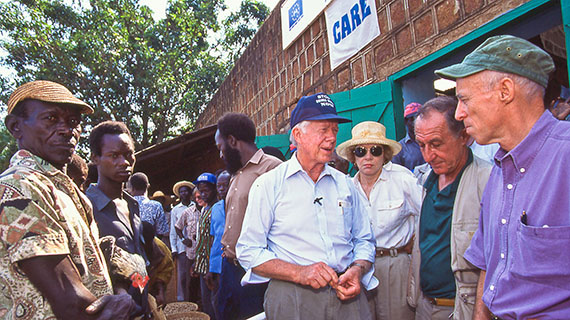
 President Carter visits CARE in southern Sudan in 1995. (Photo courtesy of CARE)
President Jimmy Carter reached the highest pinnacle of political leadership, but he arguably did more good for more people during his encore career in the nonprofit sector—and that may be his most enduring legacy. I began my career with a start-up volunteer organization in Georgia a few years after President Carter started The Carter Center and have had a front-row seat as he and Rosalynn Carter modeled critical lessons about the power of civic leadership and the independent sector to address the world’s biggest problems. His leadership elevated the social sector, created a model for scaled global impact, influenced the world’s philanthropists and presidents, and demonstrated the importance of supporting grassroots leaders.
President Carter did not simply lend his name to fundraisers or make modest investments of time and energy, he pursued a different scale of change-making. He and Rosalynn set about creating a nonprofit, The Carter Center, that would focus on the most important global challenges—safeguarding and spreading democracy, securing peace, and tackling public health inequities. He did not see this work as something nice to do on the side but as something to devote himself to at an urgent and granular level. He raised an endowment of billions of dollars to support 125 elections in dozens of countries, made great progress in de-stigmatizing mental health nationally and globally, and helped forge peace agreements in dozens of conflicts. Alongside his work at The Carter Center, he picked up his hammer and lent his star power to propel a fledgling organization building affordable housing into one of the most recognized nonprofit brands in the world. With President Carter as champion, Habitat for Humanity has served more than 62 million people around the world, demonstrating the power of fueling a movement with big resources, big ambition, and a big story.
One of the key lessons of President Carter’s civic leadership was a special combination of bold aspiration coupled with strategic, detailed, and sustained execution. For instance, he did not simply seek to alleviate health inequities and suffering, he set out to completely eradicate diseases like Guinea worm. The audacity of his vision made possible what had seemed impossible, and he was able to enlist others because of his boldness. Because of President Carter, Guinea worm disease—a painful, parasitic disease caused by drinking dirty water—has gone from 3.5 million annual cases to fewer than 20 this past year. President and Rosalynn Carter strategically tackled under-addressed challenges from mental health to rare diseases where they could create high leverage and disproportionate impact. They worked in more than a hundred countries, visiting places that rarely made the news. They recognized and demonstrated that every life has equal value, and that well-placed strategic investments can change the trajectory for millions of people.
One of the most powerful forms of impact is through emulation, and President Carter’s nonprofit leadership rippled out to influence future presidents and the world’s biggest philanthropists. We forget how revolutionary President Carter’s embrace of his role as “citizen” was because he has changed the expectation for post-presidential and political life. President George W. Bush and President Clinton’s work around HIV and AIDS, the Clinton Global Initiative, the paired leadership of President George H.W. Bush and President Clinton in the aftermath of 9/11 and the 2004 tsunami, the Obama Foundation Scholars—all were, in some form, shaped by President Carter’s example of leadership. He set the stage and the standard. As he monitored elections, he was the walking manifestation of the power that remained possible for defeated political leaders. And he influenced philanthropists from Ted Turner to Bill Gates to take on global challenges, to create institutions like GAVI, the global partnership to increase access to vaccines, and to fight poverty and disease. From the X Prize to the Audacious Project, the global ambitions of The Carter Center shaped today’s philanthropic ecosystem.
President Carter matched his focus on grand challenges and systems change with a dedication to supporting locally led community-building. As a young civic leader in Georgia, I asked him to join Hands On Atlanta Day, Leadership Georgia, visiting Kellogg Fellows, and more recently, events at CARE. When, as the CEO of Points of Light, we invited all the living presidents to join in a celebration of President H.W. Bush, the Carters were the first to sign on. Over and over, he said yes to me and to so many others. President Carter was not on the honorarium circuit or focused on speaking to the highest bidder. He humbly showed up as a volunteer. He traveled millions of miles to meet with local leaders in places like Southern Sudan, to participate in Habitat for Humanity builds from Appalachia to Seoul, and to meet with emerging leaders like me from Georgia to those in Ghana. He recognized that investing in grassroots community-building is essential and that the quilt of civic action and social capital is ultimately woven by neighborhood and community leaders.
In his farewell address to the nation, President Carter said, “The only title in our democracy superior to that of president, [is] the title of citizen.” In his final chapter, he showed the world the power of “citizenship”—for our country and the world—in a model we all have the capacity to emulate. As citizens, philanthropists, activists, and volunteers. For in the end, as he eloquently noted in his inaugural address, “To be true to ourselves, we must be true to others.”
President Carter pointed the way, and his legacy holds continued lessons for each of us about leading with boldness, determination, and humility to create change in the world.
Read more stories by Michelle Nunn.