


Everybody’s getting ready for the annual social sector lollapalooza in Oxford, and there have never been so many sessions with the word “scale” in the title. There seems to be a collective recognition that the problems are looming, the clock is ticking, and we’ve got hard choices to make. If anything, the consensus is validated by a predictable backlash on this very platform, ranging from the plaintive “Does Everything in the Social Sector Have to Scale?” to the unhinged “Scale is a Myth! Embrace the Long Defeat!”
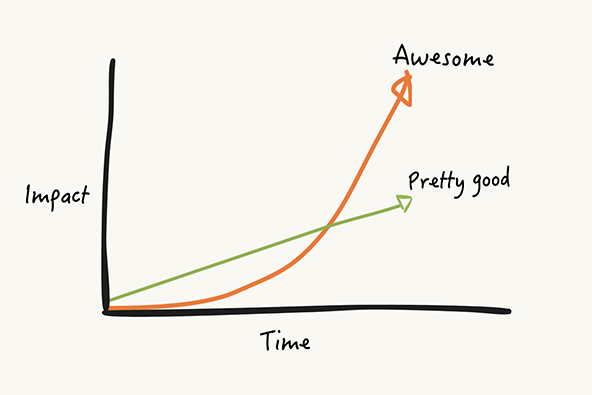
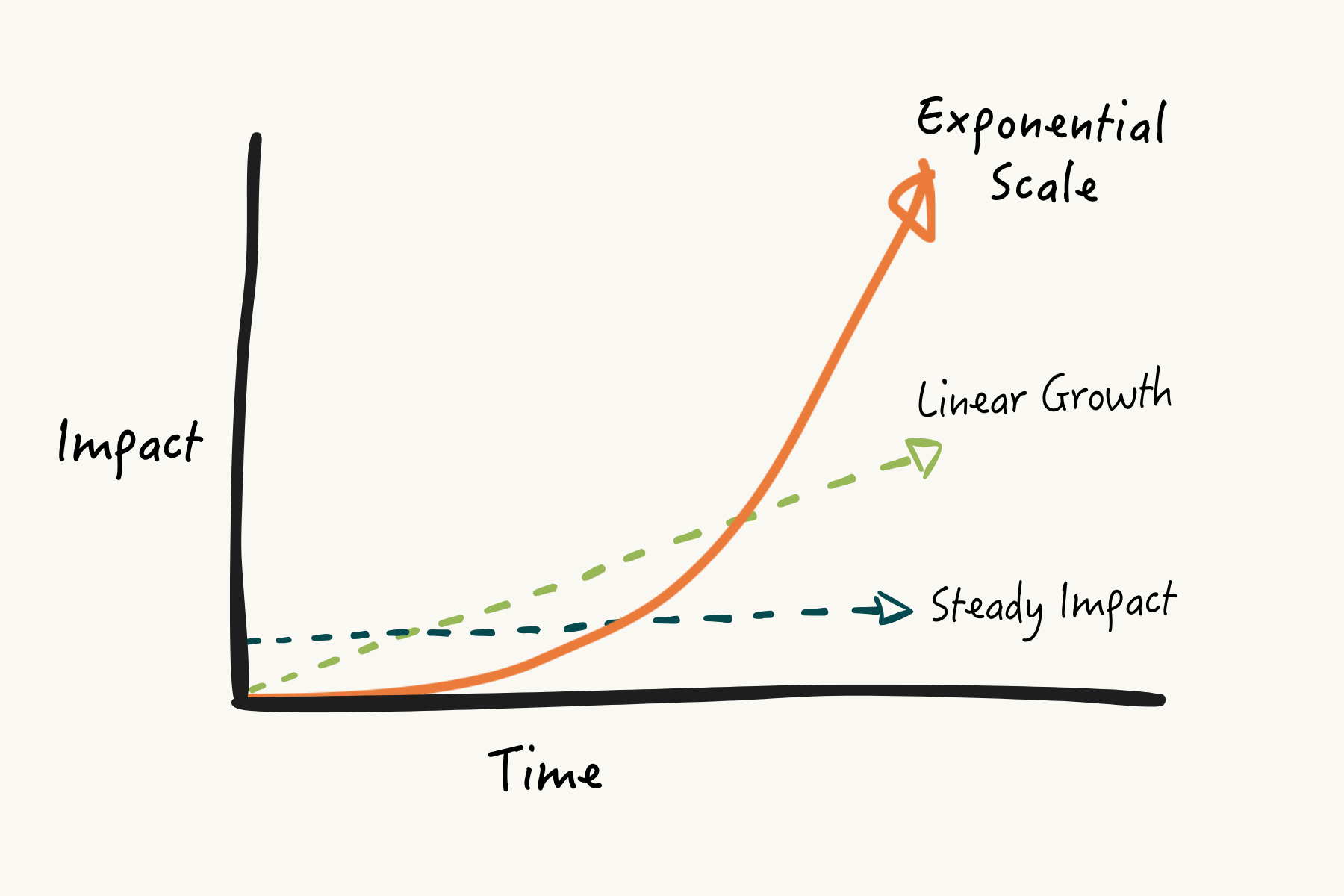
For all this attention, there are as many different interpretations of “scale” as there will be sessions, and a coherent discussion of anything must start with a shared definition of what it means. Let’s try this one more time: Scale is about exponential impact. It’s a curve, not a line.
Hear me out. The best way to define scale is to look at it alongside the two other kinds of impact, steady and linear. They look like this:
While we’re at it, we need a simple definition of impact. Try this: “A material change in the world attributable to your efforts.” When we’re talking about steady, linear, and exponential impact, we’re presuming that there is impact, and it has to be said there are still far too many organizations, projects, and initiatives that create little or none of it. They’re zombies: They consume money, they do stuff, but they don’t accomplish anything. If we funders were doing our job, we would identify them, defund them, and put them out of business. Enough said.
To make sense of these three kinds of impact, we need context, so consider Sub-Saharan Africa, where 800 million people live on less than $3 a day, a massive burden of poverty that comes with a host of attendant ills. When problems are that big, the differences between these three kinds of impact—and their corresponding kinds of organizations—really matter. Let’s look at the three kinds of organizations and their implications when we need to solve problems this big:
Steady Impact. This is work that has local impact without big growth ambitions. Local organizations can have a profound impact in the lives of people and their communities but aren’t focused on growth beyond their borders. I’m talking about things like food banks, clinics, community centers, and scholarships—the best of them are grassroots projects that are deeply rooted in the communities they serve. Impact and money are tightly coupled—if you want to keep impact coming, you’ve got to keep the money flowing.
When there’s real impact, this is a great choice for funders who need to feel a strong connection to particular people and places. It won't solve problems, though—you could have hundreds of thousands of local projects in Sub-Saharan Africa, and while they’d do a lot of good, they wouldn't move the needle.
Linear Growth. These organizations respond to the size of the problem by growing; by churning out ever more services for ever more people. Money and impact are still tightly coupled in a linear relationship: If you want to create more impact, you have to raise a corresponding amount of money. At their best, these organizations function kind of like a Coke machine: You put your money in, and you get a reliable product—impact—out.
The combination of reliable impact and demonstrated growth is attractive to a lot of funders, especially the effective altruism crowd. It’s a perfectly good use of money. But given the size of the problems, the math isn’t in your favor. Think about a great outfit like GiveDirectly: If they give $1000 in cash to 10,000,000 families in poverty, that’s $10,000,000,000 a year to cover a fraction of the population that needs it. Drilling boreholes for water costs $10,000 a pop, so 100,000 of those will set you back a billion dollars. Community health workers will do a remarkable job for $100 a month, but we need a million or so of them—that’s another $10 billion a year. Even simple stuff like mosquito nets and deworming pills require many organizations and a ton of money to meet even approach the need.
I could go on with examples like this all day, but you can see how the need quickly outstrips the capacity of philanthropy (not to mention its attention span). With linear growth, big ambitions drive ballooning budgets and rev up the fundraising hamster wheel. You can do a lot of good, but you can count on hitting a funding ceiling long before you’ve made a big dent in a big problem.
Exponential Scale. Here we’re talking about a curve, not a line—about going from linear to exponential. The crux of that transition is to decouple philanthropy and impact. This is scale—this is how you make a big dent in a big problem—and the key to that uncoupling is a transition to the doer and payer at scale. The doer at scale is whomever is implementing the idea at problem-solving scale. The payer at scale is whomever is paying for it at that same kind of scale.
Philanthropy can get things started, but it’s never enough to achieve exponential impact. NGOs can develop ideas and prove them out, but the NGO sector has never proven to be a reliable and efficient way to scale much of anything. It turns out that for the most part, government is the only realistic doer at exponential scale, and while we all indulged in the fantasy that Big Aid would be a reliable payer at scale, it turned out to be just that, a fantasy. That leaves government as the only realistic payer at scale. So outside of market-based solutions, when we’re talking about scale, we’re talking about governments as both doer and payer.
In this vision of scale, the role of the NGO—and, hence, of philanthropy—is to develop solutions that can be scaled via governments, prove and refine those solutions, and then work with government to achieve ownership and adoption.
Moving to Recruiting
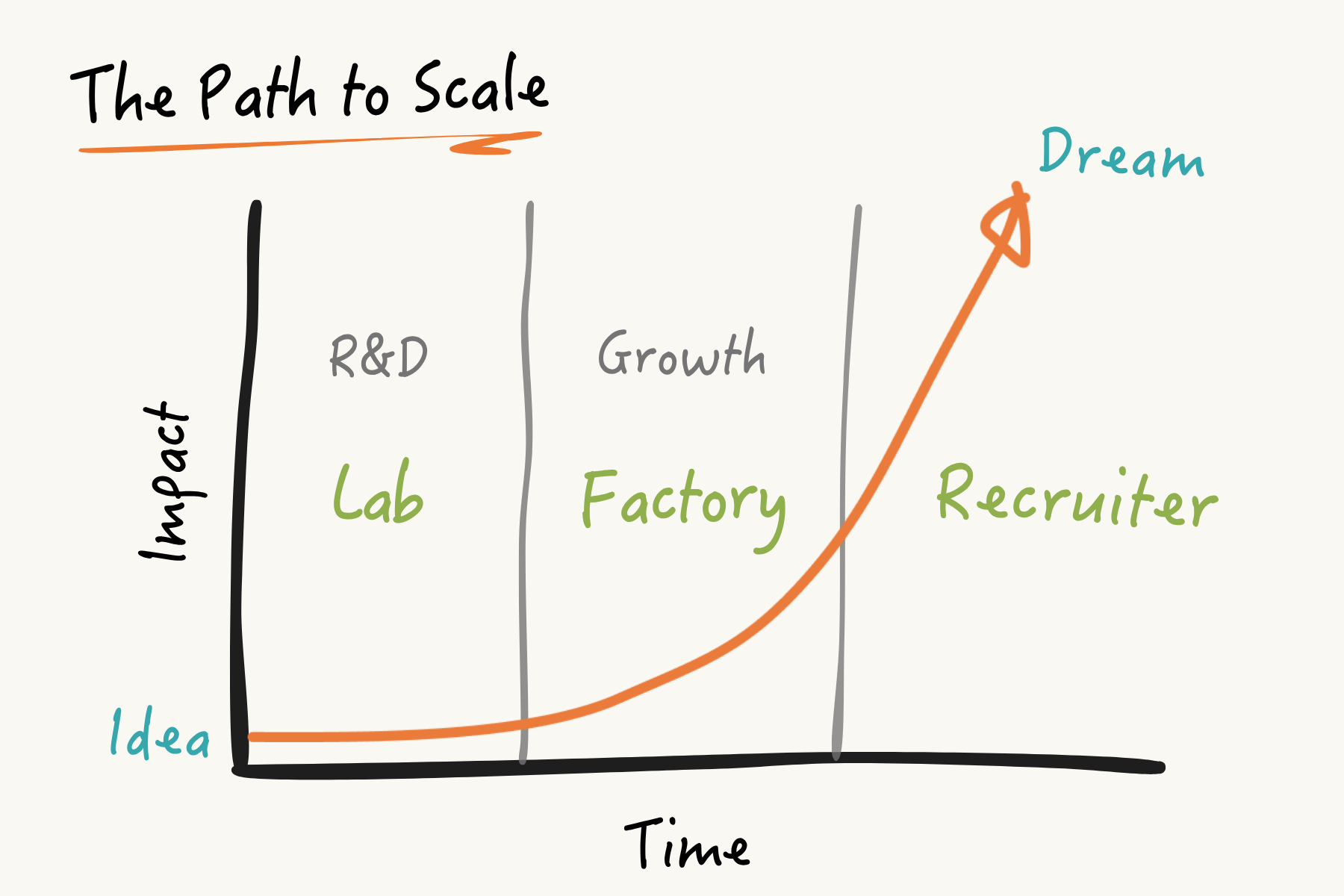
An NGO that is serious about scale goes through three stages on the way to exponential impact:
- In R&D, the organization is mostly a lab, iterating and experimenting to get to a scalable model.
- Going into Growth stage, the organization becomes more like a factory, churning out replications, tuning the model, and exploring economies of scale.
- In Scale stage, exponential impact is enabled by a shift from factory to recruiter.
Not that many organizations make this last transition. Recruiting means that you de-emphasize doing stuff yourself and you recruit (and enable) others to do it. You stop building more factories, and you start building something that looks like a sales and customer service team.
Lab, factory, and recruiter imply three transformations of an organization in sequence. Every organization should maintain a lively lab, and scaling organizations may still find an important, if limited, role for factories. But an organization on its way to exponential scale moves through these three stages, each with its own different people and skill sets. These stage transitions often require leadership transitions as well, but there are occasional founders who can navigate all three.
In graphic form, it looks like this:
I hope that this is achingly obvious by now, but I’ll beat it to death: Growth and scale are not the same thing.
Confusing the two comes at a cost—you only have so much bandwidth, and they require different activities and skillsets. Growth and scale can even be in opposition, especially when working with governments. If you keep building factories in a country, the government will get the distinct idea that you are trying to do the job for them. Those factories can create a parallel system that actually undermines governments’ efforts to do things themselves. And a lot of organizations think that just by having visible factories doing a thing in a country, there will be a painless handoff or transition to governments doing the thing. This never happens. Thoughtless growth can set back the prospect of scale in a country, if not doom it entirely.
To be an effective recruiter, to sell your idea to a government and help them make it their own, you need a serious sales and customer service team. Most organizations, even if they recognize this, do a half-assed job of it (even half might be generous): They don't develop the muscle, they don't use state-of-the-art methods, they don’t give it enough heft, and they don’t devote their best talent to it. If you want to see a great idea achieve exponential impact, you need a badass team to work with governments—and you’re going to need to make substantial investments to help governments do their best work. If you’re lucky enough to get Big Bet funding, this is what you should use it for.
If you lead an organization that is making that big shift from factory to recruiter, your chief problem will be that most funders don't get it. Funders refer to the result as “indirect impact,” as if it's the poor cousin of “direct” impact. That’s backwards. Direct impact is just the limited progenitor of exponential impact. Exponential impact accomplished by the doer at scale counts a lot more.
An essential job for any funder is to decide which of these flavors of impact—steady, linear, or exponential—they want to fund. Given how fundamental that it is, it’s astonishing how many funders go through interminable strategy processes while failing to do so. Mulago has gone all-in on scale. A good funder friend of ours likes to maintain a portfolio with a balance of the three. That’s not unreasonable, but it is fundamental to your job to make sure that you understand the difference and decide.
If we want to solve much of anything, though, we need a lot more funders to understand and choose exponential impact. Scale really is the impact jackpot. Growing the factory is still the default move and real change is going to require a lot more funders to throw their lot in with scale, to fund NGOs that want to develop scalable solutions, prove them out, and enable the doers at scale to deliver them.
What it will take is a lot more of this, with a lot more discipline:
- Funders choose exponential impact—scale.
- Doers devise awesome scale strategies
- Funders fund those strategies.
- Doers stick to and execute on those strategies
If any one of these doesn’t happen, the whole thing goes sideways. Because of their heft and influence, Big Bet funders have a special responsibility and are often prime offenders. I’ve seen too many organizations with a perfectly good scale strategy enticed into building a much bigger factory instead. It’s hard to resist the temptations of an eight-figure grant, but because most Big Bets are a one-time thing, they can drive these organizations off a fiscal cliff. We blame the organization leaders when it’s every bit as much the fault of the funder.
With linear growth, every additional unit of impact requires a corresponding unit of money, so more impact means more money and more organizational growth—forever. However, if you’re doing exponential growth, and you’re making that shift from factory to recruiter, it can look like this:
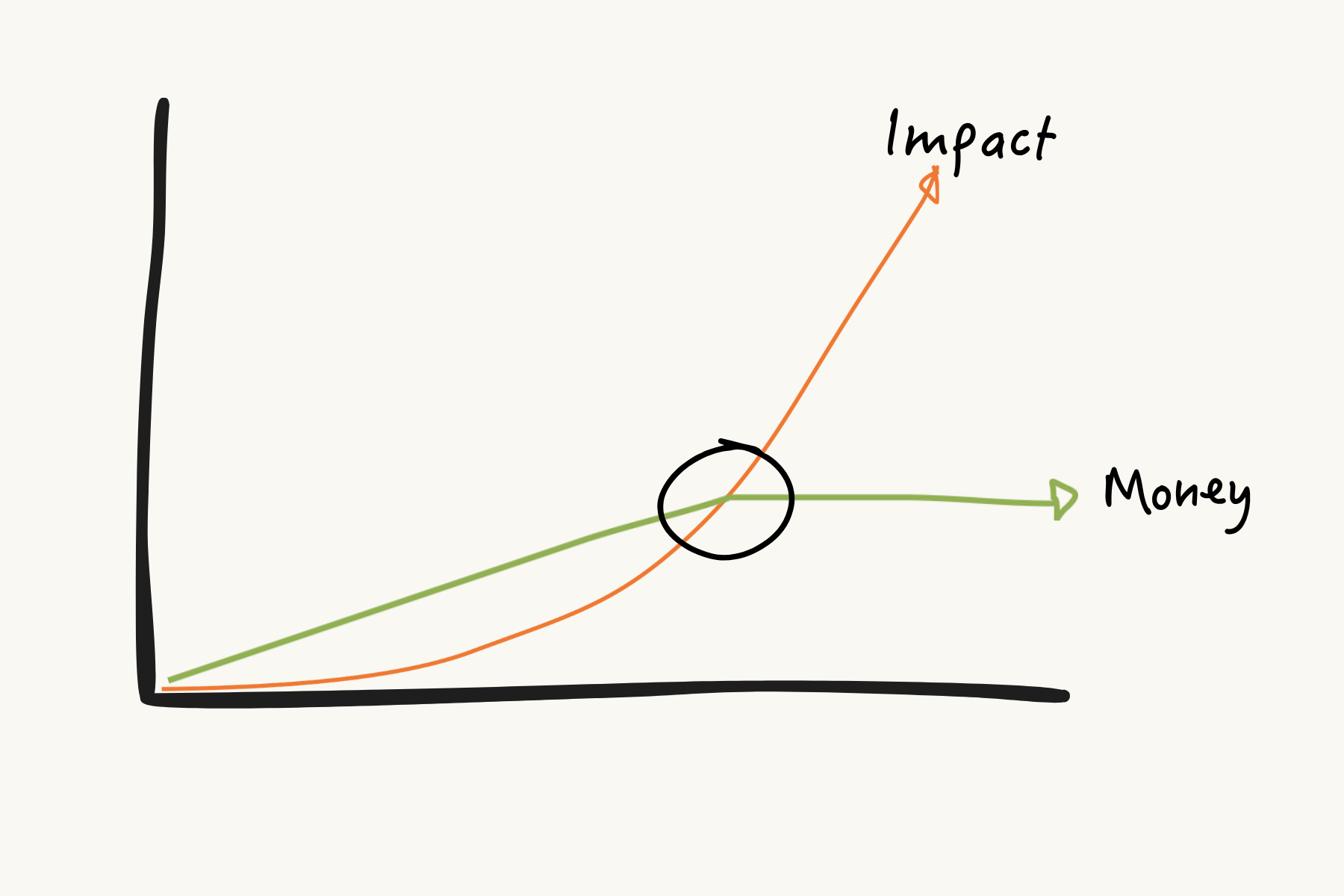
Decoupling money and impact provides the way out of a cycle nobody likes. We need to scale ideas, not organizations! The same money it takes to run a limited number of factories can drive a whole lot of recruiting and enabling. When governments are the doer at scale, smart NGOs have an awesome value proposition: “You want to do solution X? If you’ll own it—you do it and you pay for it—we’ll join you in a joint venture to help you deliver it, and we’ll do it for free.”
That means no more “transitions” and no more “handoffs” to government ownership, no more bullshit “in kind” government contributions. And most important, no more disappointment when governments deliver solution X and don’t get the same results you did. Of course not! You specialize in X and they don’t. In truth, your own results are only briefly relevant—what matters is what happens when a government does X, and the only RCT that matters is the one that happened with full government implementation The result of government ownership and delivery isn’t some kind of sad “voltage drop,” it’s the thing that reveals the true promise of any idea.
So, any impact is worth funding. Exponential impact—scale—is the least understood, and certainly underfunded, especially given the problems we’re trying to solve. Imagine what could happen with an army of NGOs able to drive exponential impact without the crushing burden of endlessly bigger budgets. Growth isn’t enough, and business as usual won’t cut it. Do scale. Fund scale.
Read more stories by Kevin Starr.