


 (Illustration by iStock/ erhui1979)
Reaching scale has long been a central organizing ambition of international development, but is too rarely achieved and even more often, is not lasting. Recent foreign assistance cuts have made this painfully visible: When programs are built on donor funding, donor systems, and donor management, they do not survive the donor’s exit.
We are by no means the first to suggest that donor funding is limited when it comes to reaching people in need with social services and that there are more sustainable paths to pursue. We have followed the evolution of this discourse in SSIR, reflecting deeply on multiple hard-hitting articles just this past year.
Five years ago, well before the recent aid cuts, the team at the Eleanor Crook Foundation asked a simple but uncomfortable question: If we already know how to prevent and treat malnutrition, why do millions of children continue to suffer? Why do so few people receive these life-saving interventions? And what would it take for a donor like us to help change that?
In trying to answer this question, we identified three pathways for programs to reach scale and concluded that not all of them lead to the same place.
- Sometimes a window of opportunity creates rapid adoption: An outbreak forces a nationwide replication of a locally designed case-tracking tool. Or a political champion, for example, a prime minister, publicly orders that every local hospital must be able to identify and treat severely malnourished children and mandates expansion.
- Sometimes external or normative pressure drives uptake: donor conditionality, peer influence, or simply the momentum of “everyone is doing it.”
- And sometimes, donors and partners choose accompaniment as the pathway to scale. Accompaniment is a term used by the late Dr. Paul Farmer to describe a fundamentally different approach to partnership for service delivery grounded in solidarity with the community in need. In global philanthropy, we define accompaniment as walking alongside governments with humility and empathy, while working in sustainable, deliberate partnership to embed programs into national systems, budgets, and routines.
The first two pathways can initiate or expand programs, but they rarely sustain them. When the triggering crisis passes or the external pressure fades, programs tend to contract or collapse entirely. Accompaniment is different. It is not necessarily a method of reaching scale faster, but it is a method of reaching scale that lasts.
As a US-based philanthropy focused on ending child deaths from malnutrition, we have deliberately changed course and employed an accompaniment approach in our programmatic grantmaking. Previously, like many philanthropies with issue-based missions, we organized our grantmaking around key technical questions, like whether bundling interventions can improve nutrition outcomes or how to reduce the cost of wasting treatment. Despite contributing to a growing and robust evidence base about what works in treating malnutrition, we realized we were not meaningfully moving the needle on delivering care to the people who need it most.
We needed to move from being a global grant maker to a long-term country partner—not to run programs, but to accompany governments as they do the hard work of turning interventions into routine services. Thanks to a grant from Coefficient Giving (formerly Open Philanthropy) in 2023, we were able to take that step. Our continuing work with the Government of Nepal to scale two high-impact malnutrition interventions illustrates what an accompaniment approach looks like in practice and has surfaced lessons we believe are relevant well beyond Nepal.
Scaling Malnutrition Solutions
Despite significant national progress in reducing some forms of malnutrition, wasting, the deadliest form of malnutrition, remains a persistent challenge. In Nepal, about 8 percent of children under 5 suffer from wasting, a rate that exceeds global targets. In some provinces, that number is even higher, with one province having as many as 16 percent of children suffering from wasting. Additionally, a third of women of reproductive age are anemic, posing serious risks to their health and nutrition if they become pregnant.
ECF started working with the government of Nepal in 2023 to support the government’s approach to scale the coverage of two highly cost-effective, evidence-backed malnutrition interventions. Wasting treatment with ready-to-use therapeutic foods (RUTF) is lifesaving for children who are severely malnourished, and, separately, comprehensive prenatal multivitamins (known as MMS) improve maternal nutrition and prevent babies from being born too small and too soon.
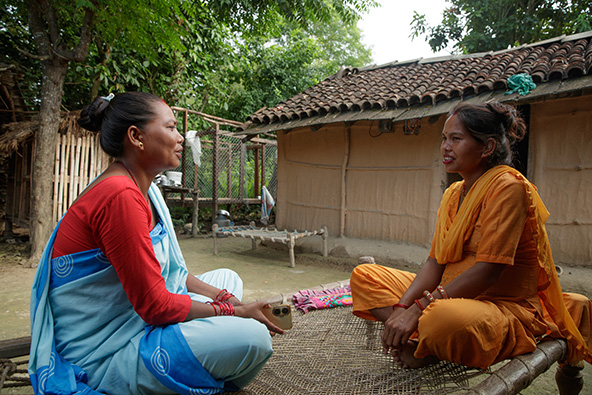 Female community health volunteer Kumari Tharu visits Sarita Tharu (no relation) at her home. Sarita is four months pregnant with her second child. (Photo by Gorakh Bista)
We decided to work with the government of Nepal on this targeted scaling effort for a few reasons. There is a relatively strong health system in place in Nepal, with a network of well-trained community health workers who serve as the backbone. As a result, most women receive antenatal care, which is critical for accessing prenatal vitamins. The country is also uniquely positioned to own improvements in access to wasting treatment since it previously financed procurement of RUTF from its national budget. This strong infrastructure, combined with an openness to further address malnutrition issues, made Nepal a good fit for this work.
Accompaniment has been central to how ECF has approached the scale-up of both wasting treatment and maternal nutrition programs. Nepal’s Ministry of Health and Population has defined research projects, policy reform needs, and developed a financing road map. In each case, ECF has followed the government’s lead to invest in strengthening health systems and their leadership. We have been joined by international and local partners who have committed to an accompaniment approach to impact.
Based on our experience, we offer five principles for what accompaniment requires in practice:
1. Plan for scale from day one. This means committing from the beginning to a government-set vision rather than a short-term project approach and making sure that vision is shared among supporting partners. In Nepal, we were clear early on that ECF funding for research should inform operational challenges related to scaling solutions and shape how MMS could be introduced through government systems. We collaborated closely with government officials to create a plan for national expansion and supported that goal in practical and political ways. Our technical partner, Helen Keller International, is now working closely with the government to develop a road map for scaling MMS, outlining the sequence of policy, financing, procurement, and delivery steps needed to progress from initial introduction to nationwide coverage.
2. Design for institutionalization and government-run systems. Scaling requires thinking about the whole system from the beginning—not just the intervention, but how every facet of government, from supply chains, financing, and partner coordination will need to function together. The government must lead on supervision, reporting, and decision-making. Partners play a supporting role: coaching, troubleshooting, providing tools, absorbing short-term surge demand, but never running a parallel system that the government can’t sustain on its own. In Nepal, we clearly delineated what our philanthropy would fund and what the government would fund. For example, health worker training on wasting treatment is paid for by the government, while ECF funded the development of the training manual. And in the short term, ECF is supporting scale-up of MMS in one province, while the government works toward a plan for national scale-up across all provinces.
3. Understand incentives for government bureaucrats to lead reforms and achieve scale. In the public sector, the term incentive can carry a negative connotation, but global development actors must understand what drives decision-making because that is what moves the work forward. We knew that a prerequisite to scaling up malnutrition solutions was updating Nepal’s Essential Medicines List (EML) to include important nutrition commodities. Our government partners wanted to update the entire list rather than adding the nutrition commodities to the existing EML. So, we supported a full EML revision, going beyond our organizational mandate on malnutrition, because updating the entire list of more than 4,000 medicines to strengthen the overall health system was the real incentive that encouraged decision-makers to act.
4. Build an accountability and ownership narrative. Accompaniment does not end when a policy is adopted or a government ministry endorses a scale-up road map. Sustained scale requires two things working in tandem: Citizens and communities actively expecting and demanding services, and national leaders with the conviction that delivering those services is worth sustained political investment. We work with government partners not only to design delivery systems, but to equip them with a clear story about why maternal and child nutrition matters: as a human capital imperative, an equity issue, and a measure of state effectiveness. As part of our advocacy effort, we are working to develop politically resonant narratives that can raise malnutrition higher on the political agenda and bring it more prominently into public discourse, helping strengthen public accountability and deepen government ownership. Accompaniment without accountability risks creating programs the government inherits but never truly owns.
5. Be patient and redefine success metrics. Scaling takes time, and finding wins along the way is essential to sustaining commitment. Institutionalization markers like updated guidelines, protocol adoption, and newly functional procurement cycles are real signals of progress, even when coverage remains stagnant. It indicates that the system is advancing toward government ownership, and it codifies progress in that direction. The path won’t be linear. Working with any government requires navigating election cycles, unforeseen global and domestic crises, and at times slow-moving, bureaucratic processes. When Nepal faced political turmoil and government collapse in September 2025, we remained patient and engaged, working with an interim government and, after peaceful elections, a newly formed government. Philanthropy willing to celebrate milestones along the way and commit to the long arc of institutional change with long-term, flexible funding will see the payoff.
Pathway to Progress
This approach won’t work in every setting. Accompaniment requires a strong government counterpart, making it less feasible in humanitarian settings. It also needs to be tailored to each context, something that happens most naturally when national governments, with their unique realities, are truly in the driver’s seat. MMS is now being introduced in Lumbini province, one of the poorest regions in Nepal, with the potential to reach more than 100,000 pregnant women and their babies with improved nutrition this year. A road map for national MMS scale-up by 2030 is being considered by the government—and would set the course for transformative impact across generations.
The progress in just three years, and amidst a change in government, is remarkable. That being said, we are still in the early stages of this journey in Nepal, and we are learning as we go. The work ahead—navigating procurement cycles, transitioning to end-to-end domestic financing, and sustaining political will through government and leadership turnover—is less visible and immediate than launching an ECF-funded child malnutrition program. But it is what genuine accompaniment demands.
We’re on track to help Nepal sharply reduce malnutrition and give more children the chance to survive and thrive. And we’re doing it through the only path to scale that lasts.
Read more stories by Yashodhara Rana, Sudip Pokhrel & Danielle Porfido.