


 (Illustration by Valentia Fraiz)
The United States is experiencing the most drastic attacks on science in its modern history, as the government imposes unprecedented budget cuts on federal research agencies, undermines transparency, and casts scientific expertise as partisan. For many in Brazil, this moment feels disturbingly familiar. In 2023, the country emerged from four years under President Jair Bolsonaro—a period that revealed what climate denialism and authoritarian populism look like when they take root in power.
Bolsonaro’s government systematically dismantled Brazil’s research infrastructure between 2019 and 2022. It slashed the budgets of the country’s two main federal science funding agencies—Coordination for the Improvement of Higher Education Personnel and the National Council for Scientific and Technological Development—to a fraction of their former size. His administration also harassed universities and branded researchers as ideological enemies; dismantled the Brazilian Institute of Environment and Renewable Natural Resources (IBAMA), which monitors and fines breaches of Brazil’s environmental law; and celebrated an 80 percent reduction in IBAMA fines on rural properties. The result was an explosion in deforestation rates, wildcat mining, invasion of public lands, and great social conflict. This instability also contributed to many young scientists leaving the country. For example, the Serrapilheira Institute, a nonprofit that promotes science, found that about 10 percent of its young grantees left Brazil, moving to countries like United Arab Emirates, Portugal, the Netherlands, and the United States.
Brazil, therefore, has already lived through what many other countries are now passing through or fear, and this experience offers painful but important lessons about how science philanthropy might act in times of political hostility. By supporting the preservation of public goods essential to science and democracy, using communication strategies that counteract polarization, and adopting a more coordinated and transnational approach to funding, philanthropy can be a stabilizing force.
Balancing Science Philanthropy and the Continuity of Evidence
In the United States, science philanthropy commands billions of dollars. In Brazil, the picture is dramatically different. The country’s largest private science funders—foundations such as Serrapilheira Institute, Ciência Pioneira Initiative, Boticário Foundation, and the Alana Institute—represent a very small fraction of the public science budget. Even at full strength, they could never replace the federal government’s support.
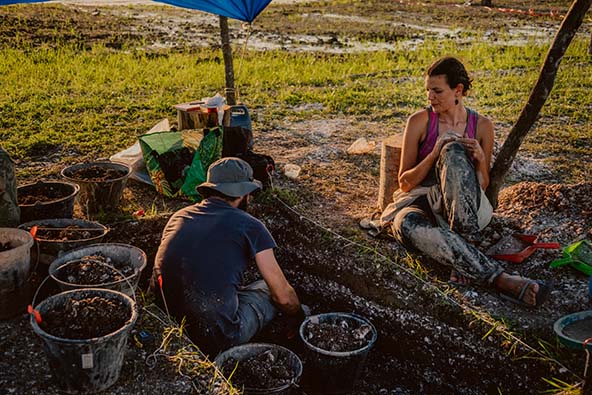 Flexible philanthropic resources are fundamental to field research in remote locations, such as the work archaeologist and Serrapilheira Institute grantee Gabriela Prestes Carneiro conducted in northern Brazil in 2023. (Photo by Bárbara Pereira Vale).
Yet this limitation may, paradoxically, be healthy. The temptation to view philanthropy as a substitute for the state is a trap for democracy. Science is a public good, and only elected governments should provide and finance a national strategy. Philanthropy can co-fund government initiatives, but its greatest contribution lies elsewhere: in agility, tolerance for risk, and the capacity to test alternative funding models. Rather than rescuing the system, philanthropy can act as its creative laboratory—supporting curiosity-driven research and incentivizing early-career scientists to tackle bold and risky questions with flexible funding. This complementary role preserves both the legitimacy of public science and the integrity of private giving; if philanthropy ever sought to replace the state, it would lose its ability to challenge it.
However, some moments of democratic backsliding may demand temporary and targeted philanthropic interventions to preserve public goods that are essential to science and democracy. Bolsonaro’s government did not merely neglect science—it actively sought to erase it. A vivid example emerged during the COVID-19 pandemic, where the federal government downplayed the importance of the pandemic, putting the population at risk. The replacement of his Health Minister—a physician who had voiced doubts about the efficacy and safety of the drug hydroxychloroquine to treat the virus—with an army general who had no medical experience stands as a symbolic silencing of scientific voices. Bolsonaro also called COVID-19 a “little flu” and a “fantasy.” Yet nearly 700,000 people in Brazil died from it between 2020 and 2022.
In this context, the Todos Pela Saúde initiative—founded in April 2020 and led by the Itaú Unibanco bank in partnership with universities, hospitals, and public authorities—demonstrated how philanthropy can mobilize resources rapidly while reinforcing public capacity. By funding diagnostic research, coordinating epidemiological data, and supporting vaccine-related studies, it delivered timely data on where and when COVID-19 was spreading fastest, developed affordable rapid-testing kits, and produced models pinpointing effective interventions—efforts that allowed state and municipal authorities to respond with far greater precision.
When governments falter, philanthropy’s role is to bridge discontinuities, not to redefine who governs science.
Another striking philanthropic response came when the Bolsonaro government attempted to bring strategic environmental data under political control after its public attacks on Brazil’s National Institute for Space Research (INPE). Bolsonaro accused INPE of spreading lies after it released data showing rising Amazon deforestation and dismissed the organization’s director soon afterward. His administration then transferred the responsibility for publicly releasing data on fires and forest burnings to a different agency under the Ministry of Agriculture, the National Institute of Meteorology. The move weakened an institution that had monitored and disclosed fire data for decades, and raised concerns about transparency at a moment of rising environmental scrutiny. The fallout was also diplomatic: In 2019, Norway and Germany froze new contributions to the Amazon Fund.
Importantly, databases like these are not just technical repositories—they are pillars of democratic governance that allow civil society, journalists, and researchers to hold institutions accountable and to anchor public debate in evidence. Their weakening endangers not only the continuity of scientific work but also the very capacity of society to deliberate on facts. The Brazilian experience exposed how political volatility can undermine the infrastructures that sustain both environmental policy and democratic trust.
Since this disruption, innovative and resilient initiatives such as the MapBiomas, funded by both national and international philanthropies to provide land-use and land-cover data from satellite imagery, have become essential to ensuring that the country does not depend solely on INPE data. Brazilian philanthropy has also begun to reflect more deeply on how to help protect the continuity of public goods. Foundations have convened scientists, policy makers, and civic leaders to discuss models of shared data governance—exploring how to shield critical datasets from political interference through redundancy, open access, and institutional cooperation. An international Science Meets Philanthropy seminar, for example, took place in November 2025 at the University of São Paulo, and a cohort of institutions are now discussing a Brazilian science philanthropy alliance to help ensure that collective knowledge can endure political turbulence without philanthropy assuming direct control.
The challenge, then, is to sustain evidence without usurping authority—to keep the lights of knowledge on while leaving the power grid in public hands. When governments falter, philanthropy’s role is to bridge discontinuities, not to redefine who governs science. This delicate balance between continuity and legitimacy ultimately safeguards both democracy and discovery.
Science Communication as a Counterforce to Polarization
One of the clearest lessons from Brazil’s recent experience is that defending science is not only a technical matter—it is political, cultural, and civic. Public understanding of science determines how a society responds to climate denialism, anti-vaccination movements, and disinformation. In a polarized world, science can become a rare vector of unity, helping societies rebuild trust and shared reality.
Supporting science communication is not ancillary to research—it is a strategic investment in democracy.
In addition to cuts to science research, the current US federal administration has made cuts to science journalism. An article in Undark emphasizes the important role that philanthropy plays in supporting media organizations in the country: “According to 2024 analyses by the membership organization Media Impact Funders, between 2018 and 2022, the top 25 funders collectively gave $1.1 billion towards journalism, and nearly three-quarters of all 47 organizations surveyed reported an increase in journalism grantmaking.”
Brazilian philanthropy has started to recognize the importance of science communication, but investments in the field are still modest. Over the past years, the Serrapilheira Institute has supported more than 130 initiatives in science journalism and media, including podcasts and YouTube channels. It has also supported the creation of independent platforms that connect researchers with journalists, such as Agência Bori and Amazônia Vox, making it easier to disseminate scientific information.
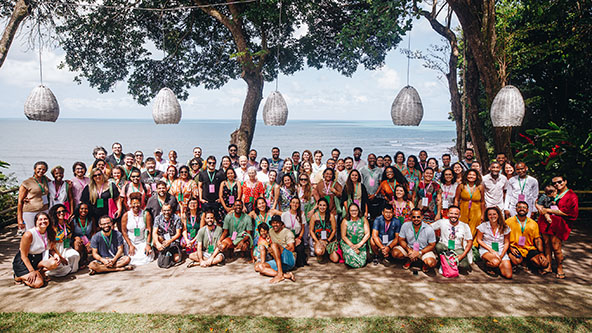 Scientists, journalists, and podcasters—grantees of the Serrapilheira Institute—gathered at a 2024 retreat in northeastern Brazil to think about forms of interdisciplinary collaboration in science and communication, and discuss topics such as diversity and inclusion in science. (Photo by Luana Thayze)
Projects such as Bori, which disseminates Brazilian scientific research under embargo to journalists registered on its platform, and the Ciência Fundamental column in Folha de S.Paulo, a publication that explores fundamental scientific questions for a non-specialist audience through the view of young scientists, have brought new perspectives on how science stories reach the public. These initiatives not only amplify scientific evidence but also help journalists navigate complex fields—from epidemiology to climate modeling.
Supporting science communication is not ancillary to research—it is a strategic investment in democracy. The goal is not simply to make science popular. It is to bring people closer to the scientific process, embed scientific reasoning into the cultural fabric of society, and—while recognizing other knowledge systems present in society—ensure that people see science not as an elite language, but as a truth-seeking practice. This vision reaffirms that scientific thinking belongs to everyone, not just to laboratories or ministries.
Building a Networked Defense for Global Science
Bolsonaro’s Brazil also exposed a structural vulnerability in global research: its limited capacity to respond in moments of political crisis. Thousands of scientists saw their projects collapse, their funding disappear, and their laboratories dismantled. Only a handful of international partnerships could offer temporary refuge.
This fragility highlights the need for a more coordinated and transnational approach to science philanthropy. Imagine if, during the Bolsonaro years, a global network of private foundations had offered emergency fellowships or temporary positions abroad for threatened Brazilian scientists. Today, such a system could operate in both directions: Latin America, Europe, and others might also host US researchers whose work becomes politically untenable.
These networks could act as a safety net for global science, preserving research continuity and the international flow of knowledge. They could be modeled on existing frameworks—rapid-response funds, shared mobility programs, and open-access data partnerships—to ensure that scientific communities remain resilient even when national politics falter.
As instability spreads across democracies, this idea grows increasingly strategic. Political cycles fluctuate, but science depends on long time horizons. International philanthropic collaboration could thus serve as a stabilizing force—a means to preserve inquiry, foster exchange, and resist isolationism. A networked defense of science is no longer a luxury; it is a prerequisite for the survival of evidence-based societies.
Read more stories by Hugo Aguilaniu.