


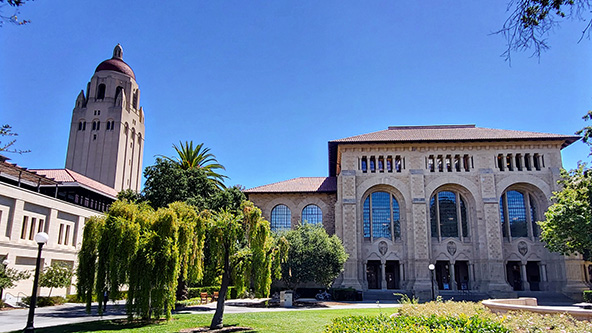
 Stanford University (Photo by iStock/tc397)
Late last summer, I received two pieces of unanticipated news. The first was that the Stanford Center on Philanthropy and Civil Society, the organization that publishes SSIR, was to be housed in Stanford’s Graduate School of Education, where I have my primary academic home. As a scholar of the sociology, history, and politics of education in America, I know that neither universal mass schooling for children nor wide postsecondary access in the United States would be possible without philanthropy. The campus building in which I work was what we now call lead-funded in the 1930s by Ellwood Cubberley, a Stanford professor with a lucrative side business selling textbooks and consulting in the then brand-new specialty of educational administration. There was a healthy market for his products because business and civic leaders across the country had for decades been assembling officially public schools whose survival often depended on the labor and money of volunteer contributors. And of course Stanford itself is a gorgeous example of what sociologist Elisabeth Clemens calls a civic gift, a contribution to the public good freely (albeit strategically) offered by a husband and wife who were railroad titans, canny politicians, and generous benefactors all at once.
The other news was, for me at least, even more surprising. I was asked to serve as the next academic editor of Stanford Social Innovation Review. Answer: YES. And surely a high point of an admittedly luck-filled career. Situated at the intersection of academia, philanthropy, and business, SSIR is exactly the sort of interstitial platform that builders of civic capacity can leverage for practical benefit in our present time: when political and cultural polarization divides and weakens what were presumed to be the most durable democracies worldwide; when a handful of global firms rival nation-states in the sheer scale of their capital holdings, computational capacity, stores of data, reach into everyday lifeworlds, and capacity; when trust in public institutions has in many places reached historic lows; and when spectacular technological advances challenge us to dramatically expand our imaginations of what might be possible for human societies to achieve—or destroy.
SSIR has always been a critical but optimistic venue. It takes blind spots, negative externalities, and outright failures of social innovation seriously and invites readers to learn from them. It also recognizes the inexhaustible promise of human creativity and collaboration and the many forms these can take as history unfolds. It shares good news. It empowers dedicated people in a wide array of endeavors to listen to one another, share wisdom, work harder, try again—and to find intellectual insight and sheer pleasure along the way.
I already have found such pleasure a mere two months into my editorial appointment. The professionalism, seriousness, and camaraderie of the SSIR team are consistently evident in face-to-face meetings and Zoom calls. The quality and international reach of the magazine and its contributors are truly impressive. And possibilities are open: for new story formats, media channels, and collaborative editorial, convening, and educational ventures. In the coming months, SSIR will be assembling a new advisory group to help us cast an even wider net for creative ideas and business models. We also will be considering possible “tent-pole” initiatives to lend ongoing attention to a few domains in which we have especially deep pools of talent and investment, and that seem especially germane for our time. Please reach out to me directly with any ideas or advice. All the while, be assured that maintaining the integrity, excellence, and practical usefulness of SSIR is my top priority.
Read more stories by Mitchell L. Stevens.