


 (Photo by iStock/ko_orn)
Addressing complex social challenges at scale requires strong, well-connected networks that can coordinate action, share learning, and adapt as conditions change. Whether in philanthropy, social investment, member alliances, or regional platforms, networks play a vital role in mobilizing resources, surfacing innovation, and supporting solutions across diverse contexts.
Yet a fundamental challenge persists: Many networks lack clear, current visibility into who their members are, what they do, and how their efforts align. Reliance on outdated directories, infrequent surveys, or anecdotal knowledge limits collaboration, progress tracking, and access to relevant opportunities. These gaps are often most acute in fast-changing or under-resourced environments, where information is fragmented or rarely updated.
In response, a growing range of networks—including grantee communities, professional alliances, funder collaboratives, and industry-wide partnerships focused on shared social or environmental goals—are beginning to adopt more dynamic, data-informed approaches. Tools such as AI-enabled analysis, automated research, and real-time feedback mechanisms are helping these groups replace static records with living, evolving views of network activity tailored to their unique data environments, geographies, and organizational types.
For the better part of a decade, our AI and data analytics company, Impact Intelligence has helped a range of networks—including international member alliances, funder collaboratives, professional associations, and alumni and awardee groups—understand what is happening across their communities and how best to serve them over time. In the process, we have noticed some common blind spots that thoughtfully designed, AI-supported approaches can bring to light.
What follows are snapshots of three core analytical capabilities that networks can apply incrementally, as well as a case study highlighting a shared analytical platform and a framework that organizations can use to rethink their own network intelligence.
Three Core Analytical Capabilities
1. AI-powered text analytics. General-purpose text mining and media analysis tools are now common across sectors. But more specialized applications designed for social and environmental contexts (for example, analyses drawing on publicly available publications and datasets from organizations like the OECD or the World Health Organization) can identify patterns such as recurring challenges highlighted across reports, shifts in policy focus over time, or regions where organizations consistently report certain issues. These insights help networks see which issue areas and members need the most attention and resources at any given time.
Take the Bayer Foundation, which sought to strengthen how it supports and engages alumni of its Women Entrepreneurs Award, a global program backing early-stage, women-led social enterprises. During our work together on the initiative, Peng Zhong, the foundation’s director of social innovation, explained that the program was responsible for managing an expanding, geographically distributed group of entrepreneurs. This made it difficult to consistently track how alumni enterprises were evolving. Important developments—such as new partnerships, media recognition, awards, and expansion into new markets—often surfaced late, intermittently, or only when alumni proactively shared updates. As a result, much of the network’s progress remained opaque, limiting timely engagement and evidence-based decision-making.
To address this, we introduced a monitoring approach. By continuously scanning organizational websites, media coverage, and other public channels, the system created a live, regularly refreshed overview of how alumni organizations were progressing over time. The system also generated curated monthly highlights that surfaced notable milestones and success stories across the portfolio, providing both immediate visibility and periodic synthesis.
The monitor freed a lean team from doing manual research and replaced fragmented, ad hoc tracking with a more reliable evidence base. While traditional criteria—such as financial statements and readiness assessments—remained central to evaluating ventures’ initial investment readiness, the monitoring insights provided ongoing validation of those early judgments. They helped the team sense-check assumptions over time, flag ventures requiring closer support or review, and increase confidence that selected awardees for the Women Entrepreneurs Award and accelerator program continued to demonstrate observable momentum. This enabled a shift from reactive tracking to more proactive engagement, better-targeted introductions, and more informed communications with funders and partners.
2. AI research agents with human validation. Many organizations already use this approach: AI agents identify potential organizations, initiatives, or trends at scale, and human researchers then review, refine, and enrich these findings. The key is to focus human analysis on areas where judgment, local knowledge, and ethical considerations matter most.
One example comes from our work with Google.org and Asian Venture Philanthropy Network (AVPN) on the AI Skilling initiative in the Asia-Pacific. The challenge was to understand a highly diverse and fragmented landscape of AI transition and digital skilling efforts across multiple countries, languages, and sectors, where no comprehensive or up-to-date mapping existed. In response, the project used AI research agents to scan more than 400,000 public sources, identifying approximately 20,000 digital skilling programs and highlighting skills that AI advances would likely affect. A survey of nearly 3,000 individuals across eight Asia-Pacific countries—capturing perspectives on barriers to access, relevance of training, and unmet needs—complemented this initial mapping. Human researchers then reviewed the combined findings, validating program classifications, identifying regional differences, and ensuring that groups such as women, persons with disabilities, and workers with low digital literacy were meaningfully represented.
The resulting analysis informed specific design decisions for the AI Opportunity Fund: Asia Pacific, including which learner groups to prioritize, how to differentiate support across countries, and how to embed outcome measurement into funded programs. For example, the identification of distinct skilling clusters helped the fund focus resources on workforce segments facing the highest transition risk, while survey insights shaped requirements around job readiness, accessibility, and continuity of learning. In this way, the research translated directly into how the organizations structured and deployed funding, rather than remaining a standalone study.
3. Voice-based interview agents. Sometimes, the fastest way to understand a community is simply to ask. But for many networks, especially those working across regions or languages, traditional survey and interview methods fall short. Scheduling interviews is logistically complex, and language diversity creates additional friction. And response rates for written surveys tend to be low, particularly when respondents are busy, under-resourced, or uncertain about how their input will be used. For many teams, participating in formal research also competes directly with day-to-day delivery work.
AI-powered voice agents that conduct conversational, multilingual, and on-demand interviews via the web or mobile phone can offer a practical alternative. Participants respond in their own words and at their own pace, without needing to coordinate calendars or navigate complex interfaces. This approach can be particularly useful for networks engaging social enterprises, nonprofits, small businesses, community-based organizations, or schools that have limited time or administrative capacity.
Voice interviews also address the rigidity of text-based surveys. Participants often share more detailed and emotionally rich insights when speaking aloud, especially in their native language. When responses are vague or incomplete, the voice agent can ask follow-up questions and probe deeper. This adaptive questioning makes the method especially valuable for exploratory research, impact validation, and learning-focused evaluations, where context and nuance matter as much as standardized metrics.
In 2025, our Interview Agent, an AI-powered platform for conducting and analyzing stakeholder interviews, supported an assessment of a flagship sustainability award backed by a national government by conducting in-depth, asynchronous interviews with representatives from winning organizations around the world, many of which have limited public information available. Traditional interviews were not feasible given the number of winners, time zone differences, and tight project timelines.
Interview Agent enabled each organization to share detailed reflections in their own words, including the outcomes of their work, the role the award played in enabling those outcomes, lessons they had learned, and their approaches to validating impact data. In some cases, the platform conducted separate interviews with different team members to help build a more complete and balanced picture of each organization’s experience.
The platform then analyzed these qualitative insights to provide a holistic view of how the award influenced winners’ visibility, credibility, access to opportunities, and ability to deliver sustained impact—findings that informed sustainability reporting and strategic planning in turn. This reduced the time and effort required to gather insights while expanding the reach and inclusiveness of the process. As a result, the dataset better reflected the diversity of experiences across geographies, organization sizes, and operational contexts, strengthening both the credibility and usefulness of the findings.
Case Study: Shared Analytical Platforms
The challenge to maintain a current, actionable understanding of member activity while operating across regions with different priorities, languages, and contexts is especially familiar to international networks, but it applies to funders, intermediaries, and large organizations working with regional chapters or country-level partners as well. These organizations often struggle to see what their members or partners are doing across regions, where efforts overlap, and where gaps or collaboration opportunities exist. In this context, a shared analytical platform with regionally tailored dashboards can help improve visibility, coordination, and cross-network learning.
One example comes from our work with several regional venture philanthropy networks—including Latimpacto, African Venture Philanthropy Alliance (AVPA), and AVPN. Together, these networks represent more than 1,000 foundations, impact investors, corporations, and international NGOs. Like many membership-based networks, they had access to large amounts of information about their members, but when we started working with them, that information was fragmented across websites, reports, news coverage, and informal updates, making it difficult to see patterns or identify opportunities for collaboration in real time.
Rather than adopting a single, uniform model, the networks focused on building a shared analytical platform that they could adapt locally. Each network collaborated on the design of its own monitoring approach, shaped by regional priorities and strategic questions, while still aligning on baseline categories to compare activity and trends consistently.
For example, Latimpacto emphasized a need to distinguish between rural and urban community development in Latin America and to develop more nuanced categories of marginalized communities, including economic vulnerability, identity-based exclusion, and racial marginalization. AVPA wanted greater visibility into catalytic capital and financial instruments in Africa, reflecting ongoing regional debates about innovative financing mechanisms. And AVPN expressed growing interest in tracking faith-based giving in Asia, given its cultural and strategic importance in many markets.
These inputs fed into the shared platform, known as Social Investment in Action, allowing partners to see both region-specific insights and structured views of member activity within their own network. The platform is continuously updated with new activities each month, providing a current and evolving picture of the landscape. Baseline categories included areas such as social causes, beneficiary groups, and types of support, including both financial and non-financial contributions. For example, users could explore how their organizations distributed activities across different causes and deployed various forms of capital and support. The platform organized all data within a consistent framework, while allowing networks to define and apply categories according to their unique regional priorities.
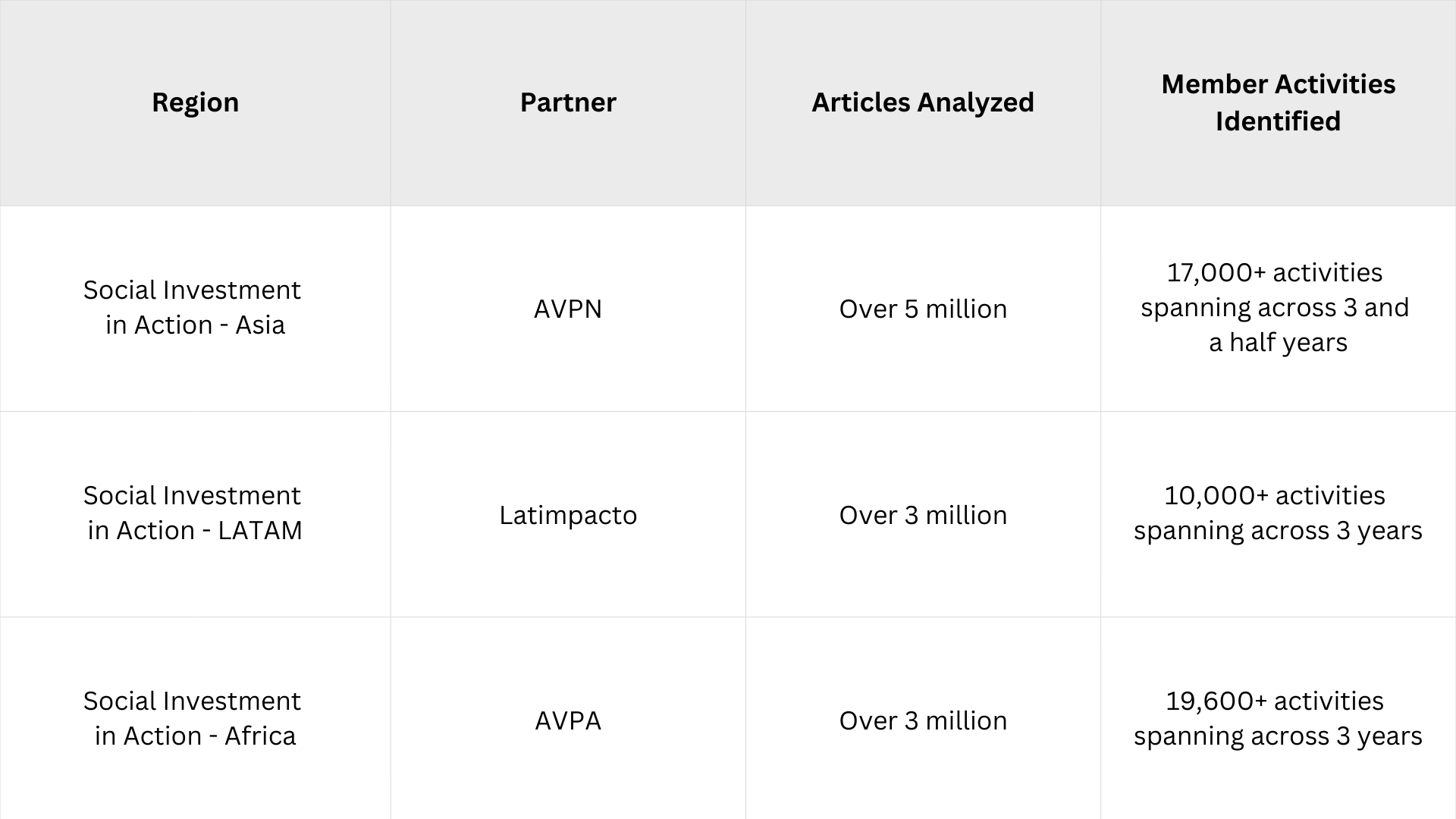 A comparison of three regional Social Investment in Action tracking monitors across Asia, Latin America, and Africa, highlighting partner networks and large-scale article analysis used to monitor ecosystem activity over time.
Over a four-year period, the approach surfaced more than 54,000 documented member activities—drawing on public sources such as news articles, organizational updates, and announcements—and helped map more than $4 trillion in social investments. This allowed the networks to explore where capital was flowing, which issue areas were gaining momentum, and where opportunities for collaboration were emerging. It also changed decision-making. Network teams shifted from periodic, retrospective reporting to ongoing analysis, cross-regional learning, and more-targeted support for members based on real-time signals rather than anecdotal updates.
 (Click to enlarge) The Social Investment in Action - Asia (SIAA) platform maps where members are driving change in relation to the Sustainable Development Goals (SDGs), helping funders, entrepreneurs, and organizations identify opportunities for collaboration across Asia-Pacific.
Manuela Jiménez López, Latimpacto’s knowledge coordinator, shared in a meeting with our team that members initially used the Social Investment in Action - Latin America (SIAL) platform to track capital flows and emerging themes but later began using it in more-practical ways. One member organization, Fundación Grupo Social, for example, was conducting an analysis across sectors (including environment, water and sanitation, road infrastructure, income generation, and education) with the aim of identifying potential national and international partners for future collaboration. In the past, this would have required weeks of manual research, personal outreach, and reliance on partial or outdated information. As Fundación Grupo Social noted, the SIAL platform’s ability to filter data by social causes and SDGs made it possible to move from fragmented, organization-level research to a more comprehensive, “macro” view of the ecosystem. This enabled the team to map potential partners more systematically and initiate connections through Latimpacto more quickly, more proactively, and with greater confidence.
The takeaway is not the creation of a bespoke platform, but the design principle behind it: separating a common analytical backbone from locally defined categories and priorities. Even at smaller scales, this approach can help organizations build shared intelligence that supports coordination and learning without forcing uniform reporting or erasing regional nuance. In this case, the implication for the field is that strengthening knowledge infrastructure can be as important as mobilizing capital itself.
A Framework for Rethinking Network Intelligence
For networks and community-based organizations new to these approaches, one of the most useful starting points is ecosystem mapping—creating a baseline view of what organizations are involved in what, how they are connected, and where information gaps exist. This does not need to be complex. A network might begin by listing its core members, partners, and funders, then grouping them by geography, issue area, or role. From there, it can add simple layers of information, such as who each organization collaborates with most often and where activity appears concentrated or sparse.
Developing a shared internal knowledge base is another good place to start, as it helps preserve institutional memory. This can include notes from past engagements, such as program interactions or partnership discussions, summaries of member activity, and links to relevant external sources, including media coverage and organizational websites, all organized so that members can update them over time.
It is also useful to step back and examine how the network gets work done. Mapping a typical process, such as how staff collect member updates or identify partnerships, and then imagining what that process would look like if time and resources were not constraints, can be revealing. Comparing this “ideal state” with current, staff-intensive workflows helps clarify where automation or AI-supported tools might add value, and where human judgment or relationship-building should remain central.
The following questions can help organizations guide this reflection:
- Do we have a reliable picture of what our members or partners are doing right now? Can we quickly see which members are actively delivering programs, expanding into new regions, or forming new partnerships, or are we relying on annual reports, outdated directories, or informal updates?
- Where are the blind spots in the information we already collect? Smaller organizations, rural initiatives, or groups working in less visible issue areas may be underrepresented because they lack the capacity to produce regular reports or respond to surveys.
- Where would small, low-risk experiments help us test what AI can meaningfully support? One starting point might be piloting automated analysis of public updates from a subset of members, such as newsletters or websites, before applying it across the full network.
- What lightweight hardware or software could help us listen better, not just report more? Short voice-based interviews, simple digital forms, or automated monitoring of public sources can help capture insights from members who rarely engage through formal reporting channels.
A growing array of digital tools and resources can support these early steps. Nonprofits beginning to explore responsible AI can take advantage of programs such as the AWS Nonprofit Credit Program, which provides promotional credits to help organizations modernize their infrastructure. The Microsoft Azure grant offers annual service credits and a structured pathway that begins with migrating existing systems to the cloud and can extend to building AI-supported applications. Google also offers freely accessible courses on AI literacy and foundational AI skills, which can help teams build shared understanding before introducing new tools or workflows.
Setting clear priorities helps focus limited energy on the needs with the greatest potential impact, and small, low-risk pilots create space to test and learn, allowing teams to adapt as they discover what works. Over time, organizations can scale the approaches that demonstrate value, strengthening both internal workflows and their capacity to act on real-time intelligence.
Read more stories by Nikolaj Moesgaard & Güliz Berfin Koldaş.