


 (Photo by iStock/FooTToo)
Capital tends to be invested for impact in one of two ways. One is in companies or projects that are more or less agnostic to geographic or social context; for example, Lime is the operator of shared electric bike and scooter networks, which can reduce greenhouse gas emissions in a variety of locations if these vehicles replace more polluting means of transportation. The other way is to invest in initiatives that are highly attuned to a particular place or market. An example would be GroundBreak Coalition’s blended finance offerings, which are aimed at specifically reducing racial wealth inequality in the Twin Cities of Minneapolis-St. Paul, by helping BIPOC and low-wealth individuals become homeowners, entrepreneurs, and commercial real estate developers.
While most impact investors operate in the former, context-agnostic way—looking for “universal” technologies, products, or services which could theoretically succeed in many different contexts—our experience has led us to question whether solutions aimed towards universal scaling run the risk of overstating impact or overlooking more impactful, context-specific approaches. The TransCap Initiative, where I work, has spent the last six years building the field of systemic investing, an investment approach designed to meet the nature and magnitude of society’s greatest challenges: the transformation of our food, energy, mobility, urban, and industrial systems. And a pattern that has organically emerged in our work is that we consistently find ourselves being pulled into specific contexts, usually intersections between a system and a challenge, such as regenerative agricultural transitions in the American Midwest and net-zero mobility transformation in Switzerland (in contrast to the context-agnostic ways in which most impact investing operates today).
There are reasons why traditional impact investors look for solutions with universal appeal. One is that the potential for financial return is believed to be higher in pursuing a bigger addressable market than for more limited, context-specific solutions. Another is that expertise within investment teams is often unidimensional and context-agnostic, which means that investors tend to be knowledgeable about specific sectors and/or asset classes but not, for example, about specific cultural, political, regulatory, and economic factors in different geographical contexts. There is also the issue that investment capital tends to be organized in thematic ways (e.g., future of mobility, climate change, etc.) and not around specific system/challenge constellations (e.g., climate change adaptation in Southern Spain). Finally, deal flow tends to scale as a function of context size, so investors looking for “universal” innovations will likely find a greater pipeline than those looking in specific contexts.
The challenge with context-agnostic impact investing is that, in the end, the extent to which a particular innovation actually solves any tangible challenge will always, still, depend on how it integrates into the contexts in which it is used. Consider the varying degrees to which electric scooters have found uptake around the world. It was once assumed that when e-scooters were distributed and available, people everywhere would start using them. But studies have found that actual uptake is a function of a multitude of factors, and the extent to which the electric scooter is actually a “solution” to a city’s transportation problems is highly dependent on specific circumstances. While in 2023 Berlin recorded a world-leading 17.5 million e-scooter trips, Paris banned them altogether that same year.
There are several reasons for why innovations often do not diffuse across different contexts. One notable barrier is the “Not-Invented-Here” problem, a well-documented inhibitor to the uptake of innovations of foreign origins. What might find success in one context might be rejected in another for no other rationale than it not being of local origin. Some of the most famous examples of this phenomenon come from the corporate world, such as Sony’s rejection of the MP3 file format to safeguard its Walkman to Kodak’s rejection of the Polaroid process. Another possible impediment is the insufficient readiness of a system to accommodate a new node for technical, legal, political, or other reasons. For instance, in the United Kingdom—as in many other countries—planning permissions and electricity grid connections for charging infrastructure have become a major issue for the increased uptake of electric vehicles. There are also idiosyncratic factors that could inhibit the success of an intervention: Consider the infamous release of cane toads in Australia, which turned an attempt at replicating a pest control strategy that has worked in one context into a human-made biodiversity disaster and a cautionary tale for non-native species introduction.
Working in context would allow investors to study a problem in depth, paying attention to local idiosyncrasies and nuances and then working out what set of solutions are required to address it effectively. E-scooters might be the answer in some cities but not in others. Investors who ignore context might be naïve about the extent to which the innovation they are backing will actually solve real-world problems, thus overstating their impact and—more importantly—leaving impact “on the table.”
Centering Context in Systemic Investing
Systemic investing, by design, puts context at the heart of investing. Context matters right out of the gate in the interconnected processes of (1) articulating transformational intent, (2) drawing system boundaries, (3) performing systems analysis, and (4) building and orchestrating coalitions of capital deployers. Each of these steps requires systemic investors to think hard about what specific problem to solve, what the problem is driven by, and who might need to be part of the change consortium.
In these processes, it might be possible to focus on “global” systems. But any analysis performed at that level will tend to produce insights of such generic nature that the single-point “solutions” suggested by the analysis will be prone to all sorts of diffusion barriers. Moreover, analytical insights at the macro level tend not to be actionable for all but the largest multinational players. This is because institutional structures within which innovation and capital deployment usually happen typically sit at sub-macro levels: Almost nobody operates at the truly “global” level, so investment strategies must often be developed for “sub-global” scales. This means that even with macro-level analytical insights in hand, a lot of additional analysis needs to be performed to reach conclusions relevant at the meso- or micro-levels.
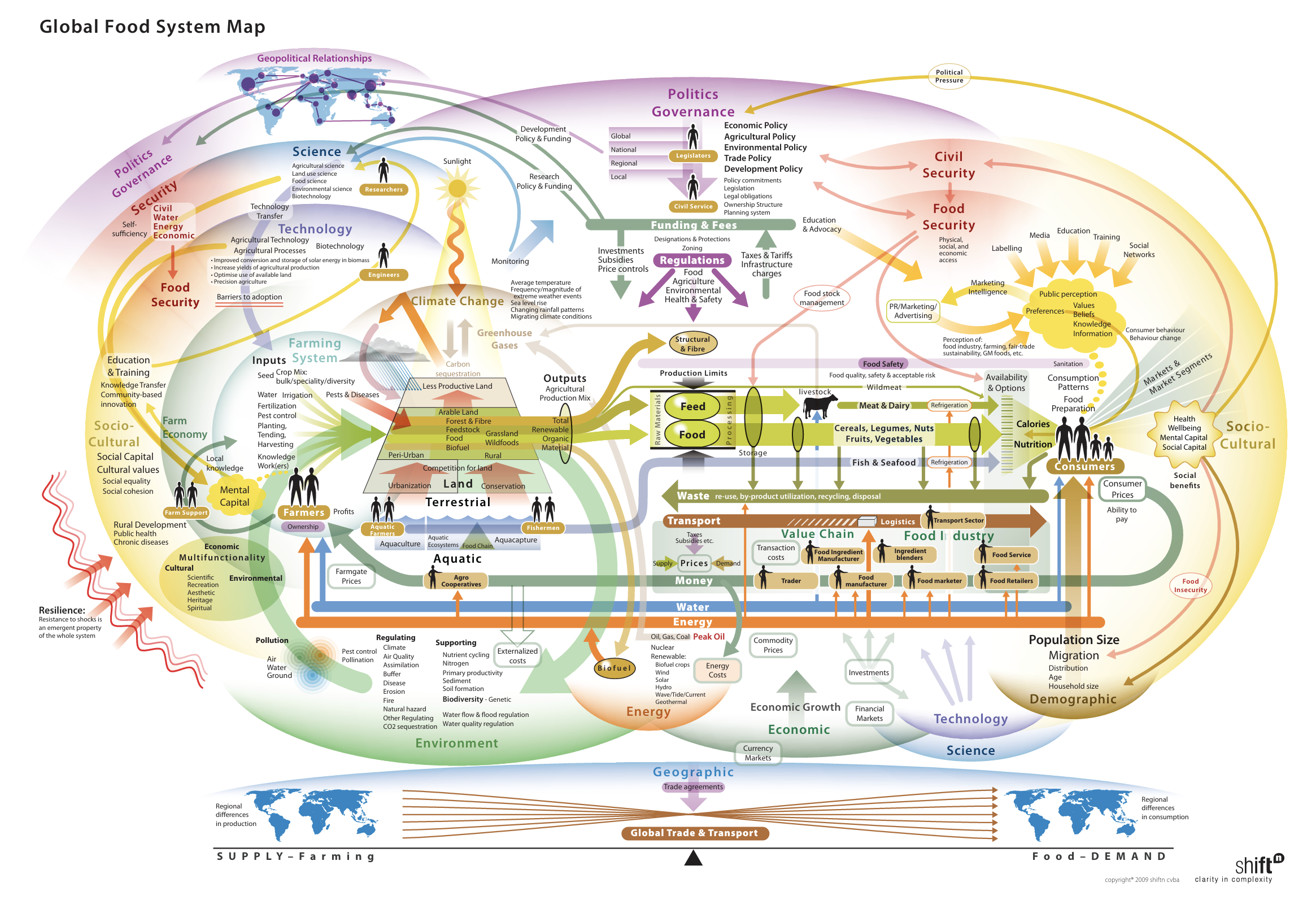 (Click to enlarge) Legend: A causal loop diagram for the “Global Food System,” an example of an analytical output at the macro level that is so abstract that it produces little actionable insight for capital deployers (Source: shiftN (2011) Global Food System Maps)
Three different factors pull us toward specificity and context in systemic investing:
- The analytical mindset of trying to understand a problem in depth and from a multitude of perspectives. Some problem drivers are macro-level forces; for example, structural racism perpetuates the economic immobility of people of color across a variety of scales. But many are micro-level issues, such as the damage to a bridge that triples the commute for such people (Race has been found to be a determinant of average commuting time, with people of color facing longer commutes than White people, particularly in urban environments). Because systemic analysis makes us dig deep, it pulls us into context.
- The search for actionability. Capital allocation is a micro-level activity, happening between specific legal entities. If analytical processes are to yield actionable insights, they need to be situated on a level that informs entity-to-entity capital deployment.
- An interest in generating combinatorial effects. The synergies that arise when multiple interventions (investees, grantees) stand in a strategic relationship with each other become more likely as the understanding of an issue and the density of connections increase, such as when it is possible to grasp which organizations mutually reinforce each other’s work in tangible ways.
This becomes easier the more concrete a context is.
Working in context comes with other benefits, all combining to increase the likelihood that a system change effort will be successful: the opportunity to tap context-specific resources (such as capital from place-focused investors, including governments), the agency and legitimacy that comes from working with local actors, and (possibly) the ease of working in a relatively homogeneous cultural and linguistic setting.
Strategic Implications
All of this illustrates a need to “pin down” the problem. Yet how much “pinning down” does there need to be? Where, exactly, is the line between too abstract and just tangible enough?
In our systemic investing work in food systems, we have come to understand that “agriculture in the American Midwest” as a system boundary does not provide a specific enough context to allow tractable capital deployment. Certain aspects of the problem are shared by all agricultural sub-systems across the region, such as the applicability of federal laws or the general problem of soil degradation. But each sub-system is a microcosm with a myriad of idiosyncrasies that invalidate a one-size-fits-all approach to systems change work. Even the drivers and consequences of soil degradation vary considerably from county to county.
Still, we have also learned that there is a risk of over-correcting, such that the system boundary is drawn too narrowly. For instance, focusing on a single agricultural commodity within a single state made us underappreciate the interconnectedness and interdependencies of agricultural supply chains, creating a risk of engaging in reductionist thinking and tunnel vision. Deal flow can also be a problem: investing is an exercise in filtering, and investors need a pipeline funnel wide enough at the top. Even a context as large as the mobility system of an average-size country can be too small to provide a deal pipeline big enough to construct a portfolio that meets basic risk/return and diversification standards, as we have learned through our work on the Swiss mobility system. Liquidity is another issue: Investors need to hold some of their money in liquid asset classes so that they can generate cash when needed. Public-market stocks and bonds provide such liquidity, but they tend to be issued by large companies. These companies tend to operate at the macro level, and it might be difficult to influence them in ways that affect the meso- and micro-levels.
We have come to believe that the tension between “abstract” and “contextualized” is more of a feature than a bug of systems work. The key to productively dealing with this tension is to work across the macro-, meso-, and micro-dimensions of a problem. The development of individual pieces of the puzzle can happen on each system scale, but assembling the jigsaw into locally adapted—and thus effective—responses must happen on the micro level, in context.
Consider the analogy of building a house. Such a project requires expertise in architecture, structural analysis, and construction techniques—all of which are macro-level elements with applicability all over the world. It also requires meso-level elements that may be shaped by national or regional circumstances, such as building codes, a skilled labor force, and financing mechanisms. Yet actually building the house (in a way that creates the desired societal outcome, shelter) is a micro-level activity in which an infinite number of issues can become make-or-break factors. Does the plot of land have the necessary load-bearing capacity? Is that plot in the right zone? Is there a paved road that allows heavy-duty trucks to deliver construction materials? It is on the micro-level that the actual impact happens as a result of the context-specific weaving of individual innovation artifacts.
Two strategic implications follow from this.
1. Systemic investing programs should work across the macro-, meso-, and micro- levels of intervention. They should develop universal pieces of the puzzle and then do the weaving in context. Working at the macro level is an opportunity to access a sufficiently large deal pipeline while retaining liquidity, but impact will materialize at the micro level where people live, work, and play.
2. Systemic investors should think about scaling impact not through the mental model of growth (making a single thing bigger) but adapted replication (copying one thing for different locations but adapting it to local idiosyncrasies)—a subtle but important difference. In so doing, it is critical to focus on the “efficiency core”: the “specific part[s], rather than the entire solution[s], that we can replicate with minimal modification to fit varied local contexts.” In other words, the core should remain largely the same, but the layers around this core—for instance, the way something is advertised, packaged, or delivered—can be tailored to context in order to promote uptake.
The Return of Context in Purpose-Driven Finance
In sum, any organization trying to transform systems should find ways of introducing context and then scale its impact through adapted replication. For many organizations—including community organizations or place-based foundations—this is a no-brainer. It is also an obvious conclusion for those who buy into the arguments for place-based impact investing or whose mission is grounded in a particular system/challenge constellation, such as the GroundBreak Coalition’s.
And yet it seems clear that many deployers of purpose-driven capital have lost sight of the importance of context, often driven by a desire to “maximize impact” by supporting “solutions” of universal applicability. Instead of starting with a solution in the abstract and taking it into specific contexts, it would be better to start in a specific context and then work to figure out what the solution set needs to be. It is precisely in this “system first” approach where systemic investing can hold one of the keys to addressing some of the most tangible and pressing issues of the 21st century.
Read more stories by Dominic Hofstetter.