


sponsored
Human Rights
Justice by the Numbers
Public interest technologists who bring their expertise to a different sector can make a real difference in people’s lives. This video shows how an innovative partnership between lawyers for the ACLU of Massachusetts and public interest technologist Paola Villarreal resulted in the single largest dismissal of wrongful convictions in US history. Part of the Putting the Public Interest in Front of Technology series sponsored by the Ford Foundation.
Roughly 20,000 people were sentenced and convicted of drug crimes based on tainted evidence from one former state chemist at the William A. Hinton State Laboratory Institute in Massachusetts between 2003 and 2011. This intentional and criminal malfeasance destroyed the ability to correctly assess evidence in thousands of drug cases, leading to longer and more severe judgments against the defendant-victims. Long after their sentencing, many of these individuals continued to struggle with the consequences of lost time and criminal records—until an innovative partnership between lawyers for the Criminal Law Reform project of the ACLU of Massachusetts and public interest technologist, Paola Villarreal resulted in the single largest dismissal of wrongful convictions in US history.
Uncovering a Large-Scale Injustice
Between 2003 and 2011, Annie Dookhan, a chemist at the William A. Hinton State Laboratory Institute, falsified results, forged lab documents, and didn’t follow procedure when testing samples. While many people raised concerns about Dookhan’s work as early as 2009, her misconduct was not formally discovered until 2011. She was subsequently arrested in 2012 and pleaded guilty and was convicted in 2013. Before Dookhan’s conviction, the ACLU and Committee for Public Counsel Services (CPCS) petitioned the court for a mass dismissal of cases—recognizing the potential breadth of Dookhan’s misconduct over eight years. However, prosecutors sought to preserve the convictions and ensure defendants served out their sentences while their convictions were challenged. Ultimately, this initial request for a comprehensive remedy was denied.
For four years, advocates for the wrongly convicted were forced to apply a piecemeal approach in which a mere 1,700 defendants sought or received relief from their convictions. There was no comprehensive list of cases impacted by Dookhan’s misconduct and not all victims had been informed about the tainted evidence. In response, the ACLU of Massachusetts filed Bridgeman v. District Attorney for Suffolk County on behalf of three victims to secure due process for all those impacted. Although their request for a comprehensive remedy was initially denied in this case as well, the team was able to secure an important victory in this case in 2015, when the ACLU finally received the many lists documenting more than 20,000 cases involving Dookhan’s work from different district attorneys. It then became clear that individually litigating tens of thousands of cases would be untenable. The ACLU knew it had the evidence it needed to demonstrate the outsize impact Dookhan’s misconduct had on so many lives. However, the breadth alone was not enough—the ACLU would need to analyze the data to build a legal argument for mass dismissal.
Achieving Justice Through Cross-Sector Collaboration
Thanks to a Ford and Mozilla Open Web Fellowship, Paola Villarreal, a self-taught systems programmer and data scientist from Mexico City, was embedded in the ACLU of Massachusetts to develop The Data for Justice project, an experiment in compiling and visualizing publicly available data in ways that might be more useful for lawyers and advocates. Paola’s data science skills became instrumental to building the case for mass dismissal. By synthesizing, organizing, and cleaning this messy dataset, Paola was able to document the granular details of a large-scale injustice that ACLU attorneys Adriana Lafaille, Mathew Segal, and Carl Williams turned into a legal argument. Her analysis demonstrated that the overwhelming majority of individuals who had been wrongfully prosecuted were charged with misdemeanors. Therefore, dismissing their cases did not pose a grave threat to public safety.
“We were able to provide a true story about the injustice (that) so many thousands of people are facing. And that is a story that was built on data,” Mathew Segal said. Ultimately, the collaboration gave the court the confidence to overturn the implicated convictions en masse, a completely unprecedented event that has shifted the space for accountability, redress, and justice. The court not only cited the data presented in this case in its decision to dismiss the more than 20,000 cases—it cited Paola by name in its final opinion.
We Need to Embed Public Interest Technologists Across Sectors
Often when we think about technology, our minds gravitate toward the physical gadgets and systems—cell phones, computers, VR headsets—that surround us. The “blood” that animates all these systems is data. Data not only fuels the tools that we rely on in our day-to-day—it also shapes the contexts of what these tools can see, do, and understand. Every sector of society is animated by data in transparent and non-transparent ways. This is why it is critically important that civil society organizations like the ACLU have the tools to look under the hood to understand not only what types of data are informing decisions but to ensure that the data is accurate, relevant, appropriate, and is not baking in assumptions and judgments that are biased. In the right hands with the right perspective this data can advance equity, expand opportunity, and protect our rights. Used incorrectly it can invisibly animate and exponentially expand grave harms.
Public interest technology helped make history in the Bridgeman litigation. The field of public interest technology envisions a world where technologists, like Paola, bring their technical expertise and ethical experience to other sectors, including civil society, to create a more just world. Shortly after this case, another drug lab scandal hit Massachusetts. Using similar data science analysis, the ACLU of Massachusetts helped overturn more than 24,000 additional charges.
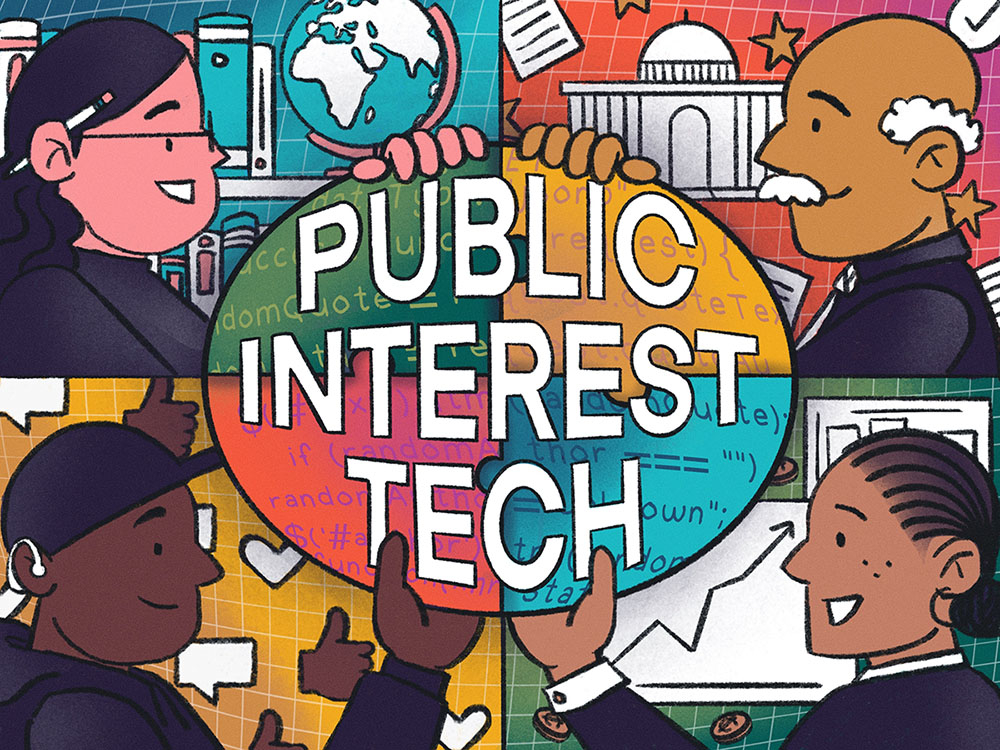
This series, sponsored by the Ford Foundation, explores the pioneering new field of public interest technology and highlights the imperative to create and distribute technology that works for all.
You'll get email alerts when there is new content in this series.