


This article was originally published by SSIR en Español in June 2024 and was SSIR en Español’s most-read original article in 2024.
Until a few decades ago, Latin American children grew up in a very different world. In my (Carolina Nieto’s) childhood, six to twelve children in a family shared almost everything, from food to television. Individual competition existed, of course, but it was so much less important. Our games were organized by rounds or turns, with no winners or losers; for example, we played quemados, a version of dodgeball in which each player took a ball and touched or “burned” another player, who, in turn, took the ball to “burn” the next one, and so the game went on, all playing together.
Nowadays, “first come, first served” dynamics predominate. The winner is the one who has more, and in more than games. We’re thinking of the serious stuff, that creates economic or social inequalities and rations out educational opportunities. In a world of champions and losers—but, above all, of “individuals”—everyone wants to know which side of the court they are standing.
Is there a way to bring back a more collaborative sense of how we play the game? More than a memory, might collaboration be the kind of knowledge that will help us move forward in the 21st century? Let's have a look.
We Have Not Always Preferred Individuality
Is the world becoming a stage for the “I” over the “we”? It would seem so: for more than half a century—as a study in Psychological Science found—the increase in individualism, traditionally associated with Western countries, may be a global phenomenon. To better understand the transition from the collective to the singular, these scholars drew a distinction between individualistic “practices” and “values.” On the one hand, “practices” are oriented toward describing people's life choices, such as the number of individuals with whom people share housing, the percentage of adults living alone, the number of people over 60 living alone, and the ratio of divorced and separated people to married people. On the other hand, “values” refer to established beliefs; among these, the researchers analyzed the perceived importance of friends versus family, the importance of raising children to be independent, and the preference for self-expression and freedom of opinion over other social commitments.
Since 1960, the results showed a clear pattern of increasing global individualism, with a rise of approximately 12 percent. Only four countries (Cameroon, Malawi, Malaysia, and Mali) showed a significant decrease in individualistic practices, and only five (Armenia, China, Croatia, Ukraine, and Uruguay) in individualistic values. While socio-ecological factors like disasters, infectious diseases, and climate stress were related to individualism, it was socio-economic development that identified as the most significant predictor of its increase.
And so, in recent decades, we have seen the evolution towards celebrating individualism over cooperation: In school, we are taught to excel as the best student or athlete, and later we transfer this mentality to the marketplace to be the biggest, best, or only. Lack of cooperation has systemic consequences, as we see in a world filled with armed conflicts and societies polarized by decisions that affect public life. As the world reinforces competition and individual capabilities, mistrust can become systemic and permeate the willingness to solve crises. The Institute for Economics and Peace, which compiled the Global Peace Index 2023, found that 52 percent of Mexicans believed their country was very or extremely divided and 65 percent thought it was unlikely to overcome such divisions. The World Economic Forum's Global Risks Report ranks social or political polarization as the third most important risk category in 2024, since polarized societies tend to rely much more on information, true or false, that confirms their beliefs than on the testimony of their neighbor.
Read more articles on co-leadership with valuable insights from co-CEOs: “Co-Leadership as Practice for an Equitable Future,” “Co-Leadership for Bottom-Up Transformation,” and “A Reality Check for Nonprofit Co-Leadership”
For this reason, there has been global interest in promoting a social solidarity economy (SSE) for sustainable development. A United Nations resolution A/77/L.60 defines SSE as “enterprises, organizations and other entities engaged in economic, social and environmental activities of collective or general interest, which are based on the principles of voluntary cooperation and mutual aid, democratic or participatory governance, autonomy and independence, and the primacy of people and social purpose over capital.”
Although relatively recent, the SSE already reports a contribution of 7 percent of the Gross Domestic Product globally since 2017, where civil associations, cooperatives, foundations and social enterprises are most active. It is therefore estimated that investing in the development of skills focused on collaborative problem-solving could add $2.54 trillion dollars to global GDP. We don't know what the monetary, social, and environmental benefit of, for example, advancing the Taxonomy of Education 4.0, which bases its design on skills for global citizenship such as interpersonal relationships, collaboration, and accessible, inclusive, and personalized lifelong learning. However, UNICEF estimates that half of the world's children and youth are not in a position to develop these skills, an imbalance that Bill Drayton, founder of Ashoka, has called “the new inequality.” Leveling the opportunities for each person to be a collaborative change agent in their communities should therefore be a strategic priority.
Ashoka’s Co-Leader Community
When I (author Carolina) was elected as a Fellow of Ashoka’s Social Entrepreneurs Network, I learned to dialogue with people from many other sectors to understand problems and find solutions, always putting the common good at the center. I found empathetic people willing to reach agreements or define joint strategies and, above all, another way to measure success through social impact, a path that is reached through collaboration. I learned that it takes a whole community to drive agents of change. Ashoka is not an educational organization per se, but it has a great capacity to promote changemaking in education and new paradigms by strengthening collaboration between different sectors. Since 2019, Ashoka Mexico, Central America, and the Caribbean's Children and Youth area—led by Brenda Villegas and sponsored by MetLife Foundation through its director of sustainability, Nalleli García—have grown the Co-Leader Community initiative. It consists of more than 30 public and private organizations and institutions focused on creating the necessary conditions for children and young people to practice transformative skills such as empathy, collaborative work, shared leadership, and creativity to solve problems. They achieve this through collaboration to establish networks, programs, and cross-sector monitoring that multiply the impact of their social innovation.
How can we rebuild individuals' participation and confidence in collaboration to deal with global situations? Using co-leadership as a starting point facilitates three courses of action to promote a world of change agents from an early age.
1. Accelerating innovation. This means ensuring that the best local innovations, with the potential to revolutionize industries and systems, are recognized and can multiply their impact.
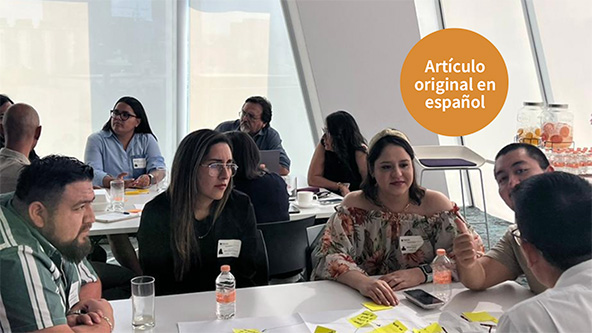
Within Ashoka's Co-Leader Community, the focus is on training changemakers to address and solve socio-environmental problems, rather than on increasing enrollment. For example, since before the Covid-19 pandemic, working groups were created to revalue the role of students, teachers, and institutions as agents of change. The community was woven together to make it participatory; this is an effort to build the vision of a transformative, innovative, and transcendent education. When we learned about the learning and scenarios that we wanted as a community, we identified good educational practices that each institution and organization implemented in their spaces. Afterward, we shared them with the public, as we also did with the stories of inspiring young people and teachers. We created a space where institutions are oriented towards the future and promote collective action centered on people based on a system of co-direction, which are desirable characteristics to ensure development and human integrity.
2. Promoting transformative education. This involves identifying and accompanying key schools and universities to establish a new educational culture with methods, learning standards, and success based on empathy and agency for change.
It is vital not only to communicate the results but also the concerns and obstacles in seeking a paradigm shift. The Co-Leader Community Inter-University Meetings are held annually, the most recent in May 2023, in addition to monthly videoconferences so that the competition between brands can be postponed in order to face challenges together. Along the way, institutions can choose to incorporate change agency into their curricular plans, open strategic roles to shape and sustain social ecosystems for impact innovation, redefine their indicators to focus on the quality of social involvement or promote greater participation of the educational community in decision-making and governance. Each experience, as told by representatives of this or that institution, is equally valuable. The forum for conversation is opened and, as we said at the beginning, everyone takes turns in this game. No one wins, no one loses: We all play and that is what matters.
At the end of the day, it is about adding perspectives to come out with new points of view on the challenges that can be addressed collectively, which involves students, teachers, administrative staff, and managers as potential problem solvers, empowered by empathy, collaborative work, shared leadership and creativity to solve problems. We measure success by working together, indivisibly.
3. Changing the conversation. It is critical to identify and accompany reliable sources of information to help society feel comfortable with the complex and multifaceted issues related to change agency.
For example, Ashoka's repertoire of educational best practices consists of activities that can be replicated in different contexts, more than 50 tools and methodologies that follow criteria of interculturally, inclusion, placing people at the center of learning, promoting sustainability, and fostering the development of independent and community-based thinking. This work has been sponsored by Fundación MetLife, in collaboration with the Institute for the Future of Education of the Tecnológico de Monterrey, and co-created alongside the Co-lead Community of Ashoka, with special recognition to Unboxed, the Universidad del Medio Ambiente and Fundación SHARE. More than 1,800 teachers are already equipped with them, and their scaling up to the six upper secondary education subsystems in the State of Mexico will be possible thanks to the co-leadership with the undersecretary in charge in that entity. This is a team of teams.
Examples of similar initiatives can be found in the manual Saber a tiempo: Methodologies for collaboration and knowledge sharing, from the Inter-American Development Bank; Mapping of Good Practices in Digital Education in the Americas from the Organization of American States in conjunction with ProFuturo and “la Caixa” Foundation; and the project The Adventure of Learning, from EducaLab, created with support from the Ministry of Education, Culture and Sport of the Government of Spain, which is based on inter-agency collaboration to develop social prototypes.
Do We Want a More Collaborative World?
Collaboration, more than a theory, is a way of living and a strategic framework that implies transforming our mentality and actions towards empathy, openness, and joint work, since it breaks with competition to join efforts towards the common good. Different initiatives encourage interaction between different actors, which promotes spaces where diversity is valued, and active listening is practiced. We strive to change how we measure success by valuing collective achievements over individual ones, and by proposing new forms of recognition that reinforce the community and solidarity approach. This approach would not only benefit our communities but could also resonate in our personal relationships. From the education of the very young to practices in the workspace, let us seek to create a lasting impact on society by promoting a profound shift toward greater collaboration and collective well-being.
Read more stories by Carolina Nieto & David Mayoral.