


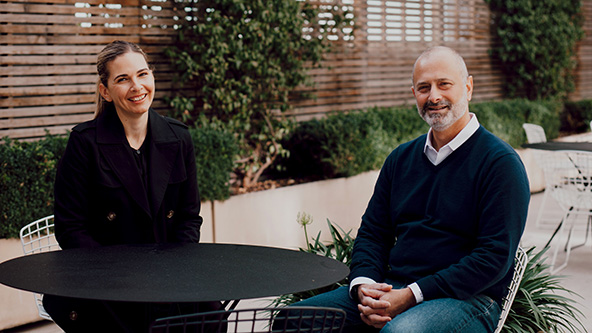
 Hayley Roffey and John Hecklinger, co-CEOs of Global Fund for Children
For some organizations, co-leadership starts from the top down. In 2024, when Global Fund for Children (GFC) announced that I would transition from global managing director to co-CEO alongside John Hecklinger (who had been sole CEO and president for over six years) it was the next step in a co-leadership journey that began several years earlier with co-leaders at other levels. We had seen inspirational examples of co-leadership in partner grassroots organizations worldwide. But GFC had already benefitted from co-leadership at regional levels, as well as on our board, with co-chairs. It had shown us that co-leadership can be beneficial at all organizational levels, that it’s an essential way of working if organizations truly want to shift power, lean into strengths-based leadership, and increase diversity and inclusion within their leadership structure.
In the nonprofit sector, co-leadership practices are emerging with feminist identifying and small development organizations leading the charge out of a desire to shift power and create more diverse and inclusive spaces for leadership. However, this often occurs only at the most senior levels, as opposed to all levels of leadership within the organization. While only 20 percent of CEO positions are held by women, only 5 percent of businesses have implemented leadership development at all levels. Whilst more research that tells the success story of co-leadership is coming to the fore, many fears, concerns, and misunderstandings are holding organizations back from sharing the mantle of leadership and creating a culture where “two heads are better than one”:
- Fear of the unknown: People accustomed to a hierarchy in leadership fear a lack of traditional control.
- Exclusion: Staff have concerns about being left out of organizational decision-making.
- Costly: Most co-leaders rightly expect to be paid the same full-time salary as if they were the sole leader.
- Confusion, duplication, and inefficiency: As Indrani Chakraborty, GFC’s regional co-director for Asia, put it: “Co-leadership can sometimes be confusing for the team. Many are more familiar and comfortable with the traditional one-in-a-box leadership style and may want clarity on who’s in charge. If roles and responsibilities aren’t clearly defined, this can result in confusion, overlapping efforts, or even gaps in leadership.”
- Slow decision-making: Especially in response to an urgent crisis, can two or more leaders always reach a consensus on every decision?
At GFC, there has been much to learn, but our experience so far indicates that these pitfalls can be mitigated and that the benefits outweigh any negatives. Co-leadership is not just a structure or mechanism for management and leadership; with intentionality in how we practice it, it can be transformative for teams and organizations.
Leaders of grassroots organizations worldwide have modeled how shared leadership can open doors for marginalized groups and lead to a new, more inclusive way. Our first exploration of co-leadership was at our regional director level. Kimberly McClain and Rodrigo Barraza, co-directors of the Americas, were interviewed for a blog post about their co-leadership, in which Kim said,
Two is most certainly better than one for GFC in the Americas. Together, we can explore countless new ways to support child-centred and youth-led civil society across the region. I also think we can expand our influence by example, by continued experimentation and innovation, and by speaking up to change how others in philanthropy approach their work.
As they explain, co-leadership creates a new dynamic where innovation flows from a place of collectivity, sharing, and generosity. Both directors have been able to use their skills and expertise on other projects relating to the wider organization because they can share their leadership responsibilities.
Why Co-Leadership Is Worth Considering
When we announced my new role as co-CEO last year, my imposter syndrome caused me anxiety. But I was able move into the role with confidence precisely because we were sharing the mantle. In this way, co-leadership opens doors that can seem closed to many women and people from marginalized groups: You’re bringing your skills and experience to a table where there are other offerings to fill the gaps in your leadership, (whether real or perceived).
This week, SSIR is publishing a miniseries on co-leadership. Read more articles with valuable insights from co-CEOs: “Co-Leadership as Practice for an Equitable Future” and “A Reality Check for Nonprofit Co-Leadership.”
Our positive experiences with co-leadership confirms the many published articles and consultations that praise the practice. The AJH Foundation and ActionAid UK have adopted this model and speak highly of its effect on organizational culture and productivity. Alece H. M. Montez, co-executive director of AJH, said, “This nurturing and flexible shared leadership approach has already helped me feel more human in a leadership role while also allowing me to connect with people on a deeper level and dive into and learn more about every aspect of the organization.” We share these sentiments at GFC; John and I have taken responsibility for different areas of the organization, which negates concerns about replication, and allows us to put our individual skills to best use.
Much comes down to execution, however. While co-leadership as a model can be an expression of feminist principles, it doesn’t mean you’ve ticked that box and the job of equity is done. It is a step in the right direction but requires building an organization-wide culture to match it.
Other benefits we’ve experienced at GFC:
- Personal growth and development: There is more space for staff to step into leadership (especially those who have never considered it when it was a solo job!).
- Mitigation of risk: Decisions are shared and there is another leader in place should one be unavailable.
- Increased capacity to explore new projects and innovate.
- Sharing the load means better well-being and the risk of burnout is reduced.
- Dismantling of traditional power hierarchies where one person holds all the authority and decision-making power.
- More organizational continuity and resilience: We are better equipped to navigate transitions, succession planning, and long-term sustainability.
- More creativity and diverse perspectives.
Slower decision-making was a real concern. However, in being very conscious about it we have embraced it. Slower decision-making can mitigate risk and allow for more considered, and creative solutions. Where urgent matters need a quick response, we take the lead individually where it concerns our areas of responsibility. If we get it wrong, we have the support of the other and with open and caring dialogue we can learn and develop.
In terms of financial impact, Oxford HR found in their research on co-leadership that 51 percent of respondents said there wasn’t a financial impact; where it did require more investment, it was a case of patience to see the return on that investment. Ultimately, positive change often requires a financial investment. Moving to an impactful new model may be costly, but we believe, in this case, it is worthwhile and this reason shouldn’t prevent leaders from exploring co-leadership as solutions can be found.
Trust Is Essential
All our co-leaders have been recruited internally. As we seek to explore and clarify what this model of leadership looks like, the most secure and productive place from which to do this is with co-leaders who are working effectively together and are aligned with the organization’s values. And when we asked our leadership team for their reflections on co-leadership, the most resounding and repeated requirement was trust. As Rodrigo puts it, “Being able to express concerns and disagreements in a respectful manner ... being open and showing appreciation for the other person.” Many of the potential pitfalls of co-leadership, such as slower decision-making, are mitigated by effective and transparent communication. As GFC continues its co-leadership journey, at all levels of the organization, we remain open to the strengths and opportunities of the model, while also being prepared and transparent about the challenges, learning from them, and channeling that new knowledge into better serving our mission: to power the potential of children and young people, wherever they are in the world.
Read more stories by Hayley Roffey.