


 (Illustration by Zuhura Plummer)
We’ve appreciated the thoughtful conversation going on between smart colleagues on both the philanthropic and implementer side of social change about the merits and pitfalls of Big Bet Philanthropy. As leaders at two organizations which have had the good fortune of receiving multiple big bets—Last Mile Health and Educate Girls—we feel a sense of responsibility to enter the fray.
First and foremost: We do not mind being the “guinea pigs” for this new, bold kind of philanthropy. We’d like to say, loudly and unequivocally: Big bet philanthropy is good, very good, and truly transformative. Our experience has proven that big bets can lead to real growth in impact. At Last Mile Health, big bet processes like the Audacious Project in 2018 and Co-Impact in 2019 helped us to raise our impact ambitions significantly: We have now partnered with governments in multiple African countries to equip more than 16,000 professional community health workers, who are improving access to primary health care for nearly 20 million people. Ninety percent of this programmatic reach came after Last Mile Health received its first big bet. And at Educate Girls, big bets like the Audacious Project in 2019 enabled us to scale 3x and grow our impact 6x. In our first 10 years, we managed to mobilize 400,000 out-of-school girls, while we mobilized 1.3 million out-of-school girls in the five years following our first big bet.
At the same time, these high growth seasons for our two organizations have provided us with insights on how we can improve big bets by making (much) longer bets, better suited to the deeply entrenched social problems they aim to solve.
1. The Charging Challenge
Here’s an analogy we feel helps explain the “doers”’ dilemma.
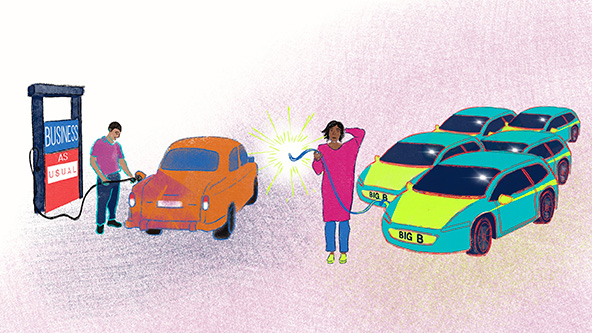
Five years ago, we were both running growing organizations, building impact momentum, and raising more money, year over year. Because we wanted to do new things—but could only afford to keep going further—our organizations were like small cars, powered by traditional internal combustion engines and fossil fuels. When the opportunity came to apply for big bet philanthropy, it enabled us to transition our organizations into a new kind of vehicle, operating at a much larger scale with a new kind of energy. It was like going from driving that single small car to managing an electric vehicle fleet.
With the influx of tens of millions of dollars, we powered up this new electric fleet and sent it out with a lot of fanfare. We garnered new financial support for our “big bettable” proposals and built our organizations to match that moment: opening offices in new locations, employing larger teams, and expanding relationships with governments in order to serve many more people.
And yet, nobody told us that the chargers were missing. Once our fleet was out on the road for a couple of years, we realized that there was no source of readily available capital that would be able to recharge a fleet of this size, with this level of complexity, and this impact ambition. Rather than planning to “recharge” our work, the big bet funding community was preparing to send out another fleet of newly charged cars, into an equally charger-less world.
Could we have better foreseen this? Perhaps. But our hindsight can be others' foresight: As Matt Forti from One Acre Fund rightly points out, big bets must not leave doers with an imposing “funding cliff.”
2. Wishful Thinking Clouded Our Vision
A design flaw in the current set of big bets is that makers and takers of big bets tend to see the world through a capital market lens. There is a desire among us, and pressure from the social investors, to reach the “Social Unicorn” status.
However, the unicorn is a mythical beast. If they think like investors of venture capital, social impact funders want to invest in a way that will allow nonprofit organizations to develop new products, expand into new markets, or even acquire other organizations. Like private sector investments, funders hope another payer exists on the other side, be it another funder, the government, or the private market. That was our wishful thinking, too.
However, unlike private sector businesses, we're not selling products or services, we're enabling rights: the right to health care, the right to education. As such, we believe cost should not be a barrier for materially poor or marginalized communities to access these rights, which means that, for those who utilize them, our services are free.
Working with the government is crucial to solving problems at scale, and it is core to the operational models of both Last Mile Health and Educate Girls. But we have come to understand that this is patient work. The payer at scale will not immediately shift from philanthropic big bets to domestic government financing, at least not in the short term. It would be more realistic to imagine building the “charging network” we need out of a combination of domestic financing, continued philanthropic support, and new financing from big aid (awards from bilateral and multilateral aid agencies), all committed to this work for the long haul.
3. Our Best Bet Is a Long Bet
For problems like the billions of people who lack access to even the most basic health care, or millions of girls in India excluded from education, there are no quick fixes. The task of supporting paid resources like community health workers or frontline education champions will require a decades-long commitment. But we are up to the challenge. If we as doers are willing to make decade-long commitments to our constituents (children, mothers, families), then we need the same bold commitment from philanthropic donors.
How, then, would we “big bet” better?
The answer is simple. Bet longer and bet multiple times on the same effort. Patient capital and long-term backing is the boldest bet because it will lead to sustained change. If we can shift our mindsets and plan for longer doer-donor collaboration, if we can reinvest based on successful outcomes (backed by rigorous monitoring and evaluation), then we have a better chance of equipping local governments and communities to address their own needs, edging our way out of business, and changing the world for good.
Read more stories by James Nardella & Maharshi Vaishnav.