


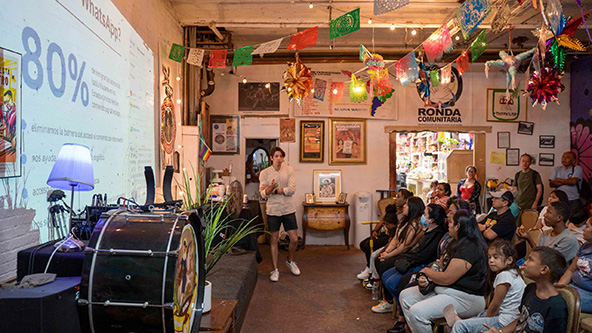
 (Photo courtesy of Documented/Micho Vitali)
There has never been a greater need for underserved communities—including immigrants, low-income Americans, and rural communities—to have access to accurate, timely, and actionable information about the issues most present in their day-to-day lives. At the same time, the information ecosystem has never been more polluted and fragmented. The rise of AI, rampant mis- and disinformation especially designed to target vulnerable communities, and a perilous economy for journalism have all contributed to a decline of trusted resources.
In short, media organizations are struggling to break through in an overcrowded and chaotic information environment, and communities aren’t getting the information they need.
There is an approach to address this that may seem obvious but is surprisingly under-adopted by media organizations: shaping editorial, content, product, and audience development strategy in direct response to asking communities their needs and what matters to them. At Documented—a New York-based, immigrant-facing nonprofit newsroom—we deliberately built a system from our founding to integrate community research and product development into how we function. We built a unique two-way communication publishing platform on WhatsApp and were one of the newsrooms to engage directly with users through WeChat and Next Door—all in response to community input. As a result, we have reached many people previously underserved with critical information.
While these ideas may seem most applicable to other newsrooms, there are lessons in our experience that apply to any organization looking to develop innovative ways to meet the information needs of their audiences, including community-based organizations, philanthropies, universities, and local governments.
What does this approach look like in practice?
Listening: Starting With Community Research, Always
Reaching underserved communities is not about being on a particular platform. It’s not about a checklist. It’s about your community understanding that you understand them through a continuous process of listening and responding. Typically, media organizations take a top-down approach to deciding what news and information is worth reporting and sharing. Our team is deliberately countering that through a methodology that starts with deep listening, community research, and a guiding mantra of don’t assume, listen.
Much of this approach is inspired by the work of Listening Post Collective, a media support organization that mentors and grants to outlets serving communities with low civic engagement across Appalachia, Southwest border communities, Indigenous communities, and the Southeast. To fill existing information inequities, they work with communities to understand where information is already being exchanged, what information people are missing, and how to design solutions that meet people where they are.
The listening phase starts with identifying who you’re trying to reach and where they get their information, mapping your community and its existing information ecosystem. This mapping can cover existing available community data, local media resources, community leaders and information sharers, and any other ways information is already being shared.
Next is understanding what you still don’t know and listening directly to people to produce original data. What are you listening for? Wants, needs, and pain points. Once you understand what information you need there are a multitude of ways to listen—SMS and messaging platforms, email, surveys, interviews, public meetings and town halls, focus groups and listening circles, social media, tip lines, comment boxes, and the list goes on.
Across all of this needs to be a guiding set of ethics in how you go about community understanding—introducing yourself, checking your questions with community leaders, responding and circling back to people with any content created from those conversations.
We put all of this into practice in our most ambitious community research initiative to date in 2022, when we undertook a five-month information needs assessment of over 1,000 Caribbean and Chinese New Yorkers, two key audiences we were looking to understand better. To do this, we partnered up with 54 trusted community-based organizations who helped distribute the research, and we participated in over 24 events to find members of those communities to connect with. We visited community centers, attended local meetings, and knocked on doors—all so we could address barriers to information access and truly meet these New Yorkers where they were.
Understand: Analyzing and Distilling Insights
Many organizations already do the listening piece, but it’s the next step where they get tripped up. What do you actually do with that information and how do you translate it into useful solutions and products? The bridge is what we refer to as the understand phase, where we take a step back to analyze the data we’ve collected and to distill actionable insights.
Once the audience’s wants, needs, and information gaps are clear, you can begin to translate them into market opportunities and potential products and solutions.
For content, this looks like shaping your editorial strategy around these insights and gaps. In the case of Documented, in addition to our ongoing investigative and daily news reporting, we do regular service journalism based on the inquiries our community reporters are getting directly from people. The result is guides and resources covering everything from where to find pro bono legal support or English language courses to how to access GED exams or job training resources to finding local food pantries and dealing with landlords.
For products, we take a wide perspective around what a product can be, both on- and off-line. This could mean developing new, original platforms or reimagining more traditional platforms like web, newsletters, podcasts, or in-person events.
Act: Product Development and Redevelopment
From there, it’s time to put this research, resulting insights, and potential solutions into practice. We do this through a “design and test” approach—starting with multiple prototypes with markedly different solutions for the problem or need we’re addressing, testing them with the community and surveying their feedback, developing a second prototype that integrates that feedback, testing again, and then eventually launching into the world.
In the early days of Documented, our team developed a new way to use WhatsApp for publishing by creating a two-way rather than unidirectional communication flow. Later, after our community needs assessment revealed that 70 percent of Caribbean respondents to our survey were using the NextDoor app, we brought our community correspondents to that platform to share resources, to gather story ideas, and to engage directly with Caribbean New Yorkers.
Every time we design and develop a new project we also design what we’re going to be measuring alongside it in a way that is bespoke to the audience and the platform. Each of the primary messaging and social media platforms we’re on have different functionality requiring different ways of capturing engagement—for WhatsApp this looks like numbers of link clicks and the number of exchanged messages, for WeChat it’s page views and subscribers, and for NextDoor we look at content views.
This approach ensures we’re regularly checking in and understanding how the audience’s needs are changing. That ongoing feedback is then used to formulate and reshape our products. On WeChat, users’ interest in connecting with other members of their community led us to set up a group where they could directly share information about upcoming events, request resources, ask questions about city services, and receive information about local elections. Our community correspondents moderate the group, dispel any misinformation that gets shared, and also share relevant new articles and resource guides we produce.
For our flagship newsletter, “Early Arrival,” we’ve done numerous surveys of readers and professionals working in immigrant support, ultimately changing the format and tone of the newsletter based on their feedback. What started as a purely information-based link pack format now includes first-person analysis from our reporters and a “community corner” section with upcoming events and job opportunities.
The numbers bear out the reach of this work: Early Arrival has upwards of 45,000 subscribers and an open rate of around 40 percent (significantly higher than the industry average), and our WeChat platform has seen over 325,000 page views since it launched.
All aspects of this process are ongoing. In our case, we are planning for updated listening surveys with each of our key communities to better understand and respond to their needs, especially in light of current events. We are also starting to formulate this process into a curriculum that other organizations and newsrooms can use to guide new editorial approaches and new product innovations to reach those who could benefit from these resources the most.
For organizations of all kinds looking to support underserved communities in this time, serving their information needs is integral. A community-first content and product development process is worth the time it takes to get it right, and it all starts with committing to listening.
Read more stories by Nicolás Ríos.