


 Illustration by iStock/GeorgePeters
In September 2022, Typhoon Merbok hit Alaska. Alaskan Native communities lost homes, critical food storage, and faced many catastrophic consequences.
Philanthropy often responds to these types of emergencies with rapid response grantmaking. But to do so, funders must be aware of the needs on the ground, which requires connections and relationships with people being impacted.
While the impact of Typhoon Merbok remained off the radar of most funders, the Environmental Justice Resourcing Collective (EJRC), a funding collective co-created by movement leaders and the Kataly Foundation in 2020, sprang into action. Because of our relationships with communities, we knew who to get money to and how. Within a span of seven weeks, we moved $200,000 to the field.
This was different from the usual spaces that funders create where they set the table and send the invitations. Kataly invited two key movement leaders into the kitchen, then stepped aside, scaffolding the work, as the leaders built out their diverse team and crafted the menu. This was critical to fostering the kind of trust needed for us to move quickly and nimbly.
More recently, when Hurricanes Helene and Milton hit the southeastern United States, we immediately connected with the Kataly team to let the staff know about the emergent needs we were hearing from the folks we knew on the ground.
Within hours of us reaching out, Kataly was coordinating the creation of a rapid response docket based on our recommendations. This is an example of what movement-led grantmaking can look like in practice. The foundation listened to our guidance, allocated resources towards climate disaster relief, and ultimately moved $650,000 within five weeks to 18 organizations we helped identify.
Since the collective’s formation in 2020, we have moved $42.9 million to communities bearing the brunt of environmental injustices—$10 million of which was distributed through six rounds of rapid response grantmaking.
A group of nine women of color, all with deep experience in intersectional environmental, climate, and social justice work, the EJRC was created to fund work led by and for communities most impacted by environmental racism, climate change, and unjust systems. When we began as a collective, we did not know where our journey would take us. What followed was a radical experiment in sharing power, total autonomy over grantmaking decisions, and an unprecedented scale of resources to redistribute. Four years later, we are embarking on the final stage of our spend-out strategy, and reflecting on what we can share with the field of philanthropy about our approach. What lessons can funders draw from our experiences supporting frontline communities of color over the past four years?
What Does Movement-Led Grantmaking Look Like in Practice?
Since 2020, EJRC has invested at scale in communities facing environmental injustices such as poor health, environmental degradation and pollution, disinvestment of public resources, and more. These communities—our communities—require resources not only to handle catastrophic events, but to make our visions for healthy and thriving futures a reality. The collective has developed its wealth redistribution strategies based upon the understanding that environmental and climate justice intersects with many social issues: gender justice, reproductive justice, economic justice, healing and trauma, and more.
The EJRC’s transformative approach is rooted in movement-led decision-making authority. We are leaders in our communities and connected across multiple formations in movement. Our structure and composition of decision-makers are critical to our core mission. As people who have organized and built power in our communities, led campaigns, survived climate catastrophes, and more, we can shape the type of support and the docket of grantees from a place of experience and deep understanding. Because we have autonomy and decision-making authority, we can act swiftly and with an alignment of purpose.
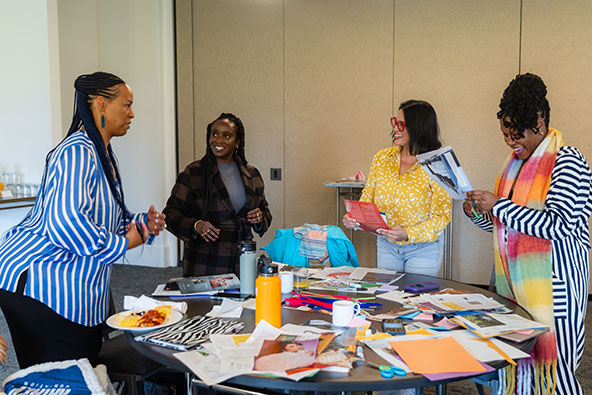 EJRC leaders gathering and working together during a retreat in March 2024. (Photo courtesy of the Kataly Foundation)
From the beginning, the collective used a consensus-based decision making model that was based on trusting one another’s areas of expertise. Part of the way we avoided the typical conflicts that come from clashing egos was that we deferred to people who had deep relationships and accountability to what was happening on the ground. Instead of prioritizing our own individual perspectives and agendas, we operated from a learning stance—if we made a recommendation for a grant to a group in a region where we didn’t live or work and there was discussion about it, we would trust the people who were closer to that space.
Part of what made the experience sacred to us was the level of trust and respect within the collective. We knew we were going to hold each other accountable and make decisions with integrity. There was never a need to justify an interconnected understanding of environmental justice—whether it was funding land-based work, supporting birth workers, or integrating language justice, the group’s collective lived experience and expertise informed how we understood the connection of all these things to climate and environmental justice.
Moving Funds Rapidly and With Purpose
After having our first meeting in April 2020, at the onset of the COVID-19 pandemic, we decided to put approximately $5 million (10% of the $50 million allocated to us by the foundation) towards a COVID-19 docket. After three days, we built out a docket of 70 grants. Following that initial round of rapid response, we established our initial grantmaking strategy, which took a let-a-thousand-flowers-bloom approach within three priority areas, which we set together: collective healing, building power, and infrastructure and land.
In our next round of grantmaking, we committed $32 million in multi-year, general operating support to 78 organizations. Climate justice, an emphasis on just transition, and building community power were the themes that connected the work we decided to resource. What this work looked like in practice included: organizing a women’s collective for safe birthing and healing; providing legal and technical assistance to BIPOC farmers and land stewards to secure land; incubating Indigenous, women-led businesses; creating food sovereignty for communities; fighting for tenants rights and safe housing protection; and advocating for public infrastructure spending to center marginalized communities.
This type of work requires organizations to have the flexibility to experiment and take risks. This includes strengthening connections between networks and creating collaborative spaces. Movement leaders are always building connective tissue that can strengthen movements. When they are better resourced, we have seen the creation of new formations that enabled resources to flow to Southern movement groups on the frontlines, that resourced the leadership of Indigenous women across the United States in accountable ways, and that advanced cultural strategy to shift narratives and thus the political landscape, to name only a few examples.
Case Studies of Rapid Response
As mentioned above, one of the many rapid response grantmaking efforts we undertook was to address the damage of Typhoon Merbok in Alaska. Many Alaskan Native coastal communities were devastated by this typhoon, one example of increasing climate catastrophes they face. These communities are only accessible by plane or boat. As we explored how best to support the people on the ground in Alaska, Enei’s relationships with people affected led the collective to understand the sheer scale of the crisis, which hadn’t been covered well in the news or received much other philanthropic support.
At nearly the same time, Hurricane Fiona hit land in Puerto Rico, and activists immediately emphasized the importance of disaster funding for basic needs, targeted relief, and visibility infrastructure. Another member of our collective, Tania Rosario-Mendez, who is the executive director of Taller Salud and based in Puerto Rico, directed resources to seven groups, including those working on disaster relief and advocating for clean energy and coastal protection.
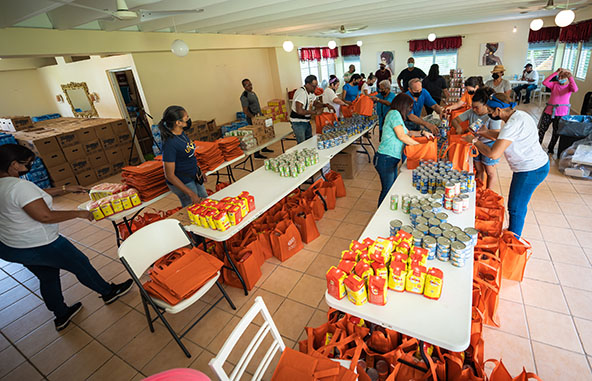 The Taller Salud team and volunteers prepared 450 basic food baskets to be distributed in communities without electricity and drinkable water in the towns of Patillas and Manunabo. (Photo courtesy of Taller Salud)
One of the unique aspects of our rapid response funding is the ability we have to align with the needs of social movements. Traditional funding responses to climate disasters tend to prioritize direct service organizations and national relief organizations. Our approach was to provide folks with what they needed immediately, while also supporting people in direct relationship with their communities doing long-term, power-building work.
Through Enei’s deep connection to Alaska and Tania’s with Puerto Rico advocates, our group provided direct resources from the EJRC grantmaking budget and other Kataly programs to provide vital relief for these affected communities. We got this support to them in seven weeks and without the paperwork processing that can frequently hold up the distribution of funds.
Our process for distributing grants does not require proposals or letters of intent, and because of our connections on the ground, we were able to get contact information from the groups quickly. Instead of utilizing traditional practices like reliance on written descriptions of the work, it was our relationships that served as the accountability mechanism. Funds flowed quickly because the foundation listened to our expertise–when we signaled that there was a crisis and leadership needed to move with urgency, they prioritized processing the grants rapidly.
Redirecting large-scale resources like this allowed us to prioritize the communities most impacted and to acknowledge their solutions and wisdom as part of our overarching commitment to their self-determination and sovereignty. In both locations, this rapid deployment of funds resulted in critical funding to families in crisis. In Alaska, the funding was vital in helping 23 Alaska Native communities cope with the loss of an entire season of food harvested from the lands and ocean. This was especially important given that the red tape associated with the Federal Emergency Management Agency’s funds often does not account for the cultural realities of Alaska Native people.
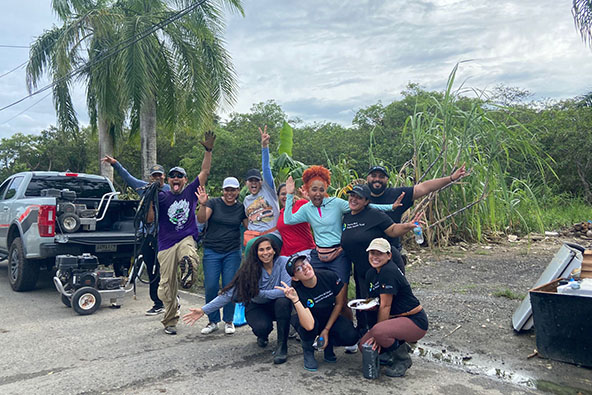 Members of Taller Salud created a cleanup brigade to give a “breath” to people who had barely rested after flooding caused by Hurricane Fiona. (Photo courtesy of Taller Salud)
Prioritizing a Holistic Approach
After our initial phase of grantmaking was underway, the collective came together in Puerto Rico in the spring of 2023 to identify what our spend-out strategy would look like. In addition to the $50 million we began with, the foundation had distributed an additional $25 million to us in 2022.
The EJRC decided to spend out the funds entrusted to us by the Kataly Foundation because our goal, much like the foundation’s, was not to amass wealth and exist in perpetuity. We wanted to redistribute money where it was needed expediently and to advocate for other funders to implement lessons learned from our work in their own wealth redistribution.
We had lots of big questions to contend with as we discussed how to redistribute the remaining resources to the field. How much should we focus on renewals of existing grantees? How did we want to bring new grantee partners into our strategy? What are the places and spaces not receiving funding from mainstream philanthropy where we could make an impact?
Our discussions surfaced a strategy that could support field building, multi-generational power building, and movement infrastructure. In addition to continuing our support of land-based work, in the final phase of our spend out we will also be focusing on language justice, elder care, and sabbaticals. These areas arose as priorities for us because they are not traditionally seen as connected to the work of environmental justice.
However, from our own experiences leading this work in our communities, we know a holistic approach to funding organizing is essential. Language justice empowers non-English speakers who have traditionally been excluded and disenfranchised by existing systems. Sabbaticals prevent leader burnout and create space for creativity and fresh perspectives that feed the work. Supporting movement elders who are facing hardships honors their decades of service to our communities and creates opportunities for intergenerational learning. Each approach is crucial to sustaining our movements for the long term.
Building and Setting Our Own Table
Early on in our lifespan as a collective, we held a webinar sharing what environmental justice means to frontline communities. One of our members, Dara Cooper from the National Black Food and Justice Alliance, talked about how we often get invited to someone’s table after the table has already been set, yet we are expected to work wonders with a table that wasn't set for us. “[But] that's not what this table was about,” she said, explaining how EJRC represented an entirely different model from the start. “This was about us building and setting a table together, deeply rooted in what we know our people need and our communities deserve.”
Philanthropic leaders don’t have to build this new table from scratch. What we hope funders will take away from our approach are a few key lessons:
1. It’s time to go big or go home. The kinds of wins we need to protect the planet and realize true democracy require long-term investments that are flexible and at scale with the problems we face. This looks like multi-year, general operating support going towards Black and brown-led grassroots organizations.
2. The best experts are on the ground. People with a track record of success in building grassroots power and improving material conditions for communities have a clear understanding of where resources are needed and how to structure that support so it is most useful. When they have decision-making power and autonomy over resources, philanthropic dollars will have a long-lasting impact.
3. Resourcing existing movement-led grantmaking vehicles and/or their grantees (including grantees of the EJRC) is the best way funders can support transformative grantmaking. It saves us from recreating the wheel in the form of new funding vehicles that take more time from movement leaders already overtaxed by philanthropy.
Our experiences as grassroots leaders has taught us that the crises which lie ahead for all of us will often hit our communities first and hardest. Funders can accelerate the pace of change by connecting directly with movements and their leaders who are continually crafting strategy, assessing gaps, and identifying vehicles needed to fill them.
Read more stories by Enei Begaye & Colette Pichon Battle.