


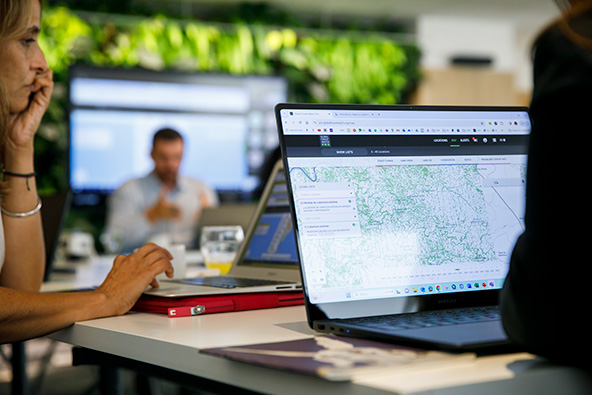
 Companies use tools like Global Forest Watch Pro to report on their ESG performance. (Photo courtesy of World Resources Institute)
If you’ve ever bought a chocolate bar, burger (beef or soy), or bottle of shampoo, you’ve probably touched a supply chain linked to tropical deforestation. For years, major food and consumer goods companies have promised to end deforestation in their supply chains, but tracking or documenting progress remained elusive. A crucial step for companies is having a clear view into the environmental impacts of production, and specifically, if the Amazon or other sensitive biomes were cleared as part of the process. Companies previously had plausible deniability: Understanding the risk from their supply chains was often unknowable. That changed with the advent of Global Forest Watch, and later Global Forest Watch Pro (GFW Pro), a forest monitoring and risk assessment tool designed for companies and financial institutions.
With a few clicks, sustainability officers or those involved in purchasing could overlay satellite-based alerts with sourcing regions and supplier lists. For the first time, the company had a credible, near-real-time view into where deforestation might be creeping into its supply chain. The tool didn’t just help them avoid risk—it helped them act. A company could adjust procurement practices, flag non-compliant suppliers, and look more closely at suppliers that raised concerns. The platform became a quiet but essential component of their Environmental Sustainability and Governance (ESG) strategy.
A similar transformation is unfolding at the intersection of the seafood and insurance industries. A global marine insurer, skeptical about exposure to illegal fishing claims, joined a pilot of Vessel Viewer, a platform leveraging Global Fishing Watch data to help insurers evaluate the risk of insuring fishing vessels engaged in illegal, unreported, and unregulated (IUU) fishing. Suddenly, the insurer has easy access to information about IUU risk by integrating vessel movement data, port activity, and suspicious vessel registration practices. For a few companies, the platform has become a significant tool in streamlining the underwriting processes while aligning with the company’s commitments to sustainability and ocean governance.
Over time, skepticism of corporate sustainability and ESG commitments has grown, driven in part by concerns over greenwashing, misleading claims, and gaps between intent and action. At the core of many of these concerns are questions of data reliability and measurement challenges. ESG data so far has been voluntary, often beginning with the companies themselves, and is difficult to measure. Although tools like GFW Pro, Vessel Viewer, and others aren’t a perfect solution, many of them address key data gaps, provide standardized metrics, and support transparency.
This kind of sustainability infrastructure is becoming indispensable for companies making evidence-based environmental claims. But the tools that enable these claims were not built by the private sector. They were seeded, nurtured, and scaled by philanthropic foundations and NGOs. As companies increasingly rely on these platforms for marketing, regulatory compliance, and risk mitigation, a key question emerges: Who should pay for the sustainability infrastructure that companies are using to measure, improve, and report on their ESG performance—and can they do so in a way that is sustainable for the tool developers and preserves the objectivity these tools were built on?
From Philanthropic Investment to ESG Infrastructure
GFW Pro and Vessel Viewer didn’t appear overnight. They emerged through years of investment and iteration by mission-driven organizations responding to global challenges—and a gap in corporate accountability.
The World Resources Institute (WRI) launched Global Forest Watch in 2014 to provide open-access forest monitoring based on satellite imagery. It is designed to equip NGOs, journalists, and governments with data on deforestation hotspots. As demand for corporate action on deforestation grew, WRI recognized that companies needed tailored tools and launched GFW Pro in 2019. Built on the same core data, GFW Pro allows companies to monitor deforestation within customized sourcing areas and securely assess risk without exposing proprietary supply chain information.
The Gordon and Betty Moore Foundation, the Norwegian government, and other private philanthropy initially supported GFW’s development, believing that open, independent data could shift corporate behavior. Funding followed from USAID, UK AID, GIZ (Germany’s main development agency), and GEF (a multilateral environmental fund).
The platform is free to use and the information publicly available—a deliberate choice to promote adoption and encourage broader accountability via civil society pressure. Previously, when asked about deforestation linked to a supply chain, companies could often legitimately claim that they “couldn’t know.” The advent of these transparency tools suddenly made that information public, both for the companies and the organizations concerned with environmental destruction.
The story of Vessel Viewer, developed by Global Fishing Watch and supported by foundations including Gordon and Betty Moore Foundation, Bloomberg, and Oceankind, followed a similar arc. Vessel Viewer translates complex vessel monitoring data into simple risk signals tailored for insurance underwriters—a previously untapped audience in the fight against IUU fishing.
In both cases, the tools were designed initially not as commercial products, but as public goods. Their goal was to improve transparency, empower watchdogs, and enable better decision-making by both public and private actors. But now, companies and other commercial users are a growing audience as they navigate new regulatory obligations and risk exposure.
The Corporate Sustainability Arc
The development of ESG monitoring and reporting tools mirrors the broader evolution of corporate sustainability over the past two decades.
- Foundation-funded innovation: Philanthropic investments made possible tools like GFW Pro and Vessel Viewer, which helped frame environmental challenges in terms companies could understand: financial risk, reputational harm, and regulatory exposure. NGOs played a dual role: holding companies accountable while offering tools to help them improve.
- Voluntary corporate adoption: Early adopters, often companies with consumer-facing brands or investor pressure, began using these tools to make and monitor ambitious sustainability commitments. Their uptake was driven by pressure, but also by the utility of the tools themselves.
- Regulatory alignment: As governments adopt due diligence regulations, like the EU’s Deforestation Regulation or the Port State Measures Agreement in fisheries, the tools have become essential for compliance. What began as voluntary infrastructure is becoming mandatory.
- Market opportunity: With tools now central to compliance and risk management, there’s growing interest in commercialization. Some NGO-supported tools have launched “freemium” models, offering base functionality for free while charging companies for advanced features, bulk data access, or integration support. Many face new competition from venture-backed start-ups promising sleek, business-friendly ESG solutions based on proprietary calculations.
Commercialization of these tools presents a unique opportunity for a sustainable, mission-aligned funding source. Companies are finding value in the information the tools provide and are willing to pay for it. NGOs have the potential to break out of the challenges typically associated with nonprofit funding: restrictive and burdensome grant funding that often features low overhead and the risk of shifting as foundations’ strategies and priorities change in roughly five-year increments.
The Risk of Commercialization—and the Cost of Doing Nothing
While the opportunity to monetize ESG infrastructure seems clear, the path is fraught with tension.
Many of these tools derive their credibility from being independent, mission-driven, and transparent. Open access to data is core to their effectiveness—not just for companies, but for NGOs, watchdogs, journalists, and consumers who rely on public transparency to hold actors accountable. Moving toward a purely paid model could undermine this. Right now, the publicly available information supports a whole ecosystem of accountability and public benefit. If they transition to a “company pays” model, will the companies only pay for their share? Or can it be done in a way that maintains support for public benefit?
There’s also the risk of perceived or real conflicts of interest. If companies are paying for the tools that assess their sustainability performance, can the results still be trusted?
Meanwhile, the very companies that benefit most from these tools are sometimes slow to adopt them, even when they’re free. Introducing fees, without clear ROI or regulatory mandates, could reduce uptake at a critical moment. In other cases, a free product can see slower adoption by companies because it is not perceived as having value. Setting a price can sometimes speed adoption.
And the competitive landscape is changing. Private-sector startups are building flashy ESG tools backed by venture capital and targeting the same corporate users. But their tools may use unsubstantiated data, lack peer-reviewed methods, and not have social/environmental mission alignment that NGO-built platforms offer.
Pilots and Emerging Models
Both GFW Pro and Vessel Viewer are experimenting with models that preserve transparency while generating revenue.
WRI has launched fees for heavy usage and memberships for GFW Pro. The model preserves free and open access to core data and functions for smaller supply chain participants while offering enterprise-scale users additional services, such as automation through application programming interfaces (APIs), pre-release access for feedback on new features, and options to host membership subnetworks. The model allows companies to pay for services while ensuring that the underlying data remains available to the public.
Vessel Viewer has taken a similar approach. The platform remains free to investigative journalists and NGOs but offers tailored subscription packages for insurance companies and other commercial users, with added functionality and direct support. The revenue supports tool maintenance and ensures the product can scale to meet increasing demand. Vessel Viewer offers a direct data integration option (API), allowing data to be integrated into existing customer platforms. Vessel Viewer is planning to implement a freemium offer in which the base model would be free, with the option of upgrading to a paid model with additional features. This change is driven by the difficulty of licensing access to a tool that is freely available.
These tools are also evolving in their internal structures. Staff who once focused solely on research or advocacy are now learning client services, account management, and data integration. The organizations behind the tools are becoming hybrid entities—part mission-driven nonprofit, part enterprise-grade service provider.
Other models being explored across the sustainability infrastructure ecosystem include pooled funding from coalitions of companies, licensing agreements, and integration into corporate software suites. Each has pros and cons. But all point to the same reality: Tools must evolve if they are to remain credible, accessible, and financially sustainable.
Who Pays for ESG Infrastructure?
For the past decade, foundations have carried much of the financial burden for the infrastructure behind corporate sustainability, quietly underwriting the systems that now underpin billion-dollar ESG claims and ratings. Now the NGO tool developers are asking companies to step up. So far, this has mostly been in the form of corporate donations or pooled investments. A few are navigating pilots for freemium models like the ones explained here. But this is just the beginning of navigating long-term funding solutions.
At the end of our story, we return to an international agribusiness company that contributed to a market assessment of GFW Pro. When asked whether they would be willing to pay for continued access to the tool, a sustainability officer responded without hesitation:
“Having a public sector name around your compliance monitoring is critical. How would investors or customers know the credibility of the numbers we’re reporting? There’s a trust element to name recognition and knowing you’re doing something transparently lowers the suspicion of greenwashing…. The transparency of having an industry standard and trust.”
That sentiment reflects a growing understanding: ESG infrastructure is both a public good and a business necessity. The challenge now is to build payment models that reflect that value—without compromising the transparency and independence that made these tools credible in the first place.
Read more stories by Robyn Paulekas.