


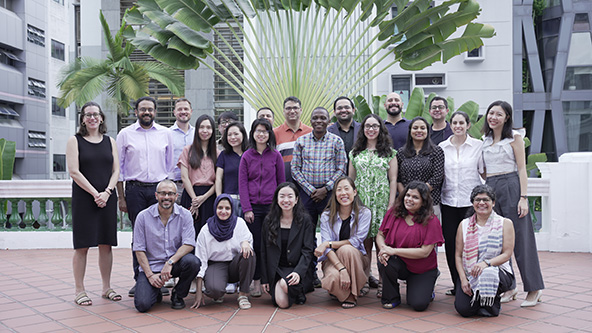
 The inaugural Climate Finance Fellowship class. (Photo by IREX)
Over the last year, we’ve attended several climate philanthropy gatherings where the agendas have focused on either geographical priorities (for example, Southeast Asia or Africa) or sectoral ones (for example, grid decarbonization, scaling wind and solar, or industrial policy). However, discussions about the human infrastructure required to drive transformational climate initiatives were almost always missing from the programming.
In our work as organizational leaders, including at the global climate education and careers platform Terra.do, we’ve found that thousands of skilled, accomplished people around the world are hungry to tackle climate change. Yet in our conversations with climate philanthropists, we’ve seen too little interest in supporting talent development and deployment. We’ve heard a lot of talk about “clean tech,” “sustainable finance,” and “speed and scale,” and far less about the people implementing these ideas—the actual leaders building scrappy nonprofits, the wonks drafting policy frameworks, the electricians installing resilient infrastructure, or the community organizers doing public engagement.
The path to a zero-carbon future isn’t paved solely with technologies and laws—it runs through people’s livelihoods, labor, and leadership. To make real progress, the field must invest in the next generation of climate leaders, create cheap and scalable green skilling pathways, strengthen organizational capacity, and connect new talent to meaningful climate careers.
How We Got Here: A Policy-First Approach That Neglects People
For the past two decades, climate philanthropy, especially in the United States, has used policy as the primary lever of change. That’s understandable: Since the global economy drives carbon emissions, changing the rules that govern that economy is essential, and policy wins like the Inflation Reduction Act (IRA) and the Paris Agreement are important to progress. During the Biden Administration, the IRA was projected to slash US carbon emissions between 43 and 48 percent below 2005 levels by 2035, doubling the pace of reductions. While the impact of the Paris Agreement is harder to estimate, countries have nevertheless advanced global climate action in significant ways since it was signed, including through the creation of the Loss and Damage Fund that provides financial assistance to poor countries. It also serves as a global rallying cry, framework, and platform to address the climate crisis, much like the Sustainable Development Goals.
We therefore understand the appeal of focusing on the hard math. Quantifying progress in terms of gigatons of carbon emissions avoided, gigawatts of renewable energy installed, and dollars of economic value created makes it easier to round up additional financial and political support for climate action among investors, funders, and policy makers.
But this focus on “hard” policy and science goals has led to a blind spot, an underinvestment in the people who implement and sustain these changes—leaders, managers, and workers across the economy.
As a result, a different kind of hard math is now playing out. Globally, there simply aren’t enough workers to deliver on climate goals. LinkedIn reports that while the global demand for green talent grew by 11.6 percent from 2023 to 2024, supply only grew by 5.6 percent. By 2030, one in five jobs could go unfilled for lack of green talent.
The problem is especially stark in clean energy. The International Energy Agency found, in a survey of 27 countries, that most energy employers struggle to find qualified applicants for nearly all roles. Underinvesting in human talent and workforce development is directly impeding the field’s capacity to achieve both gigatons of carbon emissions reductions and gigawatts of renewable energy installations.
Worse still, when climate remains abstract and disconnected from people’s daily lives, public support falters. Witness the “speed and scale” at which the current US administration is dismantling provisions of the IRA, the country’s landmark climate law. Politicians are well aware that climate change rarely cracks voters’ top 10 issues. A 2023 Pew survey found that only 37 percent of Americans see climate as a major priority—17th out of 21. Gallup data shows that while many worry about climate change, they rate it far below concerns like the economy, health care, inflation, and crime.
How, then, do we get people to care about climate change? Better communications efforts—less about gigawatts, more about lower electricity bills—will help. But workforce development is both essential and underfunded.
Jobs and Talent: A Leverage Point
The energy transition is one of the largest economic shifts in a century—and one of the most labor-intensive. The IRA alone has already generated more than 330,000 clean-energy jobs in the United States in two years. About 75 percent of these don’t require a four-year degree, and many come with strong wages. But technology is no longer the bottleneck—it’s workforce readiness and organizational capacity.
Clean energy, regenerative agriculture, building retrofits, public transit, and resilience projects all require diverse talent. Strong local and global policymaking and advocacy remain vital, especially in the current geopolitical environment, but after decades of “making the case” for climate action, the field now needs to give equal attention to “making it happen”, which in turn strengthens the case for climate-friendly policies. And that takes a different set of strategies, tactics, and skills.
Climate philanthropy can’t continue to focus on scientists, policy makers, and activists. It has to widen the tent; it needs electricians, construction workers, investors, farmers, operations experts, logisticians, filmmakers, software engineers, plumbers, teachers, influencers, and administrators to apply their skills and experience to the climate crisis.
Centering talent and livelihoods makes climate action tangible. People are more likely to support rural wind farms if they bring real jobs, not just emissions cuts. If philanthropy is serious about a just and lasting transition, it must rebalance. It must invest in the human competencies and capacities that get the work done, focusing on three interconnected areas:
1. Supporting workforce pipelines focused on education pathways, fellowships, apprenticeships, and career ladders. Programs that bridge the education-to-employment gap can help make the green transition more inclusive and real to everyday people. For example, in the United States, Grid Alternatives’ SolarCorps and other training programs provide on-the-ground solar installation training for underserved communities. And professionals anywhere in the world can jump-start their climate careers through programs like Terra.do’s Climate Change: Learning for Action, a global climate “bootcamp” program for professionals looking to remake their careers to address climate change.
Two newer efforts that we are leading include the Climate Finance Fellowship, which helps finance professionals pivot their careers toward climate while also supporting nonprofits to absorb this talent. The first cohort—spanning 11 countries in Asia, Africa, and Latin America—exceeded expectations, both in career transitions and salary viability, and inspired other funders to launch similar efforts for communications professionals in Southeast Asia and lawyers in Africa. And in the works is a nonprofit focused on equipping people with the skills—and courage—to lead on climate. The programming will help people build competencies, gain confidence, navigate the jobs landscape, and find their place in the movement.
2. Building organizational capacity by helping nonprofits, community groups, and local agencies scale effectively. Many climate-focused nonprofits—especially smaller, locally focused ones—struggle to attract, support, and retain new staff, even when they receive funding to grow programs. Some funders are setting up initiatives to address this challenge. The Growald Climate Fund, for example, significantly funded talent programs to enable scale across the energy transition field, then set up an Organizational Development Community of Practice. This robust and diverse group of funders shares best practices for helping grantees build effective and well-run organizations.
3. Advancing labor standards by ensuring that climate jobs offer income, dignity, and upward mobility. To create a climate economy that is both durable and just, the field must ensure that green jobs are good jobs. In the United States, the Climate Jobs National Resource Center works with unions in states like New York and Illinois to push for state-level climate policies that mandate job quality protections and worker training investments. In Africa, Shortlist’s Women For Green Jobs” program, funded by The Global Energy Alliance for People & Planet, supports more than 750 women transitioning into clean energy careers, and working with Value For Women and other partners to promote gender equity in clean energy workspaces and success on the job. These models embed labor protections into climate policy and bring underrepresented groups into the climate tent, building public support for clean energy and other climate solutions.
This shift from “making the case” to “making it happen” also requires that the field scale up funding for climate action. As one funder told us, “It’s so much cheaper to fund a think tank than a training program.” But if funders want to turn ideas, research, and recommendations into impact, they must be willing to invest accordingly.
The Human Climate Story
Climate action is not just about emissions curves and policy targets—it’s about people making a living, raising families, and building a future worth working for. When people start their day driving an electric truck, insulating a school, or marvelling at a 90 percent reduction in their electricity bill thanks to solar panels, they become climate ambassadors. So does their family, their network, and their community. That’s how awareness and acceptance spread.
Philanthropy has the power and the responsibility to invest in people. The greatest transformation won’t come solely from laws, subsidies, or technology. It will come from us. Let’s fund accordingly.
Read more stories by Roshan Paul & Kamal Kapadia.