


 (Photo by iStock/passigatti)
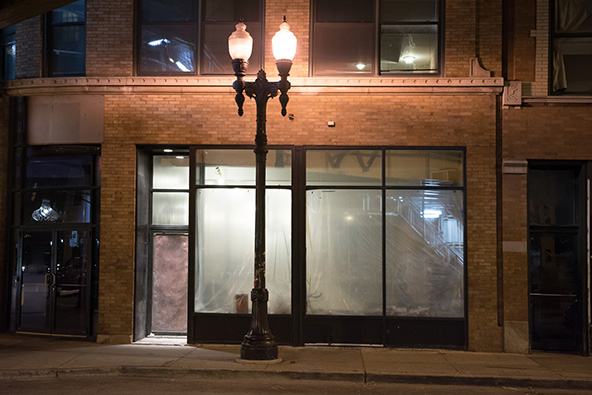
Tucked away in the West Village of Manhattan, Integral Yoga Natural Foods was a beloved institution—one of New York’s first organic food stores that served the neighborhood for 45 years. The store, run by its namesake yoga center whose founder gave the opening invocation at Woodstock, was unable to survive the overwhelming competition in the changing retail landscape and closed for business in 2018. Now open in its place is Getir, a new grocery chain of what are often called “dark stores.”
Block by block, our cities are going dark. “Dark stores” promise delivery within 15 minutes, but are not designed for walk-in customers and board up their windows. Similarly, ghost kitchens prepare and deliver food, but accept no patrons on site. These are only the latest so-called innovations in a decades-long assault on our urban landscapes. Neighborhood stores have been obliterated by Amazon and restaurant profits eroded by DoorDash and UberEats. The pandemic has now fundamentally altered the nature of work. Traffic in business districts may never fully recover, putting everything from grab-and-go eateries to shoe shiners out of business. Now, brash entrepreneurs backed by billions in capital are promising convenience like we have never seen before.
City leaders, community organizations, and residents should take notice. This next wave of disruption, layered on top of already significant headwinds, could deliver the final blow to the life, energy, and community that defines cities, resulting in higher crime, greater inequality, and increased mental illness.
Dark Businesses and the State of the Urban Landscape
Between 2007 and 2017, the number of small retailers in the US fell by 65,000. Forty percent of the nation’s small apparel, toy, and sporting goods makers disappeared and about one-third of bookstores closed. In New York City, the number of retail vacancies during that decade doubled, reaching a vacancy rate of 5.8 percent. That was before the pandemic. Manhattan’s busiest business districts now have vacancy rates well above twenty percent. The biggest beneficiary, of course, has been Amazon. The company controls nearly 60 percent of the e-commerce market, and its revenues grew from $14 billion in 2007 to over $400 billion today.
Now, a new generation of entrepreneurs aims to make Amazon appear slow and outdated. Dark store brands such as GoPuff, Getir, Gorillas, and Jokr have sprung up across big cities, offering ultra-fast delivery for the most common purchases such as milk, bananas, paper towels, and baby formula. Unlike Amazon’s warehouses, which are large and located outside city centers, dark stores might be no bigger than a pharmacy and tend to situate themselves within neighborhoods so that they can reach customers in minutes. They have narrow aisles to maximize inventory, and similar products are usually not stocked together in order to minimize error rates of pickers. Last year, dark store brands raised nearly four billion dollars in venture capital, giving them the muscle to engage in predatory pricing—a tactic perfected by Amazon and Uber earlier this century. Their intention is to capture market share with cheap goods as quickly as possible and wipe out bodegas, pharmacies, and whatever is left of neighborhood stores. Jumping on the bandwagon, existing chains ranging from Whole Foods to Walmart are turning stores dark too. Bed Bath & Beyond recently announced it will convert one-quarter of its existing locations into dark stores.
A similar phenomenon is taking place with restaurants. Heavily funded startups such as Kitchen United and Kitopi are acquiring buildings across the country, breaking them up into numerous rentable kitchens, and leasing them to anyone interested in creating a delivery-only restaurant brand. Similar to dark stores, ghost kitchens don’t accept walk-in customers, and they use third-party delivery companies to deliver prepared meals to customers in minutes. CloudKitchens, one of the largest players in the space, was started by Travis Kalanick, the founder of Uber, after he was ousted by investors in response to reports he had fostered a culture of bullying and harassment toward women. CloudKitchens, which has raised over a billion dollars from sources like the Saudi sovereign wealth fund and has bought dozens of buildings across the country, isn’t just renting out shared kitchen spaces. It is also rolling out virtual franchises of its own, often with sophomoric brand names such as “B*tch Don’t Grill My Cheese” and “Egg the F* Out.”
The industry of hyper-convenience is just getting started. The biggest delivery platforms such as DoorDash and Instacart have announced plans to open their own dark kitchens and stores, which will convert them from partners of neighborhood restaurants and grocers to formidable competitors. To bring down their costs, they are already testing delivery robots and drones. The unstated mission of these companies is to create a world where no human has to ever leave their couch. The upside is that it gives consumers precious time for other activities. The downside is that we are all susceptible to making choices that offer the highest state of human inertia—often against our own interests. After all, social interaction is critical for our mental well-being. In a country that is becoming increasingly solitary, even short interactions—on the street, in a building or in a bookstore—are worth saving. The same is true for even minor amounts of movement and exercise, which can make a difference in improving depression or anxiety.
Left unchecked, the spice, charm, and hustle and bustle that define cities will cease to exist. Dark retail means that our neighborhoods will go dark too. That means no shopkeepers, no patrons, fewer people, and less activity on the streets—a scary pathway to neighborhood blight and higher crime. In her seminal book, The Death and Life of Great American Cities, published in 1961, Jane Jacobs argues that public safety will never come just from a vigilant police force. It requires an intricate social system of “public actors” such as storekeepers, steady customers, doormen and neighbors of varying age and interests. As neighborhoods go dark, inequality will also rise. Dark businesses, like their ride-sharing and delivery platform forebears, tend to designate delivery workers as independent contractors, offering them no benefits and paying minimum wage. Last year, just days after raising a billion dollars, GoPuff, the leader in the dark store business, slashed hourly pay from $12 to $8.50 for some of its workers. When running for mayor in 2013, Bill de Blasio called New York “a tale of two cities.” Today, that story is a tale of “those who deliver” and “those who are delivered to.”
Re-Illuminating Our Cities
Restoring our cities will not be easy. For starters, it will require a degree of consumer boycott. Neighborhood residents should try to resist the natural human temptation to purchase goods whose prices are simply too good to be true. The playbook for today’s biggest technology disruptors is to raise enormous amounts of capital in order to give themselves the wherewithal to lure consumers with unsustainably cheap goods and services. Once they’ve annihilated their competition, they can price like a monopoly and generate supernormal profits. That was the trajectory of Uber, once hailed as the private car service for the masses, but now, with their competition withered away, sometimes priced as high as an airline ticket. Consumers should take note of this. Every cheap purchase from a predatory business can come back to bite later, in the form of both astronomical pricing and neighborhood decay.
City and state leaders will also need to astutely craft a vision for cities that prioritizes neighborhood life over a profit-at-any-cost ecosystem of entrepreneurs, landlords, and bankers. For one, zoning laws should be updated. Dark businesses are essentially warehouses and should not be permitted to operate in areas zoned for commercial retail. Some dark stores are preparing for a crackdown by government agencies and have started permitting walk-in customers. But they do so disingenuously, offering little to no customer support in an environment that is hostile to shopping—to deliberately keep customers away. Zoning laws will need to be drafted to distinguish stores based on whether their primary business is delivery or on-premise shopping. For example, if a store’s aisles are not wide enough, if its products are not made easily accessible, and if a large majority of its business is delivered, it should be deemed a warehouse and zoned for industrial areas only.
Second, dine-in restaurants, which play a critical role in bringing communities together, need to be given support to compete with this new breed of venture-backed businesses. Many cities are examining ways to extend pandemic-era outdoor dining indefinitely, which would give restaurants an experiential edge over food delivery and provide tremendous life to city streets. But New York City, for example, may soon do away with sheds, which would hurt restaurants during the winter months—something it should seriously reconsider.
Legislators also need to play a role in making sure the basic laws of supply and demand work better for real estate. Commercial rents have a tendency to stay high even when demand is low. There are a few reasons for this. Because commercial leases are typically long, landlords often wager it is better to wait for demand to return than to sign a lower rent lease. Lowering the rent could also result in an official drop in the property value. This reduces the levels at which landlords can leverage their properties as collateral for loans—a situation they are keen to avoid. Even if landlords were willing to lower rents, they are usually bound by mortgage agreements with banks that mandate a minimum rent. States can remove this constraint by passing a law that nullifies minimum rent requirements from existing and future commercial mortgages. Cities can also consider a tax on landlords who intentionally keep storefronts vacant for too long. Such a vacancy tax just went into effect in San Francisco, which imposes a fee on landlords if they keep a commercial space vacant for more than 182 days. To level the playing field, cities should also do away with commercial rent taxes, which is a punitive tax on tenants. In New York City, all businesses south of 96th Street in Manhattan with annual rent greater than $250,000 are subject to a base rent tax of up to 6 percent. This puts them at a competitive disadvantage to companies operating warehouses outside that area but delivering within it.
Finally, community-oriented nonprofits can apply innovative grassroots approaches for neighborhood revitalization. During the Great Recession, the city of Newcastle in Australia was suffering from sky-high store vacancy rates. A nonprofit called Renew worked with the city and some of its major landlords to test a new idea. Instead of signing leases on empty spaces, it would simply ask landlords to allow small businesses, mostly artists and artisans, to use them for free. If landlords found paying tenants, they could have their storefronts back in 30 days. Before long, vacant spaces were housing dozens of web designers, animators, toy makers, and photographers. The resulting lively street life made storefronts more rentable for landlords and neighborhood crime plummeted.
With remote work becoming the norm and the metaverse upon us, the reasons for many to leave home are becoming fewer and fewer. If our neighborhoods go dark, there will also be nowhere left to go. For the health of our cities and the health of our people, let’s not let that happen.
Read more stories by Hans Taparia.