


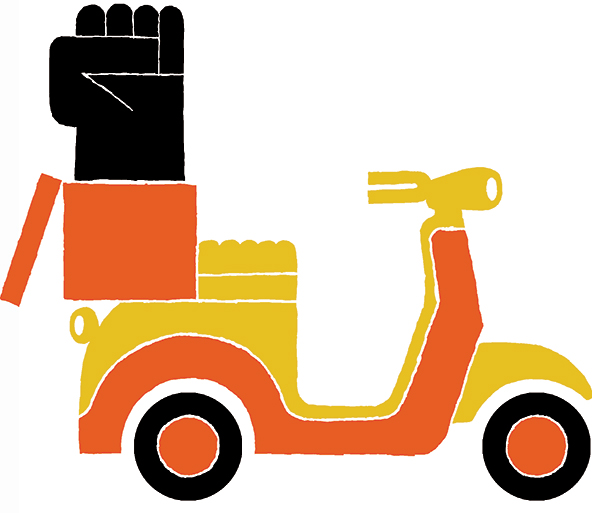
 (Illustration by Adam McCauley)
In Chinese cities, food delivery from restaurants is easy, fashionable, and affordable, with many people, including middle-class families and students, ordering as often as three times each week. On the other side of this equation, of course, is the army of delivery workers deployed by China’s two main delivery companies, Meituan and Ele.me, which together used 5.7 million couriers in 2018. These scooter drivers brave traffic, low wages, and difficult working conditions in exchange for more freedom than they might receive working in factories.
Ya-Wen Lei, an associate professor of sociology at Harvard University, began studying this world when some of the factory workers she’d been interviewing about a Chinese national drive to automate the manufacturing sector quit their jobs to become scooter delivery people.
Workers’ lives in factories and their associated company-run dormitories were hard, so “in the beginning I thought they were happy” delivering takeout meals instead, Wen says. But when she interviewed a former factory worker, she was surprised to hear that he was involved with protests against the delivery platform company where he now worked.
“A lot of workers are very angry with the way platform companies control labor,” Wen says.
The short history of labor unrest among food-delivery workers involves disputes about money and working conditions. When the platforms changed the rules about how much workers would earn for a certain number of deliveries, workers mobilized, leading the companies to back down, at least partially, several times in the last few years, Wen says. In a country where labor rules are generally strict, the government is not as concerned with small gig worker strikes because they don’t threaten social stability. But the sector as a whole is important to the government because it serves as a crucial reservoir to absorb workers displaced from manufacturing as well as other marginal laborers, she says.
With strikes and labor actions rising among China’s food-delivery workers, Wen decided to study the sector, using interviews to understand how exactly workers form connections and launch protests when, in many cases, they essentially work alone, with no colleagues or camaraderie. She compared two types of platforms used by Meituan and Ele.me: service platforms, where delivery workers have a fixed workplace, a workstation, and a supervisor, and work together with others; and gig platforms, where delivery people don’t share an employer or workspace, and a digital platform’s AI assigns deliveries based on location and the worker’s key performance indicators (KPIs). Surprisingly, she found that “it’s the gig workers who go on strike and protest more often, even though they are more atomized and don’t know each other.” Her paper describes how the gig platform’s architecture played a role in workers’ dissatisfaction, because they distrusted the digital platform’s decisions and could not communicate face-to-face with a human manager to complain and seek improvements.
The disgruntled gig workers managed to organize through social media groups where they discussed grievances, Wen found through her interviews. Typically, a core group of four or five workers would become the center of the protesters, often meeting after work for dinner.
Wen found that workers who initiated strikes against delivery platforms tended to have higher incomes and be full-time gig workers; some also had experience in factories, where they learned how to protest. The workers in the nucleus of the protest then recruited 10 or so other workers to conduct street patrols, wreaking violence against non-striking delivery workers or attacking their scooters. They also tried to make common cause with restaurant owners, who are also often unhappy with the fees that the delivery platforms extract to connect customers with restaurants. Some eatery owners give striking workers free food, she found.
Wen’s research methods to understand delivery-worker labor unrest included fieldwork, 68 interviews, ethnographic data, and 87 instances of worker mobilization, including strikes. In addition to elements of technological and algorithmic control, on which scholars publishing in English typically focus when looking at labor issues in the platform economy, Wen considered “legal and organizational aspects of control,” she says. For instance, the workers’ contracts give the platform company the unilateral right to change work rules and fees, which makes the workers’ position precarious and means they have to mobilize to make their voices heard. This becomes especially intolerable for gig workers, who find their rules and fees changed by a digital platform without discussion or explanation.
Mary Gallagher, a political science professor at the University of Michigan, calls Wen’s work “a gold-standard paper for the way it uses different types of analysis.”
The paper’s most important contribution “is to show that these workers in these new industries in the gig economy are able to find ways to build solidarity even when they’re not on the factory floor together, and in fact they may not ever meet in person,” Gallagher says. Although China is more advanced than the United States in how pervasive the gig economy and food-delivery infrastructure are, US companies such as Instacart and DoorDash have similar labor structures, she says: “Employers thought it would be hard to organize, but actually there can be solidarity.”
Ya-Wen Lei, “Delivering Solidarity: Platform Architecture and Collective Contention in China’s Platform Economy,” American Sociological Review, vol. 86, no. 2, 2021, pp. 279-309.
Read more stories by Chana R. Schoenberger.