


 (Illustration by iStock/DKosig)
What do the coronavirus, a nuclear chain reaction, and Alcoholics Anonymous have in common?
At the beginning of 2020, a concept that was once largely confined to epidemiology was released into everyday use: R₀, or the “spread rate.” If R₀ is greater than one, an epidemic spreads; if it’s less than one, it fades out. This concept quickly became central to public policy discussions because it articulated a simple but decisive structural property of the way some processes reinforce themselves over time, and grow, while others gradually die out because they do not. If a case generates more than one additional case on average, growth becomes self-sustaining; if it does not, continued external input is required to maintain the process, or it will diminish to nonexistence.
The same principle appears in other domains; A nuclear chain reaction becomes self-sustaining, for example, only when each reaction triggers more than one additional reaction. The key question is not how much effort or energy exists in the system, but whether the process reproduces itself as it goes.
Most nonprofits operate through a different logic. Resources are raised, services are delivered, and when funding stops, most of the activity stops with it. Of course, nonprofits are not pathogens or physical systems. The analogy should not be pushed too far. Yet it’s worth asking if a comparable dynamic could exist in the social sector, because the social sector often treats very different organizational logics as if they were the same. When sustainability becomes the universal benchmark, leaders and funders can end up making two opposite mistakes at once: continuing to subsidize models that could be designed to renew part of their own growth, and demanding self-sufficiency from organizations whose work should never be judged that way in the first place.
Not every organization should work this way. Many should not. But where such self-propagating growth becomes possible, when it does occur, we would do well to understand how.
This article proposes a simple way to think about that question for nonprofits: the Pay-It-Forward Threshold.
.png)
Real-World Examples
Two-thirds of United States nonprofits that receive government grants could not even cover their own expenses without it, let alone grow, according to the Urban Institute’s recent analysis.
Meanwhile, organizations like Alcoholics Anonymous grew from two founders in 1935 to over two million members, with no centralized leadership or external funding. Without implying that other organizations should necessarily imitate AA wholesale, it’s worth noting that something in its design allows participation to generate further participation. Alcoholics Anonymous is not unique in this respect. Many organizations, in different ways, manage to turn participants into contributors who help extend the system.
The examples below each demonstrate a different mechanism of continuity, collectively answering the question: If impact can sometimes spread through the people reached, what organizational designs make that possible?
- Alcoholics Anonymous: “Therapeutic transmission.” In Alcoholics Anonymous, “stabilized” members help other alcoholics, in part, because doing so supports and maintains their own
sobriety. In this sense, their pay-it-forward contribution is not merely altruistic, but is woven into recovery itself.
The design lesson is straightforward: Continuity is strongest when helping others is not an external burden added after the fact, but part of how the original transformation is maintained.
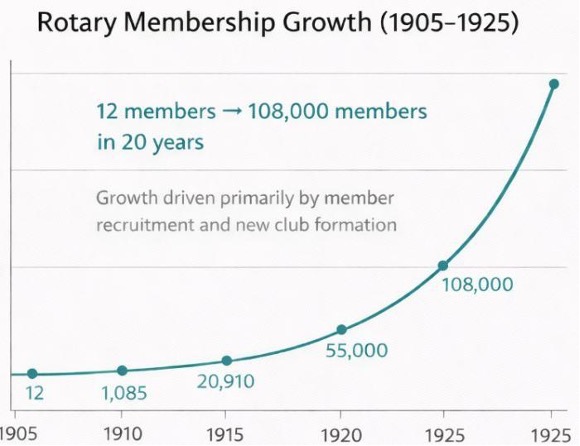
- Rotary International: “Role-embedded social transmission.” Between 1905 and 1925, Rotary grew from 12 members to more than 108,000, corresponding to an average transmission rate of roughly R ≈ 1.58 per year (meaning each generation of participants produced about 1.6 new participants). Rotary grew because the benefits of membership—professional networks, local prestige, civic identity, and regular access to business and community ties—made recruiting others a natural extension of participation. Existing members had a clear reason to invite new ones, and chapters provided a stable social structure that made replication relatively easy. Transmission can be embedded not only in therapy or formal obligation, but also in the social value of belonging.
Rotary also shows how fragile this kind of transmission can be. In many places, its growth slowed as the social role once played by local business clubs weakened: Professional networking moved into other institutions and digital platforms, patterns of civic association changed, and younger professionals often became less willing to commit to the formal routines that had sustained chapter life. The lesson is that social transmission requires continuous maintenance. When the underlying value proposition erodes, the loop can break quietly even when the organization itself remains intact.
- Habitat for Humanity: “Contractual transmission.” Habitat for Humanity helps families access affordable homeownership through a structured model that combines local affiliates, volunteer labor, donated resources, and participant contribution. In many cases, future homeowners are required to contribute substantial “sweat equity,” helping build homes—including those of other families—before receiving their own. The model, therefore, links receiving the good to helping produce it.
The design lesson is that when the good delivered is tangible, and the pathway is clear, contribution can be made a condition of access rather than an optional extra. In such cases, the organization does not have to hope that beneficiaries will later give back, out of the goodness of their hearts: Reciprocity is designed directly into the model.
- Big Brothers Big Sisters: “Depth over transmission.” In Big Brothers Big Sisters, mentors are carefully screened, matched one-to-one with youth, and supported over time through sustained relationships. The program’s model emphasizes selectivity, continuity, and the quality of the match, which makes expansion more demanding than in interventions that can be standardized or replicated more quickly.
The design lesson here is fundamentally different from the previous cases: Some forms of impact are quality-constrained rather than transmission-constrained. In relationship-based interventions like this one, trying to maximize transmission can undermine the very conditions that make the model effective. Low transmission, in such cases, is not a sign of weak design but may be the right organizational choice.
The most common mistake in sustainability debates is to turn one growth logic into a universal standard. The value of the transmissive lens is not that it tells every organization what to become. It’s that it helps distinguish where self-propagating growth may be possible from where continuity must be funded.
In some domains, asking beneficiaries to become the engine of further growth is simply structurally inappropriate. Emergency response is the clearest example: Distributing water after an earthquake has a transmission rate near zero, and trying to raise it would make little sense. The work’s success depends on speed, logistics, and reliable delivery—not on whether recipients later become distributors.
The same often holds for pure redistribution. When an initiative exists to transfer money, food, shelter, or legal protection to people who are structurally deprived of it, the value lies in the transfer itself, not in turning recipients into a growth mechanism. Many other collective-action problems also fall into this category. Efforts to improve air quality, reduce corruption, preserve wetlands, or change procurement rules may create enormous public value while remaining dependent on durable institutions, regulation, and professional coordination.
In such cases, a low transmission rate does not signal weak design. It simply reflects a different organizational logic.
The Pay-It-Forward Framework
Social organizations typically measure inputs and outputs. They track money raised, people served, volunteer hours, or program completion. More rarely, they track the extent to which a system converts beneficiaries into contributors. Yet two organizations can help a similar number of people today while heading toward very different long-term trajectories.
- Some forms of impact are consumptive. External resources are used to deliver a service, the beneficiary benefits, and the organization must raise new resources to do it again. If funding stops, most of the impact stops with it.
- Other forms of impact contain a transmissive dimension. Some participants also become contributors—by mentoring, referring, recruiting, hosting, teaching, or helping others enter the system. Under those conditions, impact can continue or grow without proportional increases in funding. Each former participant becomes a potential channel of recruitment, support, or replication, reducing acquisition costs and extending reach over time, a dynamic reminiscent of Everett Rogers’s Diffusion of Innovations and the epidemiological concept of the basic reproduction number (R₀).
This transmissive potential is not merely theoretical. As Amartya Sen argues in Development as Freedom, development depends on agency, on the capacity of people not only to receive help but to act and shape outcomes themselves. Many social programs observe the same dynamic through the “helper therapy principle,” in which helping others often reinforces one’s own progress. Research on volunteering points in this direction.
When organizational design enables this motivation to translate into action, a simple dynamic emerges: People who were helped begin helping others in turn. If each participant eventually helps two more people, those two help four, four help eight. In such a configuration, the number of beneficiaries doubles each generation, becoming roughly a thousand times larger after ten cycles.
A useful way to track this dynamic is through the transmission rate: The average number of new people each former participant helps reach, recruit, or support. Once that number rises above one, the organization crosses the Pay-It-Forward Threshold.
Suppose a nonprofit runs a six-month job-readiness program for young adults. In one cycle, 1000 participants complete the program and in the next, 1500 do. The next question is simple: How many of those 500 additional participants entered because former participants helped bring them in? If 300 did—by referring friends, encouraging them to apply, helping with onboarding, or mentoring the next cohort—then participant transmission equals 300/1000 = 0.3. The remaining 200 are explained by the organization’s usual funded channels: staff outreach, partnerships, advertising, or recruitment campaigns.
This gives leaders a way not only to observe, but to actively test and improve transmission. Even modest rates matter: A rate of 0.3 already means that 30 percent of growth comes through participants themselves, reducing reliance on external funding.
This is not the only metric every organization should pursue. But where transmission is part of the model, it becomes an unusually important operational signal: actionable, design-sensitive, and exponential in its effects.
(To make this question more practical, we have also created a simple, freely available tool that allows organizations to estimate their own Pay-It-Forward rate.)
What Changes in Practice
For policy makers, the framework offers a way to distinguish between two different evaluation logics. In consumptive domains, the right questions often concern depth of impact and cost-effectiveness per unit of investment. In transmissive domains, one additional question becomes relevant: Is the model increasing its capacity for renewal over time? Applying a single standard to both types of initiatives wastes resources in both directions.
For organizational leaders, the first question is not “How do we maximize transmission?” but “Does our model contain any real transmission potential at all?” In some organizations, the honest answer will be no, or not much. In others, transmission is possible but under-designed. The strategic shift is then to move from asking, “How do we recruit more participants?” to asking, “Under what conditions do existing participants become contributors?”
That change in question leads to more concrete design work. Leaders can examine where the chain most often breaks. Do people benefit from the program but never re-enter it in a contributory role? Does alumni engagement remain symbolic rather than functional? Is there no visible pathway from receiving value to helping deliver it? Are contribution opportunities too vague, too costly, too late, or too detached from the original benefit?
Seen this way, “transmission” is not an abstract aspiration, but a series of design choices: onboarding, peer roles, rituals of handoff, chapter formation, referral pathways, light-touch contribution before high-commitment contribution, and incentives that make participation easier to pass on.
Every other civic club of Rotary's era relied on external outreach, and most are now defunct. Rotary prospered because it made a different design choice: It embedded transmission into the membership experience itself.
For funders, the framework changes what kind of sustainability question it makes sense to ask. Too often, “sustainability” is treated as a uniform criterion. But the relevant question is not simply whether an initiative can survive with less grant support. It is whether the underlying model contains a plausible path of renewal through the people it serves.
Three questions become especially useful. First, does this intervention contain a credible mechanism by which participants or beneficiaries help carry the model forward? Second, what share of current spending supports direct delivery, and what share supports the mechanisms that make renewal possible? Third, can the organization observe signs of renewal from ordinary operational data, even imperfectly?
The funding implications differ accordingly. Consumptive programs may deserve stable long-term support. Transmissive programs require upfront investment to build transmission mechanisms, after which external funding can gradually be replaced by internal renewal.
The point of the Pay-It-Forward Threshold is not to rank one model above the other, but to ask a better strategic question: Under what conditions can impact pass through the people reached rather than ending with them? The answer does not determine the initiative's value, but it determines its appropriate design, its realistic funding trajectory, and the criteria by which it should be evaluated. Not all impact should sustain itself. But when it can, it should be designed to.
Read more stories by Florentin Koch.