


 (Photo by iStock/EyeEm Mobile GmbH)
Sometimes the simplest tools bring the most value. Simply asking “why?” can make or break a new venture or help an established social impact project achieve its goals.
When I teach systems-led leadership to students, organizational leaders, and budding social entrepreneurs, I sometimes take them through a “triple why” activity as a means of surfacing values, root causes, and barriers to their goals. This process takes inspiration from the “five whys” process developed in the 1930s by Sakichi Toyoda as a means of identifying the root cause of mechanical issues. It takes that root cause usage and spreads that line of questioning into different areas: Why do you care about something, why is something happening, and why hasn’t it been solved yet?
You could ask the “whys” three times, five times, two times, 12 times—it’s really up to you! The process is not designed to get to perfect answers but instead to drive future learning and to spark conversations about overlooked assumptions or priorities. Therefore, the exercise is most valuable when done in a team, so people can compare and contrast answers, revealing individual biases, opinions, and hopes in the process. You might choose to do all three questions in a row, focus on the one that your team needs right now, or spread the activity over time. It’s up to you!
Here are the three questions:
Why do I care about this?
This question reveals underlying motivations, values, and goals, and can help reframe action through secondary questions like if those are our motivations, is this work really what would best serve us at this time?
Why is this happening?
This question begins the process of revealing some of the causes of a problem, areas for deeper exploration, or possibilities for problem reframing.
Why haven’t we solved it yet?
This question can be framed to reveal further root causes and external barriers to change, or it can be used to reveal internal systems issues that need to be addressed within an organization or team.
For each question, I ask participants to write down the question, filling in the problem or challenge at hand. For example, if I ask myself the first question, I might write it as: Why do I care about teaching systems-led leadership?
Below that, I write the first answer that comes to mind: Because I care about helping people find their path to high-impact careers.
Then we can ask Why? a second time about that answer, so in this case the question becomes Why do I care about helping people find their path to high-impact careers? And now I come up with a new answer for that, Because I want our most bright and values-driven leaders to use their gifts to contribute to shifting unhealthy systems results.
Finally, we ask again (or again and again), And why do you care about that?
If I have done this process with a team, when we have answered at least three layers of the same question, we pause and share our list of three answers with our colleagues.
That might be all the inspiration you need to try this out, but for those who want to dig deeper into each question, let’s explore some example answers and the potential value each question can bring.
Three whys, three different questions. Simple, yet often surprising in result.
Why Do I Care About This?
First, we have to define what we mean by “this.” For this first question, the “this” can be one of two things: It can be a problem or unsatisfactory system’s result that you are wanting to understand, or it can be the work, project, or activity you are doing, or thinking of doing.
In other words, you might be asking a question about an issue area, like “Why do I care about recidivism?” Or you might be asking a question about some current or future action, “Why do I care about our organization’s training program for recently incarcerated people?”
Either question will surface the particular motivations and interests of those answering. If you choose the first option, a topic or issue, like recidivism, you can use that same issue for the next two questions: “Why is recidivism happening?” and “Why haven’t we solved recidivism yet?”
Sometimes people are unsure of or don’t collectively agree on the “problem” that is underneath their work, or their work has many potential impacts in many different areas. In that case, you might simply want to start with the work as the “this” and see what surfaces.
In our certificate program class at Dartmouth College, Katherine Milligan and I took students through a system mapping process around a topic of their choosing. The process of mapping out a system might feel sterile, such as simply exploring power dynamics or learning how to map causal loops. In one of our cohorts, before we dug further, we sat in a circle and I simply asked, “Why do you care about this?” Each person answered, many being vulnerable enough to share personal or familial stories relating to the topic. Immediately, the energy in the room changed, and the rest of the workshop took on more gravity. This was no longer simply a mapping process: It was important work that deeply mattered to people.
Asking “Why do you care about this?” can change the energy in your room too, or in your partnerships or teams. Answering honestly brings our unique humanity into the room, turning a work or research project from a task to something of value to ourselves and others. Even for me as a facilitator in that Dartmouth cohort, or perhaps for those who had picked their topic with less intention, listening to the answers to this question still gave the mapping process more importance, as I could now see that it mattered to people I cared about.
Once the “this” is defined, it’s time to dig into the first why question. I ask each person to work on their own piece of paper and sit separately so they can’t see each other’s answers. I ask each person to think about the focus area they or their team are working on or researching. Why do you care about that? Readers might pause and do this themselves now: Really, why do I care about the work I am doing or the topic I am focused on? What is motivating me? Why does it matter to me?
If your answer is “it doesn’t,” then you also have fodder to work with when designing your life path, organizational strategy, or project plans from here.
*Disclaimer: Getting to do work that is focused on social impact is of course a privilege, as many have no choice but to do their work to provide for themselves and those they love. As I am usually using these tools with social impact organizations, I am usually asking these questions of people working on systems change or for some form of social or environmental impact. I use these questions in these ways, as that is the area I personally care about, and I am privileged to get to do work that is aligned with my values and contributes to changes I want to see in the world. That said, these questions might be just as valuable in other kinds of work. For example, your team might be building a new website for your company and you might be asking “Why do I care about building a new website? Why is our old website not living up to its potential? Why haven’t we gotten a new website yet?”
Let’s look at an example. A few years ago, some students in a class I was teaching were exploring the problem of the lack of green spaces in a major US city. Their three different sets of answers looked something like this:
Why do you care about (providing more access to green spaces in this community)?
Team member 1:
- I care about this because I believe everyone should have access to green spaces that enrich their lives and provide a place to connect to nature.
- I care about that because historically certain populations have been systematically restricted from access to green spaces while other populations have generally had more access, and I want to support access to green spaces for low-income and racially diverse populations.
- I care about that because I care about equity and access issues, and I am committed to tackling racism.
Team member 2:
- I care about access to green spaces because I know that green spaces are good for our mental health.
- I care about that because I know many young people who are suffering from mental health crises, and I want more access to green spaces as a support for those suffering.
- I care about that because our communities, economies, and country will not thrive if the mental health crisis gets worse.
Team member 3:
- I care about access to green spaces because I want my nieces and nephews, and all the other kids in our community, to have places to play and connect with nature.
- I care about that because I know access to nature and time in nature is an important part of falling in love with nature, which is a necessary component of becoming environmentally active.
- I care about that because we are in an environmental crisis, and we need young people to fall in love with nature so they can be active in protecting it.
These three team members had come together to work on access to green spaces in the same community, even though their underlying motivations are wholly different. Surfacing these different underlying motivations early in the process of their work together can help them align on shared goals, and it can also help them see where potential conflicts may arise. Even if you are years or decades into a project, surfacing different motivations or different problem definitions between departments, partners, or leaders can be a valuable pause point, bringing more transparency to the underlying mental models in the system.
For example, what if this team started their work on green spaces and along came an opportunity to support the construction or preservation of a space in a wealthier community that has always had access to nature as a resource but also has an average or high amount of mental health needs. Would the person motivated primarily by equity be okay with using limited resources in this way? Surfacing these potentially conflicting priorities can bring important conversations to the surface before conflict arises.
I previously used this means of surfacing differences in the hope of working towards alignment, but the “Shared Work Model” by Tuesday Rivera and Tim Merry, facilitators and consultants who help organizations get “unstuck,” is shifting my mindset. Their shared work model helps diverse groups of individuals or collaborations of multiple partners rethink the idea of alignment. “In order to do shared work together, we don’t all need to have the same underlying motivations,” shares Rivera. “If we put our underlying motivations in the center, we might never find alignment and instead spend our time competing for prioritization of those deeper goals. In contrast, we invite groups to put the work they want to do together in the middle. If the group can define this shared work in a way where each team member or partner sees how that work aligns with their individual or unique underlying motivations, we can find enough coherence to develop strategies and get to work on them quickly. In this way, shared work becomes the aligning principle.”
Sometimes, simply asking someone to reflect on “Why do I care about this?” can help an individual or team realign their priorities and their plans. Other times, people simply realize, “I don’t actually!” Either way, the answers reveal further questions to consider with regards to how to move forward.
Why Is This Happening?
The “this” for these next two questions needs to be a problem, or something you are trying to overcome or shift, in order for the questioning to bring the most value. Therefore, avoid putting your solution or intervention idea as the “this” and instead define the problem or unsatisfactory result that is motivating your action. For example, instead of saying, “Why do I care about bringing arts into classrooms?” as that is your “solution” idea, try to find the issue underneath that. What is a problem or a current unsatisfactory system result that is motivating you to want to bring arts into the classroom?
One way to think of this is to imagine you are taking a snapshot in time of the current system and defining a result of that system that you would like to see changed. The underlying unsatisfactory results might be things like “unsatisfactory health outcomes in our community” or “lack of transparency with regards to government action,” or any number of things you care about. Just this part alone of defining the problem can be a valuable activity for a group. Sometimes people realize they are trying to do something, or sell something, and they don’t really know what problem it might be solving. Or sometimes teams realize they all define the problem differently.
Moving forward with this second Why? question takes you into the more commonly used “Five Whys” process. Asking “Why is this happening?” can kick off a root cause analysis process where you look at multiple causes of a problem. Asking why something is happening, and then digging deeper, can sometimes reveal that the “problem” you thought was the problem is actually just a symptom of something, or many somethings, deeper.
Exploring deeper symptoms of a problem is something that led Doctor Vera Cordeiro to found her award-winning work at Instituto Dara. When Doctor Cordeiro was a hospital physician, she noticed that some kids would come in with an illness, get medicine, and a few weeks later come back with the same issue or a new one, over and over. She realized the hospital was only looking at the health indicators in the patients, but that the root causes of these systemic problems were considered outside the health domain.
Doctor Cordeiro wanted to understand what was contributing to these problems, so she set up a clinic across the street from the hospital and invited those families with repeat visits to go across the street and speak with someone there who would ask questions to more deeply understand the problem. In the hospital, the doctors might only hear one part of the story, “Our son keeps getting respiratory issues,” while in the clinic they would also listen for “and we have a hole in our roof that is leaking into his room.” They would hear of people not working or not having their kids registered in school due to lack of legal resident paperwork or any number of other factors, which might have gone overlooked by a narrow health-care lens. The social workers could then point the parents to resources beyond medicine: a local organization that might help with the roof or a legal aid group providing support for new migrants.
David Snowden, founder of the Cynefin Framework, a framework for understanding complexity, says, “There is a reality on the cognitive science front that we assess a situation based on how we have already decided to act.” In the hospital, they had already decided to act with medicine and medical procedures, so they were only assessing the situation with that in mind. Asking why and digging deeper helps reframe a problem and, when you are open to a wider range of possible interventions, it provides a chance to reframe strategy.
With this question, we start the process the same way as with the last question, by asking each team member to write down three levels of answers to the question, “Why is this happening?” Someone doing work in a hospital setting similar to what Doctor Cordeiro was facing might have answers like this:
Why is the problem of so many repeat visits from some families at our hospital happening?
Possible answers:
- Our clients are facing many additional problems that are leading to their negative health indicators.
- We are working in a low-income area and access to the hospital is available, but other resources might not be.
- Many people living in our area don’t have legal paperwork to access other support resources.
Or they might have said these possible answers:
- We have a prevalence of (insert contagious health conditions) in our community so people are getting repeatedly exposed.
- Many don’t have access to the medicines they need.
- Low-income people, in order to preserve resources, don’t come into the hospital until they are very ill and by then it’s hard to deal with the issue.
Or someone might dig into some systems-level factors rather than individual outcomes by answering:
- The public health system in our country is under-resourced and wait times for preventative care are exorbitant, so wealthy people seek paid treatment, leaving only the poor to rely on this public care.
- Current and recent administrations haven’t had the will to address this.
- Many key corporate political funders benefit from the status quo.
These things might all be true, and we can see that different lines of responses reveal not only different potential root causes of the initial problem but also the biases and perspective of the person answering.
One thing to keep in mind is this isn’t intended to be a research activity, where people add references and data to back up their opinions. In complexity there is never one root cause (like a tree doesn’t have one main root), nor is there a way to ever map out or know all of the contributing factors to a complex problem, so the goal of this exercise is not to get it “right” and combine the answers into a root cause diagram. Instead, this quick process is meant to unearth further questions, like: Which of these contributing factors do we know to be important, and how? Which of these are assumptions? What else might we be overlooking? What, if any, research questions do we want to pursue further? What guidance might this provide with regards to how we might try to probe the system and try to contribute to a shift?
Why Haven’t We Solved This Yet?
The final question series of this simple process—why haven’t we solved this yet?—can continue to reveal wider systems-level drivers of the problem as well as barriers to change.
When I start my class, I often borrow an activity from John Kania, a prolific SSIR contributor and executive director of the Collective Change Lab. Having watched Kania do this himself, I now ask my students to quickly give me at least 20 answers to “Why haven’t we solved our environmental problems yet?”
They typically share answers like “because our policies are short term,” “because we can’t agree on the problem,” or “because the people most impacted aren’t the people in power.” Someone also inevitably shouts out “capitalism!” or “the patriarchy!” jumping quickly into underlying paradigms.
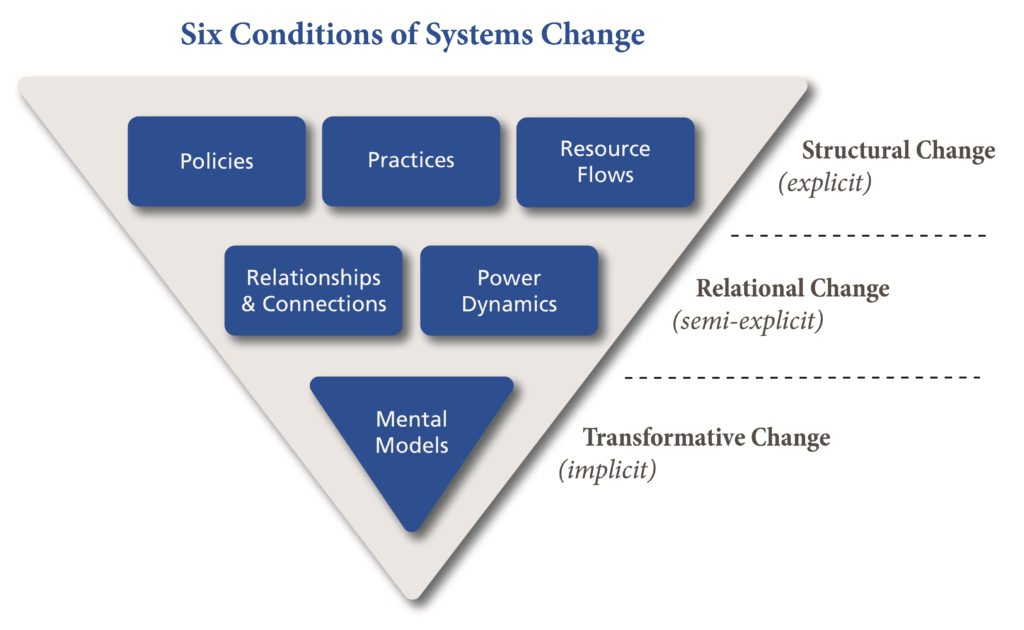
Unbeknownst to the participants, as they are answering, I am grouping their answers into a pyramid on the board that roughly matches this “Six Conditions of Systems Change” model Kania and his team at FSG created in their report, “The Water of Systems Change”:
 (Illustration by FSG)
The groups’ answers almost always fit into one of those six conditions, or they are a general definition of a complex system, such as “because it’s complex and hard to understand” or “because it’s interconnected to so many things.” Once they have paused their stream of answers, I introduce the six conditions framework, and we explore how their brainstorm has revealed some systems dynamics, such as those relating to power, relationships, and mental models, and how these dynamics hold the current system results in place. The conditions holding a system in place are also areas of potential leverage points to create change.
If I am working with a more well-established organization, I might use the why haven’t we solved this yet? question very differently. I might ask each individual on a team to answer “why haven’t we solved it yet?” in the frame of “what is holding our organization back from solving this?” Once again, I’d ask them to take their answers deeper and ask the question at least three times.
What is often revealed in these cases are internal systems that are holding back change. The answers might be things like “because people at the management level don’t realize how big this problem or opportunity is,” or “because we have allocated our budget towards other things,” or “because it doesn’t fit our current KPI structure.”
Just a reminder: The point of this quick process isn’t to get the answers “right.” It’s about starting a conversation, revealing different opinions, and asking even better follow-up questions. For example, Why do you think this problem isn’t a priority for the management team? What would it look like if we were really prioritizing this issue? What would we start, stop, or change in how we operate if we prioritized this and is there a competing priority we’d need to adjust to do that?
The FSG model of the six conditions still applies even in internal systems: It’s the internal structures, processes, power dynamics, relationships, mental models, etc. that are leading the internal system of that organization to have results which overlook or poorly address this problem. By digging deeper into the internal systems of our organizations or the wider systems of our world, we can identify what levers might be possible to contribute to change.
Three whys. Three times each. Pretty simple, yet if we really dig into those questions, discuss them with our teams, and ask ourselves what they reveal about where we are focusing our energy and what we want to contribute to changing in the future, these “whys” can help us shift the unsatisfactory system results in the areas we care about most.
Read more stories by Daniela Papi-Thornton.