


 (Illustration by iStock/Yutthana Gaetgeaw)
What happens when philanthropy clings to the familiar during moments of disruption?
In 2020, the COVID-19 pandemic upended global food supply systems; farms lost workers, processing plants shut down, and border closures disrupted shipments. In the United States, funders largely focused on stabilizing access—supporting food banks, mutual aid groups, and mobile pantries, and offering small grants to local producers. These efforts were vital, but once the crisis eased, the food system largely snapped back to its earlier form, leaving inequities intact. Low-income communities continued to face unreliable access to affordable, healthy food, and small farmers remained in a precarious economic position while large suppliers quickly rebounded.
However, elsewhere in countries such as France, Italy, Argentina, and Spain, philanthropy—often working alongside policy makers and advocates—used the disruption to strengthen local food systems. Funders supported producer networks and advocacy groups, and helped expand programs that purchased food directly from nearby farms for schools and hospitals. These efforts introduced new practices that have lasted beyond the crisis, including stronger local markets and institutional procurement from community-based producers. Where these shifts took hold, food systems became more resilient and, in some cases, more equitable—providing local farmers with steadier markets and families with more reliable access to healthy, culturally relevant food.
This systemic response illustrates how philanthropic organizations and their partners can view disruption not as a detour but as an opportunity to create new norms and systems that promise a better future. Systemic disruptions driven by natural disasters, disease, conflict, and political instability are increasingly common. Yet funders often freeze in the face of uncertainty, and those that act quickly usually focus on filling gaps. Even funders committed to systems-level change tend to prioritize a return to “normal,” partly because philanthropy tends to view risk through the lens of compliance and reputation rather than missed opportunities. Yet choosing not to fund structural change for fear of missteps—whether through inaction or only temporarily filling a gap—is still an exercise of power, just one that maintains the status quo.
Instead of bouncing back, philanthropy must learn to bounce forward. By shifting mindsets, sharing power, and acting boldly, more funders can use disruption as a portal for deeper, lasting change.
Opportunity Within Fragile Systems
Major disruptions can result in fragile systems that are either struggling or outright collapsing. For example, the US child care system—a fragmented mix of federally funded programs like Head Start, state preschool, and a patchwork of private centers and home-based care—remains operational as of August 2025 despite rapid political shifts, but it has been wracked by defunding threats and restrictions on equity-related work, as well as steep staffing losses and regional office closures. As such, it represents a struggling system that can deliver its essential functions but has experienced major shocks.
Meanwhile, in some countries, independent journalism reflects a system in collapse. In Ukraine, for example, the withdrawal of USAID dollars has forced important journalism outlets to suspend their work to provide people with accurate, reliable, and contextually rich information, and hold power accountable. Disruptions like this can trigger a system to collapse, but the underlying cause is often the culmination of long-term neglect and structural decline.
Both types of systems are vulnerable to continued turmoil, but their fragility also opens them up to positive influence and change. In times of disruption, power dynamics shift, institutional norms loosen, and long-standing barriers often fall away, creating opportunities to strategically shift the system or even redesign it toward more equitable outcomes.
Three Strategies for ‘Bouncing Forward’
Philanthropy can use disruption as a springboard for change, but it can only do so if it adopts new practices. The James Irvine Foundation’s Fair Work initiative provides an example. Fair Work supported the creation of the California Strategic Enforcement Partnership, a collaboration between 14 worker rights organizations, the National Employment Law Project, and the California Labor Commissioner’s Office (the state agency responsible for enforcing labor and employment laws). The partnership was designed to combat wage theft—a widespread problem in California and other states where employers fail to pay workers the wages and benefits they legally owe them—and to strengthen the broader system of worker protections that enforce fair wages, safe conditions, and equitable treatment on the job.
As with food systems, COVID-19 threw wage theft protection into turmoil. The California Labor Commissioner’s Office halted in-person hearings for more than a year and a half, while pandemic restrictions and fear of infection made worksite inspections and traditional outreach methods impossible. Health and safety concerns became the priority for front-line workers. At the same time, racial justice uprisings heightened awareness of inequities in frontline workforces—many of which included Black, Latino, or immigrant workers—and underscored the need to address worker protection as part of broader racial justice.
These developments shook the foundations of the worker protection system so that it could no longer continue as it had before. Rather than trying to restart hearings and inspections, partners turned disruption into an opportunity to move forward. Three strategies in particular made it possible to address immediate health and safety concerns, strengthen the capacity of local community organizations, and set the stage for longer-term structural change.
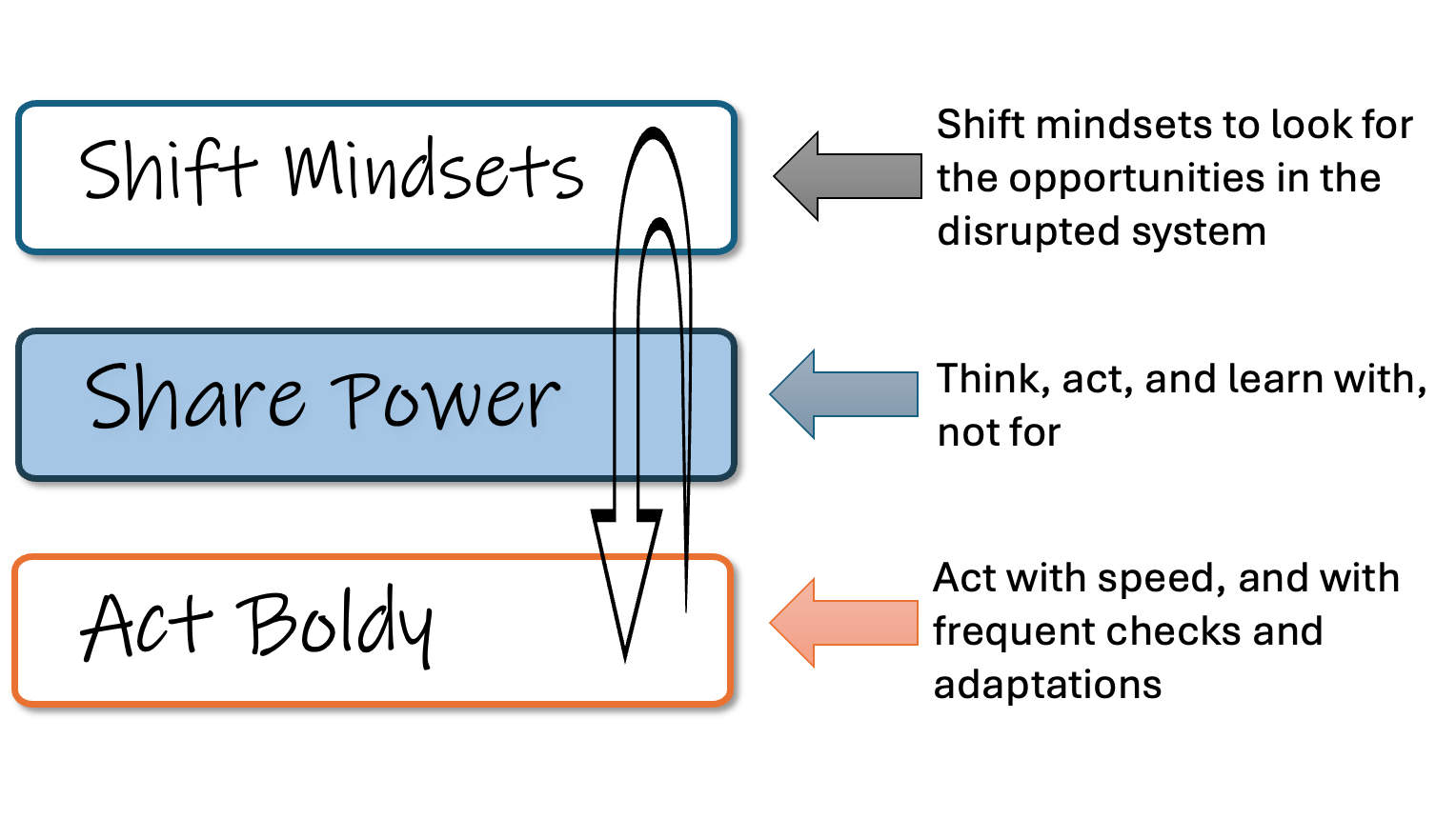 Three strategies that can help funders use moments of disruption to advance systems change. (Image by Jewlya Lynn)
1. Shift Mindsets: From Crisis Response to Strategic Opportunity
Disruption often generates confusion. Fragmented information, overwhelmed institutions, and shifting narratives can cause philanthropy to default to short-term fixes. But these moments can also serve as inflection points. Visions for change that once seemed out of reach may become newly viable. Philanthropy can surface these openings through listening, analysis, and trust in the people and organizations on the front lines, exploring questions such as: What is broken in the system that creates a sense of urgency? Who is feeling that urgency? What future vision, and what concrete changes, might be possible now that were not before?
Californian worker rights organizations had long pressed for proactive worker and employer education to prevent wage theft and other violations before they occurred. Yet until 2020 enforcement within the state system was primarily reactive; legal bodies could pursue restitution only after employers violated regulations. When the pandemic shifted the public spotlight to essential workers and a growing narrative about the importance of safety for both workers and the broader public, government agencies became more open to prevention. Agency workers and their community partners began to explore questions like, “What would it take to prevent harm before it occurs, not just respond afterward?” That shift in mindset opened the door to new strategies.
2. Share Power: Let Communities Guide Direction and Decision Making
As many funders are well aware, the best strategies emerge when the people closest to a social problem help define the solution. In the midst of disruption, philanthropy must actively support—not direct—community-led visioning and action. Some funders will have existing relationships and spaces to lean into during these moments. Others would do better to partner with local organizations or other funders that are more connected to the community, rather than trying to build new relationships and trust amid turmoil.
In the case of Fair Work, the initiative supported an array of worker rights organizations and legal aid providers deeply embedded in communities, including those in the California Strategic Enforcement Partnership. These organizations understood both the vulnerabilities of workers in low-wage industries and the limits of state enforcement. When the pandemic delayed hearings and judgments, the James Irvine Foundation faced a choice: It could reinforce Fair Work’s original focus on wage theft and enforcement through legal processes, or it could listen to its front-line partners. It chose the latter.
During one-to-one calls and strategic group dialogues across grantees, community partners emphasized that, given the pandemic’s disruptions, the most urgent priority was protecting workers’ health and safety, and preventing harm before it occurred. Rather than imposing its own plan or trying to retrofit old strategies, the foundation recognized the opportunity to support emerging needs and new solutions, educating workers and employers around COVID-19 safety issues and reframing rights education as a proactive, community-led prevention strategy.
3. Act Boldly: Fund Systemic Change, Not Just Stopgaps
In moments of disruption, bold action means moving beyond emergency relief and toward long-term structural shifts. Philanthropy can fund community-led strategies that help recalibrate systems, and offer flexible, timely resources that support realignment around new strategies. It can also act directly, whether using influence to inform policy discussions, supporting communication tools to advance a new vision, or working with other funders to coordinate efforts.
Acting boldly doesn’t usually mean staying the course; system change during disruption rarely goes according to plan. Philanthropy must be ready to listen, learn, and adjust course by building feedback loops. Holding back some funds can also help ensure resources are available when plans need to change.
In 2021, California formally funded community organizations as front-line partners in labor education and enforcement for the first time via the state’s COVID Worker Outreach Project. The project enabled more than 60 community-based organizations to deliver timely information about COVID-19 health and safety. What began as an emergency response quickly grew, ultimately reaching nearly 5 million educational interactions with workers across California. Community-based organizations conducted outreach in 46 languages—including Spanish, Chinese, Punjabi, Vietnamese, and Tagalog—and focused on sectors with high concentrations of low-wage workers, such as agriculture, food processing, and janitorial services.
Leading up to the launch of the project, The James Irvine Foundation convened and connected community organizations, state agencies, researchers, and advocates with the aim of transforming a rapid response into durable infrastructure. With continued community advocacy and demonstrated success, the project ultimately evolved into the California Workplace Outreach Program, now a cornerstone of the state’s worker protection infrastructure. It has expanded beyond pandemic-related education to address other systemic labor issues, and now represents a long-term investment of more than $79 million in community-based infrastructure, with 85 organizations reaching workers in nearly every county.
Getting Ready
Intentionally or not, the James Irvine Foundation laid some groundwork for responding to disruption before COVID-19 began. It adopted strategies such as providing multi-year, unrestricted grants to some partners; funding capacity building for its grantees; and establishing mechanisms for flexible and rapid funding in times of crisis. It also shifted the role of some program officers from grants management to systems conveners and collaborators who worked closely with grantees to understand and influence systemic change. And it steadily invested in systems knowledge. The Fair Work initiative, for example, included external evaluation and learning efforts, and brought grantees and state partners together virtually and in person to make sense of insights.
Other ways to build systems knowledge include supporting systems mapping, using foresight thinking to anticipate disruptions and stress-test strategies, regularly meeting with partners to discuss how the system is changing and why, and using evaluations to learn about grantmaking impact and the systemic context. For Irvine, this means continuing to fund community-based infrastructure and embedding flexibility into its strategies so that the system can respond not only to future disruptions but also to ongoing challenges in worker protection.
Every disruption reveals both cracks in existing systems and the seeds of something better. Philanthropy’s responsibility isn’t to restore what was, but to ask what could be—and to prepare accordingly. That means building the capacity, relationships, and reflexes to respond with purpose when the next disruption arrives.
Read more stories by Jewlya Lynn & Clare Nolan.