


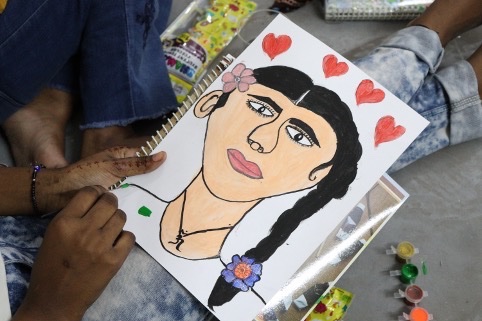
 (Photo by Jannat Hussain)
A young girl participating in a Protsahan India Foundation program paints a striking version of herself adorned with hearts; her braid is neatly tied with pink and blue flowers, her eyes are sharp, and she’s not smiling. In this moment, she’s not just creating art; she’s reclaiming how she sees herself, on her own terms, in her own power.
At Protsahan India Foundation, creating art isn’t an extracurricular activity; it’s survival. Within the urban slums of Delhi, teenage girls pick up brushes not just to paint but to reclaim their own stories. They look to the fierce beauty of Mexican artist Frida Kahlo and the resolution and resilience of Indian teachers and social reformers Savitribai Phule and Fatima Sheikh not as icons but as mirrors.
“When I met Frida on the canvas ... something in me opened” shares 17-year-old Deepa. “She didn’t hide her face. She didn’t wait to be approved. And for the first time, I thought maybe I don’t need to be approved … Maybe I can be a little messy, a little unsure ... and still be whole.”
Deepa is one of a number of migrant girls aged 15 to 18 who have participated in Protsahan’s storytelling and art workshops. Within these feminist spaces, trauma-informed facilitators and artists introduce girls to self-expression and self-reflection as a way to challenge social norms governing women’s relationships with their bodies, politics, and identity.
A typical session begins with a short, interactive lesson introducing the feminist women icons through archival photographs, short YouTube films, artwork, and storytelling. Facilitators then guide the girls through reflective conversations on topics like: “What is beauty, and who gets to define it?” “How does our body carry memories of caste, control, or care?” “What parts of your identity do people ignore or erase?” “If you could paint your truth boldly, what would it look like?”
Following these discussions, session leaders offer the girls paint, paper, mirrors, and time, often surrounded by music or poetry, to craft self-portraits that speak to their lived truths. The focus is not on artistic technique or perfection; the process is about emotional release and finding strength, resilience, and hope. Indian and Mexican cultures converge as girls are invited to blend Kahlo’s magical realism with India’s traditional folk artforms like Madhubani painting and Kalamkari textile printing. A self-affirming unibrow meets a bindi. The result is a redefinition of girlhood in India: unflinching, unapologetic, and free.
This approach is rooted in the globally recognized, trauma-informed H.E.A.R.T. model developed by Protsahan, which is based on the tenets of health (in particular, neuroscience), education, art, rights, and technology. For girls who have experienced intergenerational violence and systemic exclusion, art offers a radical pedagogy for exploring personal and collective wounds and building strategies for self-leadership. When a girl paints herself holding a book written about Phule’s life story or honing Kahlo’s unibrow, she has the opportunity to take back her power and shift her world just a little closer to healing, self-love, and justice.
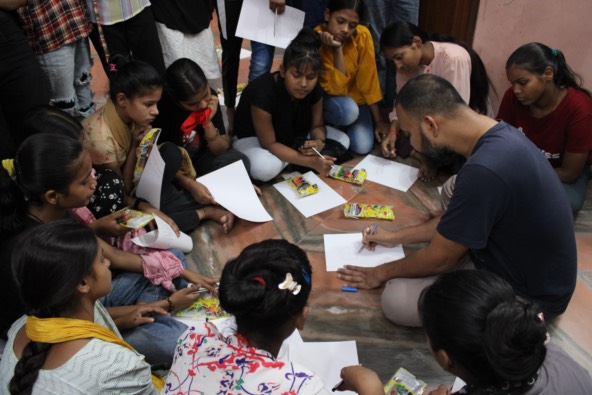 (Photo by Jannat Hussain)
A visual artist invites adolescent girls from migrant communities to explore self-expression through lines, colors, and conversation. Here, art is not the end product; it’s a deeply reflective process of building voice, confidence, and agency.
 (Photo by Jannat Hussain)
A young migrant girl creates a self-portrait, with blue tears and a question mark emerging from her head, during a trauma-informed art session to help process verbal bullying related to her body size and caste. The artwork shows a girl cloaked in black, blue tears on her face, and a question mark emerging from her head—reflecting inner conflict and resilience.
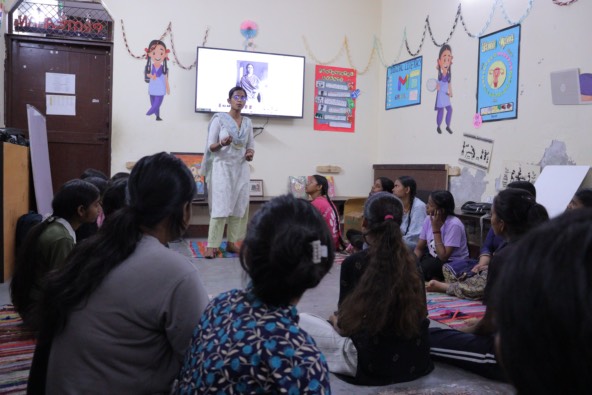 (Photo by Varsha Sahu)
A trauma-informed social worker with lived experience conducts a workshop with adolescent migrant girls focused on healing, self-expression, and leadership development through the life story of Frida Kahlo.
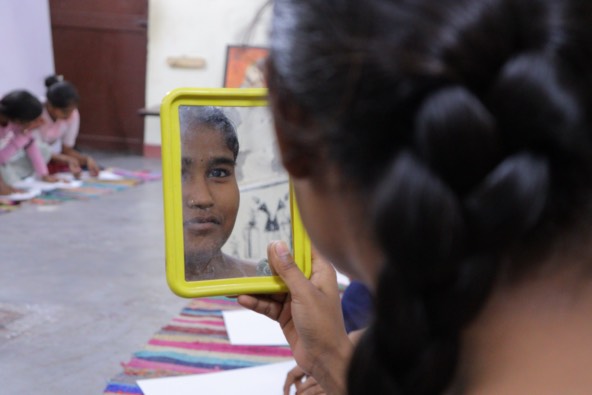 (Photo by Varsha Sahu)
A young girl looks into a mirror during a workshop on self-affirmation and mental well-being. She repeats the phrase “तुम अपने आप में काफ़ी हो” (“You are enough, just as you are”) as part of a guided exercise to build self-respect and confidence.
Read more stories by Sonal Kapoor.