


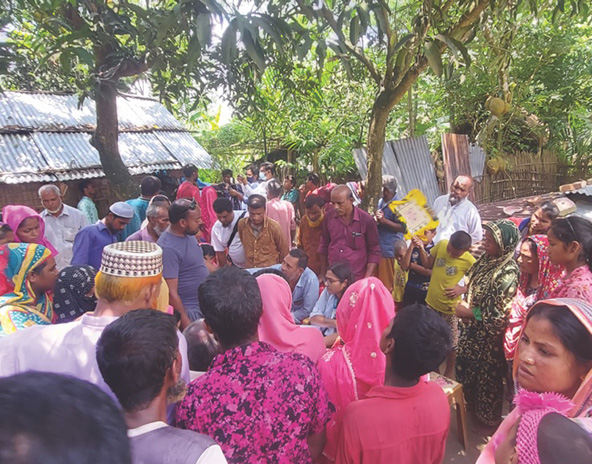
 In July 2023, after reuniting a man with his family in the Jhargram village of Bangladesh, Dr. Swarali Kondwilkar (seated in the center) held a two-day camp for the community, offering free psychiatric consultations to locals and debunking myths around mental illness. (Photo courtesy of Nitish Sharma)
Social workers found Gangadhar Vinode on the streets of Mumbai in 1989. The teenager appeared emaciated through his tattered clothes. The bones in his leg were broken. The social workers took the 18-year-old to their shelter in suburban Mumbai, and soon after, a visiting psychiatrist, Bharat Vatwani, moved him to his recovery center, Shraddha Rehabilitation Foundation. Following his treatment for schizophrenia, the boy began to heal. As details of his identity emerged, Vatwani drove him to the western Indian city of Pune and reunited him with his family—three months after he had gone missing.
“I was on my way home from a wrestling camp in Kolhapur [142 miles from Pune], but I never got off the bus and landed on the streets of Mumbai instead,” recalls Vinode, now a 52-year-old real estate developer. “When they found me, I did not know where I was, how I fractured my leg, or how I survived on the streets. I still don’t know what happened to me on that bus.”
Vinode is one of the more than 10,500 mentally disabled wanderers in India who, thanks to Shraddha Rehabilitation Foundation, have been rescued from the streets, treated, and reunited with their families. What began in 1988 as a nursing home run out of a two-room tenement in Mumbai has become a nonprofit that manages a 120-bed facility located on 6.5 acres in Karjat, 42 miles from Mumbai. In 2018, Vatwani was awarded the Ramon Magsaysay Award for his “tremendous courage and healing compassion in embracing India’s mentally afflicted destitute, and his steadfast and magnanimous dedication to the work of restoring and affirming the human dignity of even the most ostracized in our midst.”
About 200 million Indians live with mental illness, yet India spends only 1 percent of its health budget on mental health. The country also suffers from a severe deficit of mental health professionals: It has only 0.3 psychiatrists per 100,000 people, compared with more than 6.6 psychiatrists per 100,000 people in Western countries. Leading Indian psychiatrist Dayal Mirchandani says that in addition to those who wander from their homes, “people with mental health conditions are often abandoned by their families, left in the streets and hospitals, because of the entrenched societal stigma against mental illness.” According to the last census in 2011, India had about 1.7 million wandering or unhoused persons, nearly 50 percent of whom were likely to have a mental illness.
Vatwani founded Shraddha after an encounter with a schizophrenic person just over 37 years ago. The doctor was at a Mumbai restaurant with his wife, also a psychiatrist, when he noticed a young man scooping dirty water from a nearby gutter. Vatwani approached him as the famished and disheveled youth gulped the water down. The couple took the man to their privately owned nursing home and treated him for schizophrenia. Days later, Vatwani learned that the youth was a college graduate but was consumed by mental illness, driving him to Mumbai’s streets. About two months after his rescue, Vatwani reunited the youth with his family in the southern Indian state of Andhra Pradesh.
“Mental illness can reduce a person to inhumane conditions. After meeting that youth, [my wife and I] realized that there was no organization dealing with such people in India,” Vatwani says of establishing Shraddha not long after helping the young man. Today, the nonprofit has expanded from its humble beginnings operated solely by the Vatwanis to a full-scale organization with five trustees, four psychiatrists, 16 social workers with postgraduate degrees, 13 part-time staff, 12 nurses, two accountants, two ambulance drivers, and two cooks.
Rescue, Reunite, Reeducate
Shraddha pursues its mission in three ways: rescue and treatment, reunion with family and/or community, and workshops to raise awareness about mental illness.
Hospitals across the country transfer their patients to Shraddha, and tipsters, police officers, and other nonprofit organizations also routinely inform the foundation about wanderers. After receiving this information, a medical team of doctors and nurses from Shraddha take the foundation’s ambulance to rescue the person. If the patient is based at a government-run organization or nonprofit in a different city, they’re transferred to Shraddha via train.
Over the years, the foundation has facilitated reunions across all Indian states, as well as some international ones.
The medical staff’s job is not always easy. At times, patients get aggressive during their rescue, some have physical injuries that delay and/or restrict psychiatric treatment, and some speak only in Indigenous dialects. Furthermore, doctors do not have access to patients’ medical histories, making effective treatment more challenging.
When patients arrive, doctors attend to their medical needs before treating them for psychiatric ailments, says Swarali Kondwilkar, one of Shraddha’s four psychiatrists. Once patients begin to recover, the doctors initiate the second phase of the program by asking about their identity—their name, names of their family members and that of their village or city, their school, and the festivals they celebrated as children, among other questions. Shraddha’s social workers, who hail from every state in India and who speak a variety of languages and dialects, help identify the patients’ villages, towns, and cities.
Over the years, the foundation has facilitated reunions across all Indian states, as well as some international ones. However, in about 1 in 10 cases, families have been reluctant to receive their kin, largely due to the patient’s history of violence or harmful behavior. Kondwilkar says that on such occasions, they counsel the families about mental illnesses, and more often than not, empathy prevails and the family accepts their relative.
“We use [the reunion] opportunities to create awareness about mental health,” says Kondwilkar, speaking of the third phase of the program. She recalls an instance when, after reuniting a man with his family in Bangladesh, several locals in nearby villages approached her for help, telling of mental illness in their families. In response, she held a two-day camp for the community, offering free psychiatric consultations and debunking myths around mental illness.
Shraddha is funded by individual donors, government organizations like General Insurance Corporation of India, and nongovernmental organizations like the Shree Babulnath Mandir Charities and the Sir Ness Wadia Foundation. Former patients and their families, too, contribute. For instance, in 2014, a man donated 120,000 (US $1,437) after the organization reunited his brother with the family. In a letter to the organization, he wrote, “Our family was in despair. Each day of his absence was difficult to bear. Your kindness, caring, and effort to ensure his safe return was so great and so overwhelming that it [left] us speechless.”
Combating Stigma and Discrimination
Shraddha confronted challenges from the moment it officially registered as a nonprofit in 1991, from court cases to difficulties in reuniting patients with their families. For instance, that year, a woman and her 5-year-old child arrived into Vatwani’s care after the woman was found cradling a second child who was dead and putrefying in her arms. “Her mental illness had nullified her senses so much that she had neglected the child’s very basic feeding needs,” Vatwani recalls. Once her health improved over a few months, the woman told Vatwani that she was from Baroda, a city in the western Indian state of Gujarat. He drove her to Baroda, but no one recognized her. Unable to locate her family, the woman and her child continue to reside at Shraddha today.
The experience, Vatwani says, “brought me face-to-face with the reality that women in rural India are often so illiterate that, barring the name of their village, they have no idea of where they actually hail from. This continues to hamper our reunions even today, 30 years later.”
Shraddha gained public attention when a prominent lecturer from the Sir J. J. School of Art in Mumbai was rescued and treated in 1993. To express their gratitude, students and faculty organized an art exhibition featuring 141 artists from around the world. The show raised $22,357 for the organization, which the Vatwanis used to buy land in north Mumbai to develop a 20-bed facility with the help of volunteer professionals and social workers. Prior to its opening in 1997, however, locals demanded that the nonprofit leave the vicinity, for fear that they were bringing “psychiatrically disturbing elements” into the community, Vatwani says.
The locals “physically threatened me and my wife, did a public display of protests, put up huge banners against us all over the neighborhood, and on one occasion, a mob of 100-odd residents barged into the premises, surrounded my wife, and shouted abuses against us. In the melee, she was pushed to the ground,” Vatwani recalls. The residents then filed two petitions against the foundation. Thankfully, the Bombay High Court rejected both suits.
While mental health continues to be stigmatized in India, films, books, and several nonprofits focused on mental health education have catalyzed a cultural change. Shraddha does not face as much resistance as it did in the 1990s and, last year, even established a second, 14-bed facility in the western Indian city of Nagpur.
Vatwani says that Indian society has finally opened up to the cause of the wandering mentally ill. “History is witness that change in society is indeed a very, very slow process,” he says, “but the tide seems to be turning, and some succor seems to await the mentally ill person on the streets.”
Read more stories by Puja Changoiwala.