


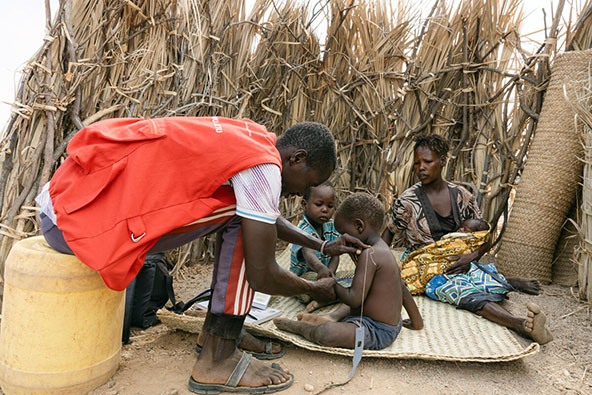
 Health Promoter Charles carries out a check up on Daudi at home.
This is the fourth article in an SSIR series authored by T. Alexander Puutio and other global development experts and leaders on how the sector can chart a path forward in the face of government pullbacks. See “Development in Retreat?” for an introduction to the series.
As dashboards chart the steepest retreat in development finance in recent times, the scale of the disruption dwarfs every previous contraction in the field. Yet even these sweeping curves can flatten the human cost. As psychologist Paul Slovic observed, big numbers can breed a kind of “psychic numbing”—they may signal crisis, but they can also anesthetize our empathy.
Beneath every downward trend lies a story: a clinic that never reopens, a vaccine fridge left empty, a parent whose tomorrow now hinges on choices made oceans away. Yes, aggregated data can inform policy, but it cannot capture the lived experiences at play.
Think of a malnourished mother of twin boys in war-scarred Raqqa, Syria. After 14 years of conflict, her life revolves around a single, desperate goal: finding food for another day. When she learned that the nutrition center sustaining her children might close, she broke down, her tears soaking the dust at her feet.
Her story isn’t the exception, but one of millions. Survival isn’t theoretical, but a daily battle. In the midst of global pullback from the systems meant to support families like hers, how do we refocus on her, on what truly matters?
Rebuilding Aid—The Great Humanitarian Reform?
Across the globe, traditional donor governments are slashing foreign assistance budgets—none more abruptly than the United States. To remain relevant, our sector must confront a hard truth: We’re not structured for the world we now face. So, where do we go from here?
To begin, let’s not only retire the term “foreign assistance,” but also the way of thinking associated with it. Done well, humanitarian and development assistance is not a handout but the catalyst for a partnership in global stability. And the words we use to describe our work shape incentives around it. “Foreign assistance” implies charity to strangers, prompting policymakers to ask how much altruism they can afford. In contrast, a vocabulary rooted in reciprocity—global health security, climate resilience, and mutual investment—highlights the benefits that flow in every direction.
When aid is portrayed as outflow rather than a form of collective insurance, bipartisan support erodes. Recasting development as shared resilience work not only clarifies why retreat is self-defeating—it also shows why renewal must begin at the grassroots of every political stripe. Retiring outdated labels isn’t a cosmetic makeover; it’s the first brick in rebuilding a field the world still desperately demands.
This moment of disruption is an opportunity we can’t afford to waste.
Every crisis forces reimagination. The humanitarian and development sector must seize this moment not just to redesign projects, but to reimagine its pathways for delivering impact. Many well-intentioned reforms over the past two decades—from the Paris Declaration in 2005 to the Grand Bargain in 2016—made big promises but fell short. Why? Because systems are stubborn. Incentives didn’t change. Short-term fixes remained easier to fund than investments in long-term resilience.
For so many urgent challenges—from child mortality and illiteracy to teacher performance, cash assistance, and even child marriage—we know what works. We must realize how attainable the goals of global development really are. Previous generations could say that their world lacked food, money, or science to save every child. We do NOT have that excuse anymore.
Today, our world produces enough calories for every person on this planet, and diseases like pneumonia, diarrhea, and malaria can both be prevented and treated by low-cost vaccines and medicines. The fact that five million children die before their fifth birthday, every year, is not a tragedy of scarcity—it’s a tragedy of choice.
Revamping Aid Architecture
So, how do we start rebuilding aid? Here are five ideas to consider:
- Share and pool resources. In the fiercely competitive private sector, even rivals strike distribution and manufacturing deals. Why is this so rare in a sector where collaboration is a core value? In a world marked by shrinking empathy and growing division, yet more connected and interdependent than ever, we must remember that most of the progress over the past 100 years—from eradicating smallpox to landing on the moon—has come through collaboration at scale.
- Shift power locally. Impact happens mostly at the community level. Some of the best humanitarian assistance today—from pooled country funds like South Sudan’s locally led platform to the Start Network operating in 20 countries—are built on local ownership and delivery.
- Invest in local markets. Aid alone isn’t enough; strengthening local economies is equally critical. Despite two decades of evidence, a shocking percentage of life-saving ready-to-use therapeutic foods—like fortified peanut paste—are still produced thousands of miles away instead of near the communities that need them. Local manufacturing would be faster, cheaper, and create local livelihoods.
- Fund global public goods. We must invest collectively in rigorous research and ensure that knowledge is freely shared and widely used. Too often, evidence remains siloed as organizations prefer to invent their own solutions rather than adopt proven ones. Smarter incentives and stronger market signals can help. At Save the Children, we’ve captured our learnings in our evidence-based Common Approaches—a step toward shared progress to meet the greatest challenges facing children.
- Build humanitarian bridges. Humanitarian and development assistance are not handouts from rich to poor; they are partnerships and investments in shared stability and prosperity. Real progress—for instance, in social mobility, life expectancy, or child survival—requires governments, nonprofits, businesses, and communities to come together to co-create solutions, build durable policies, and commit resources. When that happens, foreign assistance is a catalyst, not a crutch.
“As local as possible, as global as necessary,” must be more than a slogan—it must be a strategy. Over a century ago, Save the Children’s founder Eglantyne Jebb said: “Every generation of children offers mankind the possibility of rebuilding his ruin of a world.”
For the sake of millions of families, let’s remember what we look like at our best. It’s time to move beyond broken systems and start building something better.
Read the rest of the series so far:
- “Development in Retreat?” by Michael J. Mortimer and T. Alexander Puutio
- “Beyond the ‘Good Enough’ Charity” by Sarah Holloway and T. Alexander Puutio
- “Development Philanthropy Must Be Partnership, Not Patronage” by Karen Kardos and T. Alexander Puutio
Read more stories by Janti Soeripto & T. Alexander Puutio.