


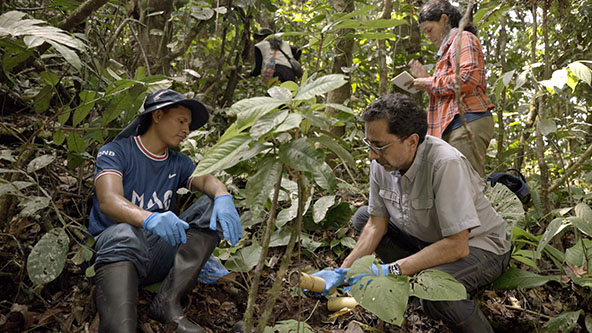
 NYU MOTH Founding Director, César Rodríguez-Garavito (center), conducting fieldwork for legal action on rights of nature with Indigenous and non-Indigenous scientists in Sarayaku territory, Ecuadorian Amazon, 2024. (Photo by Natalia Arenas)
Today, the planet is facing what César Rodríguez-Garavito, founding director of the More-Than-Human Life (MOTH) Program, calls a “triple planetary crisis of climate, biodiversity, and pollution.”
With billions of tons of CO2 released into the atmosphere each year as a result of human activity, global temperatures are rising and species are dying off at a rate 1,000 times higher than before the arrival of humans 60 million years ago. To help counter these issues, Rodríguez-Garavito’s MOTH, a legal research and advocacy effort, has set out to extend legal frameworks designed to protect people, such as intellectual and human rights, to the more-than-human web of life.
Since its launch in 2022 as an initiative of the Earth Rights Research and Action Clinic and the Center for Human Rights and Global Justice at New York University’s (NYU) School of Law, MOTH has filed a case to establish the creative rights of a forest, investigated the legal and ethical possibilities of translating whale communication using artificial intelligence, and supported the implementation of a landmark court decision granting rights to nature in Ecuador. In addition to spearheading efforts like these, the program offers week-long intensive trainings for mid-career professionals interested in advocating for the more-than-human world, and hosts both an annual public festival at NYU and an annual invitation-only symposium that brings together scientists, philosophers, lawyers, Indigenous leaders, environmental advocates, and journalists from around the world to shape the program’s agenda.
The concept of the more-than-human world originates from the writings of American philosopher David Abram, who coined the term in the mid-1990s to break down divides between humankind and other life on Earth. A broader movement to recognize rights of nature dates back to 1972, when Christopher D. Stone, a law professor at the University of Southern California, wrote an article arguing that “natural objects” should have legal rights. Since 1990, about 500 initiatives recognizing the rights of nature have been undertaken in dozens of countries and international venues, including the United Nations. Rodríguez-Garavito says he opted for the term “more-than-human rights” over “rights of nature” to emphasize that humans and their rights are not separate from nature, but nested within it.
At MOTH’s NYU headquarters and during its annual convenings—which took place in New York in 2022, Chile in 2023, and the land of the Sarayaku Indigenous people in the Amazon Rainforest in Ecuador in 2024—Rodríguez-Garavito and a team of associated researchers and staff provide a home for a growing movement organizing for the rights of nature. “Everyone is looking for new tools to defend and protect nature, because the ones that we have clearly have limitations,” says Rodríguez-Garavito. “Rights of nature offer a new layer of claims or arguments to protect the more-than-human world.”
Merlin Sheldrake, a biologist and author of the book Entangled Life: How Fungi Make Our Worlds, Change Our Minds and Shape Our Futures, says MOTH’s convenings are paradigm-shifting events. “Today's challenges demand that we think across disciplinary boundaries, and it’s been wonderful to watch new ideas and projects bubble up from the unusual constellations of people and perspective that these gatherings facilitate.”
This year’s convening will take place on Cortes Island in British Columbia, Canada, and focus on the rights of oceans and marine life. The theme aligns with MOTH’s ongoing efforts to explore the legal implications of translating animal language, an initiative undertaken in partnership with Project CETI (Cetacean Translation Initiative). Going forward, MOTH also plans to launch additional week-long courses and residencies for artists, scientists, lawyers, and journalists. “There’s a cultural moment where people in every field are looking for frameworks that offer a way to reconnect with nature,” says Rodríguez-Garavito. “The rights of nature and the work of MOTH are one such way.”
Read more stories by Marianne Dhenin.