


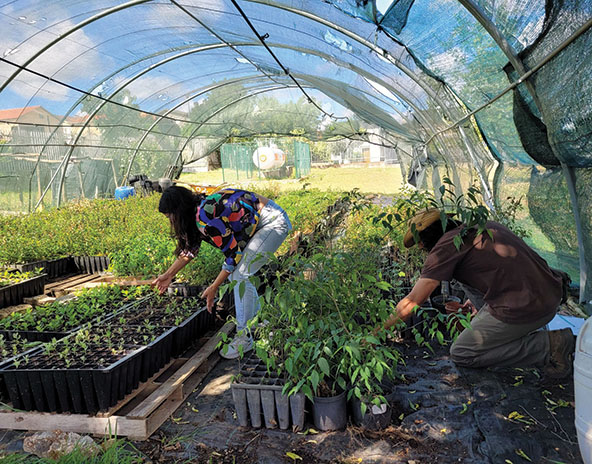
 Volunteers attend to one of the sapling nurseries in the Faia Brava reserve. (Photo courtesy of Rita Duarte)
Throughout the 1990s, the largely untouched hinterlands of the western Iberian Peninsula straddling Spain and Portugal endured a series of manmade environmental disruptions: The Portuguese government’s failed attempt to construct a dam on the Côa River, the rapid deforestation caused by tree clearing, and the proliferation of illegal quarries depleted the region’s biodiversity. Additionally, traditional land management—farmers’ and herders’ practice of using cattle grazing to prevent the overgrowth of vegetation—declined due to depopulation as younger generations migrated to cities seeking opportunities. The absence of this practice further exposed the landscape to natural disasters.
Portugal’s rural landscape once was a mosaic of pastureland and shrubs interspersed with trees such as the holm oak, cork oak, and maritime pine. Modern agricultural practices felled trees and flattened this variegated landscape, which was further destroyed by invasive species of shrubs. The unpruned vegetation, desiccated by the summer heat, resulted in a series of wildfires that ravaged the region in 2003.
According to a 2006 International Forest Fire News report, 21 people died, 500,000 hectares (more than 1.235 million acres) of land was lost, and around 60,000 hectares (around 150,000 acres) of agricultural crops went up in flames. The fires rattled Portuguese biologist Ana Berliner, who in 2000 launched the environmental NGO Associação Transumância e Natureza (ATN) to conserve the nature of northeast Portugal through community participation.
Berliner first visited the Côa Valley in 1996 to research cliff-breeding birds like the cinereous vulture, a near-threatened species of Eurasian vulture. What she saw in the Côa Valley mesmerized her: The steep inclines and dramatic views of the mountains notwithstanding, the valley was also home to vibrant biodiversity, a rich yet extremely vulnerable habitat that hosts several rare species.
Along with her husband, biologist António Monteiro, and a few other environmentalists, Berliner founded ATN as an umbrella organization overseeing the management and protection of the valley’s environment. She bought 30 hectares (74 acres) of land on the banks of the Côa River from farmers with her personal funds and a small grant from the now-defunct Swiss NGO MAVA to establish Faia Brava, a private nature reserve project. Berliner believes ATN functions as a much-needed supplement to the Portuguese government’s limited nature-conservation strategies, which include regulation of forest-land use by shepherds, species conservation, and compensation to farmers for abstaining from killing wolves that have preyed on their livestock.
Faia Brava is the foundation of ATN’s diverse conservation efforts, including forest restoration, biodiversity and species conservation, climate education, and, critically, wildfire prevention, since the threat of desertification hastened by climate change continues to loom large in this extremely arid region.
Today, Faia Brava is the geographical centerpiece of Natura 2000, the protected-nature zone in the Iberian peninsula. According to the European Commission of Environment, it is the largest coordinated network of protected land in the world.
Privatizing Conservation
ATN focused on manageable, small-scale rewilding efforts in the Côa Valley because nature conservation is a slow and laborious process. In addition, the land that Berliner acquired lacked the species diversity that is necessary to maintain a sustainable ecosystem, making the project more challenging. Berliner and the team also realized that they needed to help the ecosystem damaged from the 2003 wildfires recover quickly in order to better endure any potential future fires.
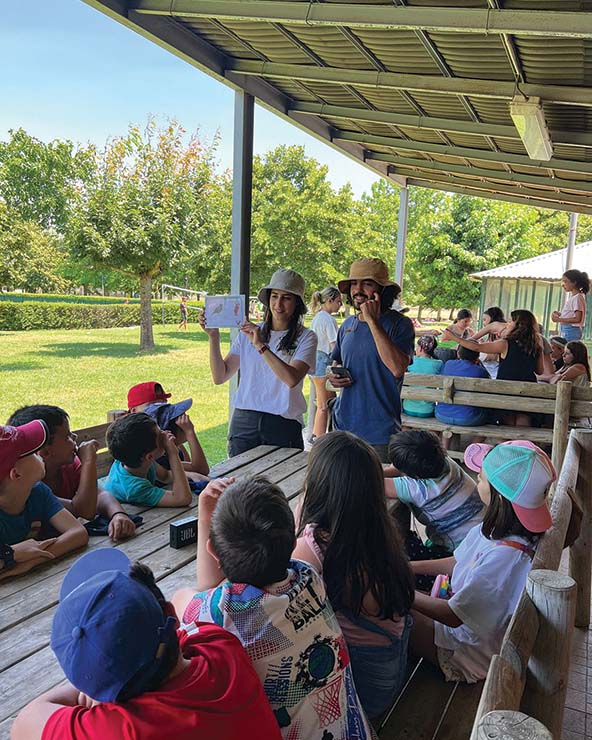 Associação Transumância e Natureza holds educational labs for youth who want to learn more about the region’s biodiversity. (Photo courtesy of Rita Duarte)
ATN is currently managed by a seven-member board that meets monthly to discuss strategic initiatives like land purchases. It has eight full-time staff who, alongside several volunteers, implement new projects in Faia Brava.
With Berliner and Monteiro already working on species conservation—including endangered cliff-breeding birds like the golden eagle, Bonelli’s eagle, and the petrel—the team started planting trees in 2008. Thanks to constant monitoring by ATN’s staff that resulted in 15 years of uninterrupted growth, greenery has returned.
“Old forest stores much more carbon than new trees,” explains Frederico Leite, an ecologist and part of the team that monitors soil health and tree planting. “So, our focus is more on protecting the old trees within Faia Brava. Not just trees but also animals; when they fertilize the area, [they] help retain carbon.”
Animals are also part of ATN’s nature-intervention plan. Berliner and Monteiro, who were already raising donkeys at the time that they purchased the land for Faia Brava, introduced local Garrano horses to the land in 2014 and Sayaguesa and Maronesa cattle breeds in 2018. The overall biodiversity of the reserve increased because these animals grazed the grass and shrubbery, keeping the overgrowth of bushes under control and lowering the risk of wildfire. In fact, no worse wildfire has occurred in the region since the 2003 tragedy.
Dutch ecologist Henk Smit insists that civil society must act immediately to prevent further loss of biodiversity.
These measures have turned Faia Brava into an outdoor laboratory conducive to performing ecological field studies and experiments, according to João Carvalho, an ecologist at the University of Aveiro’s Center for Environmental Studies (CESAM) who researches the dynamics of Mediterranean ecosystems. Carvalho adds that the center also has multiple research projects that utilize the reserve’s rich biodiversity.
In late April, CESAM hosted college students from across Europe to work on a project to study the impact that large herbivores have on the Mediterranean landscape. “From soil to vegetation to mammals—reptiles and carnivores—if the density is higher, it can have a feedback effect on ecosystems,” Carvalho explains. “We’re trying to disentangle all these relationships, and Faia Brava is an amazing place to test this.”
Bird conservation also remains a priority for ATN. Eduardo Alves, who is responsible for maintaining the feeding station of Egyptian and cinereous vultures, says the work “involves habitat restoration, feeding, rehabilitation and recuperation, monitoring of vulture habitats, searching for new colonies and new nests of raptors, and tagging young birds with GPS.” Faia Brava’s purview also extends to the 120 bird species existing in the special-protected zone of Côa Valley.
Tackling Desertification
Rewilding a region where climate change manifests in increasingly extreme and unpredictable weather conditions is not an easy task. In the last few years, droughts have intensified, further accelerating desertification in the region. Because of these worsening effects, Dutch ecologist and ATN board member Henk Smit insists that civil society must act immediately to prevent further loss of biodiversity.
“When desertification starts to have alarming effects, we need to be ready,” he says. “We’re improving tree cover and trying to enrich the soil by adding more organic material and nurturing it.”
Nature conservation is an ongoing, expensive enterprise. Berliner and her husband invested their own funds to establish ATN, but they turned to the fruits of the land to raise the necessary funds for ATN’s growth. In the early 2000s, they began selling olive oil made from olive harvests within the reserve and retailing products like almond butter and body lotions crafted by the small business owners at Berliner’s property, in the village of Castelo Rodrigo. “This was also a way to get the word around [about ATN’s work],” Berliner says of the commercial venture. Profits from product sales are supplemented with funds from European agencies and private donors to maintain ATN’s bottom line.
Each project’s funding needs are met by specific grants. For example, the vulture-conservation program is funded by the EU’s European Climate, Infrastructure, and Environment Executive Agency. The Portuguese foundation Fundação Belmiro de Azevedo granted more than €96,000 ($105,000) to Faia Brava’s Research and Education Learning Lab, which provides environmental training programs at the reserve for students and teachers in elementary and secondary schools. And ATN’s forest restoration project—which aims to restore the Montado landscape with 80 mature trees per hectare, thus accelerating the regeneration of the Mediterranean forest in Faia Brava—received a combined €1 million ($1.06 million) in funding from the Portuguese government.
Since its founding, Faia Brava has grown to approximately 1,600 hectares (4,000 acres) of land. “Our new management plan is to expand the reserve to 15 kilometers [9.3 miles] along the Côa River to 2,000 hectares [around 5,000 acres] of interconnected land,” Smit says. According to Berliner, ATN’s goal to finance this expansion relies on sustainable business opportunities, such as ecotourism.
Despite the climate-related threats, a silver lining remains. “Due to [human] depopulation, this region has one of the lowest rates of [crop] monoculture in Portugal,” Leite observes. The pipeline from abandoned agricultural land to untrammeled wilderness is not straightforward in an environmentally sensitive region prone to droughts and wildfires. However, ATN’s private reserve is slowly but steadily making a positive effect.
“Thanks to collective and measured efforts by organizations like ATN,” Leite adds, “this area will be stable and rich in biodiversity in the coming years.”
Read more stories by Prathap Nair.