


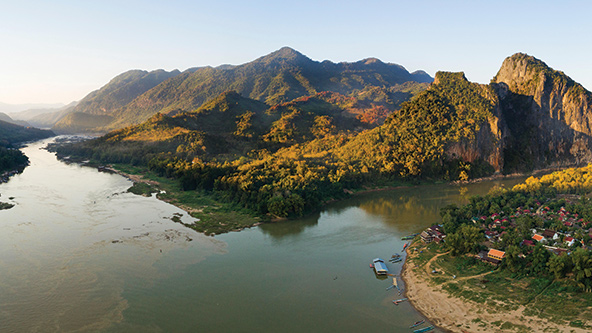
 A view of the Mekong River, where the Lower Mekong Funders Collaborative has dedicated its efforts to environmental protection and restoration. (Photo by Dennis Schmelz/Alamy)
When it comes to areas of the world that are rich in both natural beauty and complexity, Southeast Asia provides a perfect snapshot.
Stretching south of China down into archipelagos in the Pacific Ocean, it is a region of tropical and subtropical climates, where mountains of limestone karsts give way to coastal plains, and where a large number of endemic species not found anywhere else in the world call it home. Zero in on the continental mainland of Southeast Asia, and amid this lush, diverse region of mountains, plains, and forests is the mighty Mekong River.
At more than 2,700 miles long and winding through six countries, the Mekong River is the longest river in Southeast Asia, the 12th longest in the world, and possesses some of Earth’s richest biodiversity, with more than 1,300 fish species, 1,200 bird species, and 20,000 plant species.
The river’s economic impact on residents encompasses much more than tourism, as the river is home to the world’s largest inland freshwater fishery, which provides food security to millions of citizens. According to a joint report from the World Wildlife Fund (WWF) and global financial services giant HSBC, the Mekong region’s growth rate in recent years has been estimated to be between 5 and 8 percent, propelled by agricultural industries like fishing and rice production. Economies are especially prospering on the lower basin of the Mekong River, which is more navigable than the upper basin due to a lesser concentration of sandbanks and rapids.
The intergovernmental organization Mekong River Commission has placed the annual value of fisheries and fish farms in the lower basin at $17 billion; they make up more than 10 percent of the world’s fishing business. The region’s rice production is just as formidable, as it consists of around a quarter of the world’s rice exports. Nearly 65 million residents live in the lower basin, and out of this flourishing economic activity, more citizens are flocking to urban areas.
The river, which runs from China to Vietnam before emptying out into the South China Sea, is heavily trafficked by cruise lines. Reporting on the Mekong River’s “booming” tourist industry in 2019, CNBC noted that at least 10 ships had been slated to operate tours on the river in 2020, before the COVID-19 pandemic shuttered the industry.
The rise of the lower Mekong’s urban population has gradually affected the land along the entire Mekong River region, from the upper to the lower basins. Throughout the Greater Mekong Subregion (GMS), consisting of China, Cambodia, Laos, Myanmar (Burma), Thailand, and Vietnam, urban areas have been growing by 3 to 5 percent each year. By 2030, it is expected that more than 40 percent of residents will be living in and around GMS cities. Consequently, this growth has put a strain on natural resources along the lower Mekong River, particularly with the increased generation of hydroelectric power from dams. A similar situation is occurring in the lower basin, where annual energy demand growth is estimated at 7 percent.
Having previously spent years living in Southeast Asia, Jack Tordoff is intimately aware about the region and knows quite well the tension there of balancing economic development with environmental and ecological conservation. Tordoff is the managing director of the Critical Ecosystem Partnership Fund (CEPF), an Arlington, Virginia-based venture dedicated to worldwide biodiversity conservation, and he has spent more than a decade working on behalf of sustainability conservation and development efforts in Southeast Asia.
Dams play an important role in the economic development advancement of nations by producing electricity, preventing floods, and providing crop irrigation in dry areas. Dams also impede the natural flow of rivers and lead to alterations in habitats where fish feed and breed. The alterations, in turn, can harm the life cycles of fish and their ability to reproduce, consequently negatively affecting the food supply for residents who rely on the river’s fish as an essential staple and a means of financial stability. This is the current situation of people who live along the Mekong River, where two major dams currently operate and several are in the planning stages.
“Once you play around with the availability of water, there are implications for people who are most directly impacted,” says Tordoff. According to the World Health Organization, those implications include a loss of food security, negative water quality, and an increase in communicable diseases from species in the river.
Additional ecological concerns in the region have arisen from the increased deforestation to make way for large-scale agro-industrial complexes, which are being built to meet the demand for commodities like rice, along with rubber and palm oil. “On the one hand, you’re damming the river,” Tordoff says. “On the other hand, you’re clearing natural vegetation in the watershed.”
A perfect storm of human-generated conditions such as climate change and environmental degradation have made Southeast Asia a prime candidate for the work of organizations like CEPF. Since 2011, CEPF has partnered with a number of international philanthropic organizations to invest in solutions to environmental and ecological issues in the lower Mekong. This partnership, known as the Lower Mekong Funders Collaborative (LMFC), has provided economic support to more than 100 local civil society organizations working on biodiversity conservation projects and the promotion of economically sustainable development.
“We’re trying to come up with models whereby protecting ecosystems, we can also deliver on the key development priorities for people, particularly food security and income,” says Tordoff.
Establishing the Collaborative
The LMFC comprises several grantmaking organizations that in addition to CEPF include the Margaret A. Cargill Philanthropies (MACP), the Chino Cienega Foundation, and the McConnell Foundation. Beneficiaries of the collaborative’s largesse include nongovernmental organizations (NGOs), community groups, and people’s movements that have initiated projects of their own in the lower Mekong.
“With all of the development that has taken place and the degradation that has happened, it’s a critically important freshwater system,” says Shelley Shreffler, an environment program officer at Margaret A. Cargill Philanthropies. “I think it’s important that we support communities and people in the region.”
The lower Mekong basin—in which lie Cambodia, Laos, Myanmar, Thailand, and Vietnam—has been a focus of grantmaking efforts by various American funders since the late 1980s. That interest in the area came at a time when Vietnam was attempting to normalize relations with the United States after decades of regional conflict, and it increased in the mid-1990s, around the time that diplomatic relations between the two countries were established.
Tordoff notes that those initial undertakings were driven by international aid organizations from outside the region. Despite good intentions, Tordoff suggests, some of those early funding initiatives used more of a top-down approach that did not always take into account the input of local stakeholders. “The first real effort to improve environmental quality began in the late 1980s into the 1990s,” says Tordoff, who spent over a decade working in biodiversity conservation in Southeast Asia before joining CEPF in 2009. “Not that they were not effective, but they were very externally driven.”
Before the formation of the LMFC, its member organizations were already pursuing biodiversity and sustainable development projects independently in Southeast Asia. Knowledgeable of each other’s work in the region, the organizations figured there was strength in numbers by pooling together their various research efforts, resources, and strategies.
Tordoff says that what set the collaborative apart from other outside funders of Southeast Asia conservation and development projects was its commitment to helping local organizations set the tone for their own objectives—taking a bottom-up approach instead of a top-down one, with the intention of letting local organizations lead. For local organizations, bottom-up grantmaking from collaborative members would expand resources and raise their profile when it came to getting their voices heard by governments regarding the affairs of their communities. These local organizations found their footing at the start of the new millennium, as governments started making room for civil society organizations to be part of the political process in the lower Mekong.
“What we’ve seen from the 2000s onwards is a greater localization of these efforts,” Tordoff says. “Partly that’s due to the change in policy, as governments have gradually allowed more political space for civil society organizations. At the same time, that is partly due to the support that groups like CEPF and other funders have made available for local entities to access funding to do environmental work.”
Focusing on a Hotspot
A snapshot of the ambitious initiatives that the Lower Mekong Funders Collaborative participates in can be found at the Indo-Burma Hotspot, which encompasses all nonmarine areas of the five lower Mekong countries, plus parts of southern China, northeastern India, and small areas of Bangladesh and Malaysia. Because of the emphasis on conservation efforts around the Mekong River, Bangladesh, India, and Malaysia are not included in CEPF’s funding for Indo-Burma. Northeastern India, which is also located outside of the Mekong, was previously part of a separate CEPF funding project.
Numbering 36 worldwide, hotspots are terrestrial areas with diverse biological ecosystems facing a variety of environmental and ecological threats. For an area to qualify as a hotspot, it must have at least 1,500 vascular plants not found anywhere else on Earth, and it must have lost at least 70 percent of its primary native vegetation from environmental degradation. CEPF began investing in conservation efforts in global hotspots not long after its establishment in 2000, and in 2003 it created an “ecosystem profile” of Indo-Burma to identify that hotspot’s top concerns regarding biological erosion.
“We have a focus on the particular places on the planet that are very rich in biodiversity and have a high level of human activity,” says Tordoff.
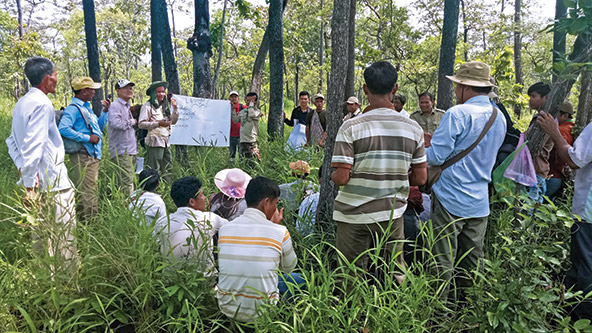 Trainers teach sustainable land-use planning and management in Cambodia’s Mekong Flooded Forest Landscape. (Photo courtesy of CEPF/WWF-Cambodia)
After initiating investment projects in other worldwide hotspots, CEPF turned its attention to Indo-Burma, launching a five-year plan in 2008 to help fund projects addressing critical concerns of environmental and ecological decay. The size of the hotspot and the magnitude of environmental and ecological issues presented significant opportunities for grant makers. With over 346 million residents, Indo-Burma has more than any other hotspot in the world, and in 2011, CEPF declared it to be Earth’s most threatened hotspot.
“The lower Mekong, as part of Indo-Burma, has been a very important area for the investment of CEPF,” says Olivier Langrand, CEPF’s executive director. “A lot of species are at the brink of extinction in this hotspot because of the trajectory of economic development.”
Those species include birds like the Bengal florican, which can be found in Cambodia and Vietnam and is categorized as a critically endangered species by the International Union for Conservation of Nature. In addition, trees like the Siamese rosewood and the Cambodian rosewood are threatened due to the high regional demand for furniture that is manufactured from the species’ wood. Such furniture has become a status symbol among citizens to represent a prosperous lifestyle, and the demand has even attracted organized gangs to get in on the action logging rosewood trees.
“The rosewood has an incredibly high price,” says Tordoff, who notes that beds manufactured from rosewood can command six-figure price tags. “The price is incredible because they are a status symbol, and people invest in them to demonstrate their wealth.”
Ultimately, if you talk to people like Tordoff, they will say that biodiversity conservation is not an issue for just one part of the world that is out of sight for many, particularly for those stateside. Rather, it is an issue that impacts people across the globe.
Conflict in the Lower Mekong
Conservation and sustainable development efforts have been prominent in Southeast Asia since international funders first became attracted to the region in the 1980s, when the work of environmentalists like Norman Myers and Russell Mittermeier gained traction in the wider environmental advocacy sphere. In the lower Mekong basin, the need for assistance can be traced back to when the region was mired in armed conflict between 1946 and 1989, when battles between communist-supported forces and Western-backed governments engulfed the region in the First and Second Indochina Wars.
The First Indochina War was fought mostly in northern Vietnam, which along with the southern part of the nation was colonized at the time by France. That war ended in 1954 when the Ho Chi Minh-led nationalist group Viet Minh—supported by the Soviet Union and China—beat back French forces at the Battle of Dien Bien Phu, marking the end of French rule in the country.
Postcolonial Vietnam was subsequently divided into two countries: communist North Vietnam and the West-supported South Vietnam. Smaller skirmishes between the two countries had morphed into bigger ones by the time the United States—which supported South Vietnam and had backed France in the First Indochina War—got involved after 1964, following reports that North Vietnam attacked an American military fleet operating in the Gulf of Tonkin. Tordoff, for his part, specifically places the region’s environmental decline with “the American involvement in Indochina with the Vietnam War.”
As part of their offensive, US military forces used the defoliant Agent Orange against North Vietnamese fighters in the country, as well as in Laos and Cambodia, where the North Vietnamese army and their allied Vietcong guerrilla forces had operations. The defoliant, which caused long-term health complications and illnesses among residents and military personnel, also resulted in extensive deforestation of rural areas that held large numbers of displaced citizens from other war-torn areas.
Stephen Nichols, founder and president of the California-based Chino Cienega Foundation, which funds climate change and environmental sustainability projects in Southeast Asia, saw up close the magnitude of war’s destruction when he arrived in Vietnam in 1967, where he served in the US armed forces as a volunteer teacher.
“The first thing you see is huge environmental damage,” Nichols says. “You’re flying in, and you see bomb craters all over the place. You just can’t imagine the extent of that destruction. I remember thinking, ‘When this war ends, how long is it going to take this country to heal from all those wounds?’”
In the aftermath of the conflicts, various countries in the lower Mekong region sought to revive their economies through heavy agricultural investments, such as the exportation of commodities like coffee and rice and the cutting down of trees for timber production.
“It was deforestation, followed by decades of people reacting to the economic shocks of war,” says Tordoff. “Countries were tempted to get their economies started, and one of the ways they did was investing in natural resource sectors.”
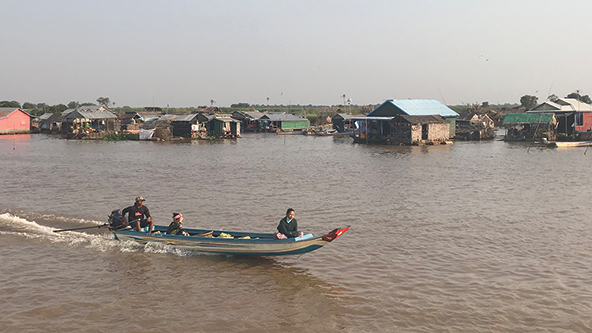 A fishing boat, with its net submerged, coasts through the Tonlé Sap, a freshwater lake and river system, with a floating village in the distance. (Photo courtesy of Shelley Shreffler/MACP)
Decades later, the challenge of balancing regional economic development with environmental sustainability has become a formidable one, caused by a perfect storm of factors such as continued regional deforestation, hydroelectric power dependence, and climate change.
A Decentralized Effort
In many ways, the LMFC is a meeting of the minds of organizations that are each passionate about the promotion of Southeast Asian environmental and ecological issues. Each organization, at times, will diverge in the conservation and development objectives they prioritize. Some organizations, like CEPF, might choose to focus on funding biodiversity conservation efforts, while other members might have more of a bent toward issues like climate change and public advocacy.
The collaborative has a rather informal, egalitarian approach to its work. It is not an incorporated collaborative—there is no website, and none of the organizations involved dictate the types of projects that the others undertake.
“We don’t all have exactly the same mandate,” says Tordoff. “There’s a significant area of overlap, and at the same time there are things that one funder may be working on that the other funders are not. We respect that.”
The California-based McConnell Foundation—which awards funds for nonprofit and educational undertakings as well as government entities—is a collaborative member that takes a significant public advocacy approach to its funding, supporting efforts like conflict resolution work in Nepal and legal aid rights among rural communities in Laos. The foundation also provides small grants for conservation projects in Laos, a country it was initially attracted to due to the sizable Laotian diaspora in and around its home base of Redding, which is located north of Sacramento. Many of those residents are descended from refugees of the Laotian civil wars of the mid-20th century.
“Working with a collaborative helps us identify the strengths of various funders, because everyone is able to contribute in different ways,” says Jesica Rhone, the international programs director for the McConnell Foundation. “That’s been really highlighted in getting to know these other funders who are of different sizes and have different networks, and who have social capital that they each bring to the table.”
In its own work, CEPF has invested more than $30 million in grants to Indo-Burma civil society organizations. Since launching its five-year plan, CEPF has supported more than 310 projects in the hotspot. Just a few examples of stakeholders’ work: Indigenous communities campaigning for land rights, community groups managing fisheries, and media-focused organizations looking to bring more awareness to regional issues.
To assess outcomes of its worldwide hotspot assistance, CEPF uses four separate categories, or what it refers to as pillars: whether (1) the quality of a hotspot’s biodiversity has improved; (2) the capacity of civil society organizations to carry out their work has been strengthened; (3) there have been gains in the quality of life of citizens living in the hotspot; and (4) conditions have been established for the public and private sectors to contribute to biodiversity conservation efforts. Within these pillars, CEPF scrutinizes certain benchmarks to gauge the efficacy of its grantees’ groundwork. These benchmarks vary according to locale and are set by stakeholders. For instance, CEPF looks at the number of citizens receiving direct benefits from wildlife-friendly production of commodities such as rice.
In exchange for meeting specific environmental targets set by local stakeholders who are CEPF beneficiaries, farmers can receive a higher price from stakeholders on crops like rice than they would otherwise command from other buyers. Without the higher prices paid for their crops, farmers might ultimately have to supplement their income from side jobs like forest clearing.
CEPF also looks at the number of residents receiving indirect benefits from wildlife-friendly commodity production, like rice, which comes not from directly selling their crops to market but from having a cleaner supply of water with which to irrigate their fields. “It’s been very effective,” says Tordoff. “These rice production schemes are now exporting internationally to some big buyers.”
CEPF further evaluates the efforts of local stakeholders to see if their work has resulted in the establishment of conservation areas from previously threatened lands. “We measure these in terms of numbers of acres or hectares,” says Tordoff. “That might mean formal measures like a national park or nature reserve. But increasingly, it means more informal measures like indigenous conserved areas, where the indigenous community can support it.”
More benchmarks include measuring how regionally threatened species have benefited since the collaborative started funding conservation projects of local stakeholders. Additionally, CEPF provides a screening apparatus for grantees to measure their capacity for initiating and carrying out projects.
“All of the local organizations who receive a grant fill in a self-assessment tool where they are asked questions about their organization,” says Tordoff. “Do they have trained staff? Do they have a permanent office? Do they have volunteers? After three or five years, they can reassess themselves, and we can look at how their capacity changes.”
Local Investment and Activism
CEPF had initially begun its funding of Southeast Asian conservation projects in 2008 as part of its five-year plan. At the time, CEPF partnered with conservation organization BirdLife International (where Tordoff served as its program director prior to joining CEPF) to disburse 126 grants worth more than $9 million in Indo-Burma. At the close of the plan in 2013, CEPF re-upped its economic commitment to the region, this time for seven years and partnering with new organizations to form the LMFC.
Since 2013, the collaborative’s funding in the Indo-Burma Hotspot has helped local stakeholders strengthen their conservation management efforts in specific locations where industries such as agriculture and fishing have intensive production. According to Tordoff, the collaborative’s grant work has covered an area that encompasses more than 1.9 million acres and has resulted in at least 120 local and indigenous communities receiving increased benefits in land tenure, food security, and income.
More than 80 grants have been awarded to stakeholders and international organizations doing work in the area, with examples including the creation of conservation programs for species, the establishment of pilot programs promoting community-managed forests and fisheries, and the promotion of conservation issues through more local media coverage.
Among the 100-plus regional civil society organizations to be awarded a grant from the LMFC is the Vietnam-based PanNature. Headquartered in the rural Son La province bordering Laos in the northwestern part of the country, PanNature partners with citizens, the private sector, and government agencies to find solutions to critical issues like the prevalence of dams along the lower Mekong.
More than deploying workers to administer projects on the ground, much of the organization’s work comes from advocating public policy reform and establishing relationships with local media to bring awareness to regional environmental issues. Funding from CEPF and other collaborative members has allowed the organization to ramp up its communication outreach, enabling PanNature to expand the publication of materials to citizens, boost its staff, and conduct press tours.
“We now get a lot of coverage on environmental issues in the media,” says PanNature executive director Trinh Le Nguyen, who founded the organization in 2004. “We’ve got a lot of supporters who are working on environmental protection and conservation. Ten years ago, environmental issues were not very high on the media’s agenda.”
As a result of the increased awareness of environmental and ecological issues from the work of the LMFC’s grant organizations, governments are offering some significant concessions to the region. Last year, the Thai government canceled a planned dam project that would have detonated a section of the Mekong River specifically where rapids are located in order to make the area navigable. This construction would have allowed large commercial vessels from China to travel downstream to a part of the river that is home to breeding, stocking, and nursery areas for fish of various sizes, potentially causing significant disruptions to the habitats of species. Not long after the Thai dam project was suspended, the Cambodian government announced that it would be suspending construction of dams along its section of the Mekong until 2030.
“We’re starting to see a few high-level, important decisions made that are favorable to the environment,” says Tordoff, stressing that his optimism for Indo-Burma is, nonetheless, a cautious one. “These decisions can always be reversed,” he adds. “Another government could come in, or people may change their mind about sustainability.”
For Tordoff, the scuttling of the construction plans was especially meaningful because it came after CEPF initially funded regional stakeholders’ efforts to stop construction on another lower Mekong dam. In the early 2010s, concerns were raised by lower Mekong residents and activists about the potential environmental and ecological consequences for fisheries of the planned Xayaburi Dam in northern Laos. The project called for the dam—financed and operated by Thai private enterprises—to produce hydroelectric power, nearly all of which would be sold to Thailand’s state-run energy agency.
Efforts to stop the project were ultimately unsuccessful. “I think that was the biggest body blow to the environmental movement,” Tordoff reflects. “We were probably 5 or 10 years too late in recognizing the best way of engaging on the issue.” A memorandum of understanding between the Laotian government and the Thai construction company CH Karnchang PCL had already been signed in 2007 before CEPF began its first funding phase in the region a year later. By that time, the preconstruction phase was speeding along with development agreements and feasibility studies having been completed. After more than a half-decade of construction, the dam began operating in 2019, and Tordoff says that as a result, areas around the dam have become drier and less nutrient-rich, which has adversely affected fish habitats and increased the likelihood of droughts and fires occurring.
“If we could have had five more years’ lead time, we may have been able to present alternatives,” he adds. “But it was so far advanced before anybody really got to grips with it. People at the time didn’t realize it was a lost battle before it began. I think it opens a lot of questions about whether we can legitimately engage the internal politics of another country, when we’re not sufficiently informed.”
Bureaucratic Barriers
In spite of gains made on the ground, bureaucracy can be an issue for many stakeholders in the lower Mekong nations, where residents occasionally encounter obstacles to making their voices heard on political matters directly affecting them. This is certainly so when it comes to matters of environmental and ecological implications.
“The examples of civil society organizations being able to engage in public policy development are the exception rather than the norm,” says Tordoff. “It is still challenging for many community groups, indigenous people’s movements, and NGOs to really have influence on development decision-making.”
These sentiments are echoed by those working on the ground, who are beneficiaries of the collaborative’s economic support.
“We would like to be able to see indigenous people networking and talking with people at the highest level of government,” says Mong Vichet, the executive assistant director of the Highlanders Association, a Cambodian organization that has received funding from the collaborative for its efforts to increase political participation among ethnic minority—or indigenous—groups in the province of Ratanakiri.
The organization places a strong emphasis on getting women and youth involved in issues such as land rights and conservation in areas where ethnic minorities form a sizable presence. In Cambodia, where the majority Khmer ethnic group controls the country’s political, social, and economic institutions, the voices of indigenous peoples are clamoring for attention.
“Only those indigenous people who work with NGOs are able to talk with the government,” Vichet explains. “But local communities are not, and this is what indigenous people’s organizations like the Highlanders would like to see.”
Collaborative members who do not engage in public advocacy must also walk a fine line when it comes to other matters they have no control over, like questions of political transparency, in the lower Mekong basin. It is an issue that has been thrown into relief of late with the military-backed coup in Myanmar that took over the nation’s elected government. It has also proved problematic over time in various forms for all the countries of the region, where authoritarian or nondemocratic regimes proliferate.
“The political space that’s available for civil society to operate in is more limited in all of the countries in the Indo-Burma region, massively more so than in North America or Europe,” Tordoff says. “That’s for various historical factors. You have to be very careful.”
In addition to negotiating unfriendly government bureaucracies, the collaborative has also had to deal with the recent loss of two members: the MacArthur Foundation and the McKnight Foundation. The MacArthur Foundation, which had been part of the collaborative since 2011, ended its investments in Southeast Asia as of early 2021 and has left the collaborative.
In 2019, the McKnight Foundation, which had been engaged in public advocacy on behalf of sustainability and natural resource rights in Southeast Asia, announced that it was ending its funding in the region in 2020 and therefore pulling out of the collaborative. “We have been a big contributor to the collaborative, says Jane Maland Cady, McKnight’s international program director. “The core of our work was this focus on community resource rights and natural resources. That’s where we ended.” No additional information was disclosed about why McKnight left the collaborative.
Although McKnight’s departure leaves a hole in the area of public advocacy, CEPF has no immediate plans to pick up the mantle; however, it is looking for a new member foundation that might do this work. The current lack of public advocacy might come as a disappointment to proponents of sustainable empowerment initiatives in developing world regions, who might hope that organizations involved in such work would use their influence to advocate for concerns like human rights.
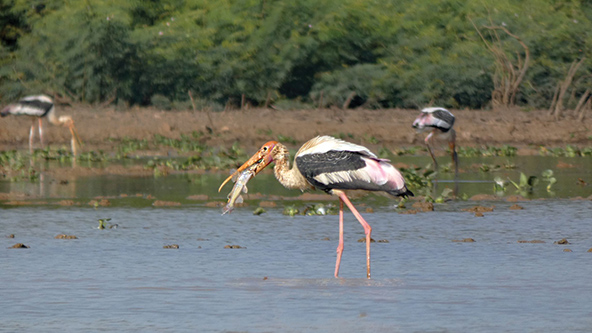 A painted stork catches a fish on the Tonlé Sap, which flows into the Mekong River. Storks are a common species in the area. (Photo courtesy of Shelley Shreffler/MACP)
In context of their own work, CEPF’s Langrand uses the term “agnostic” when describing the organization’s view of the situation in the lower Mekong. “We say to these countries, ‘We’re here to support civil society and to protect biodiversity,’” Langrand says. “There are some countries where we experience pushback. But in most countries, governments are quite happy to see us looking for solutions.”
Nonetheless, economic development objectives of municipal leaders do not always put a premium on environmental and ecological sustainability. To be sure, this is nothing unique to the lower Mekong or Southeast Asia, on the whole, as many world powers throughout history (including the United States, China, and various nations in Western Europe) have built their economies at the expense of environmental and ecological quality. The precedent of history, however, does not necessarily make the dilemma any easier to deal with for members of the collaborative or the stakeholders on the ground. This is particularly so when the conversation turns to issues like hydroelectric-powered dams, which can drive economic prosperity but result in serious environmental and ecological consequences for residents and the land.
Tordoff believes that not only does sustainable development make more sense from an environmental perspective, but also investments in solar power are more prudent economically than hydroelectric power. When it comes to selling that view in the lower Mekong, the issue becomes complicated due to those potential economic benefits being more widely dispensed to citizens in the region beyond companies and politically connected elites.
“Even though the economic argument may be there for a greener, more equitable approach, it isn’t just whether it makes sense economically,” Tordoff says. “It’s also who gets the benefits. Sometimes, with environmental and other more equitable approaches, the benefits get shared more widely, and communities have more of a voice.” Cady shares Tordoff’s wishes regarding sustainable development and hopes other collaborative members will do more work in sustainable development. “I’d like to see a little more innovation around that,” she says.
China’s Plans
Even if all nations in the lower Mekong basin decided to end their hydroelectric projects on the river, they would still be hamstrung, in large part, by China’s own plans for development upstream. China operates 11 dams on the Mekong in the southwestern part of the nation, and many observers contend that due to its economic might, the country has a largely one-sided relationship with its smaller, neighboring southern countries when it comes to the river’s management.
In 2019, China accumulated large amounts of rainfall and snowmelt, while a drought in the lower Mekong basin took the river to its lowest levels in more than a century. According to a report by the American nonpartisan think tank Stimson Center, China’s dams restricted nearly all of the precipitation from the excess moisture going downstream to parched areas that could have otherwise received above-average flows. Those areas presently remain very dry.
The report also described China’s management of its dams as “erratic” and noted that on occasion, dams unexpectedly release water downstream, causing environmental shocks like floods to the lower Mekong basin that damage the ecological processes of the area.
“China’s going to do what China wants to do,” Cady says. “They’re going to make the money they want to make.”
Although it might seem like a rather Sisyphean task to manage conservation efforts in the face of whatever China’s plans may be, Tordoff is content to take victories where the collaborative has influence, such as with stakeholders on the ground in the lower Mekong who can advocate on behalf of residents and communities.
“It’s not to say that every decision goes in favor of the groups who are campaigning for environmental sustainability,” Tordoff says. “But I think we’re starting to see a bit of a change.”
Looking Ahead
CEPF last year renewed its commitment to the Indo-Burma Hotspot through 2025, earmarking $10 million in funding over the duration of the period. Collaborative members have been keeping an eye on how the pandemic might affect daily business in the lower Mekong going forward. Even as strides have been made worldwide with vaccinations and some reports are showing the number of deaths falling, the pandemic-led economic downturn that has affected various industries has also been felt in the nonprofit sector with cuts in resources and staff across many organizations.
Regarding the lower Mekong, the pandemic appears to have had a more direct effect on the daily work of local stakeholders than the collaborative itself. However, for stakeholders, the impact has less to do with the objectives they work to accomplish than the manner in which they operate on the ground. “What hasn’t been possible is for groups to meet and network regionally,” Tordoff says, noting that many such meetings have now been moved online, with business going on as usual.
“What I am hearing from my grantees is that there has been an impact,” says MACP’s Shreffler. “They’re needing to devise different ways of engaging with communities, because they’re not always allowed to go out into the field.”
The remaining members of the collaborative are committed to funding stakeholders through the period of global uncertainty.
“In terms of the collaborative, I’m not expecting a huge impact,” Shreffler adds. “From MACP’s perspective, we remain committed to the region. In the near term, our funding levels are not going to change.”
Steve Nichols of the Chino Cienega Foundation also says that he and his team are all in. “Who knows what is going to happen?” he says. “But for now, it looks like we’re going to be able to maintain the kind of support that we have done historically.”
Former stakeholders like the McKnight Foundation are also keeping tabs on the collaborative. Though no longer involved in Southeast Asia, Cady speaks fondly of McKnight’s time in the collaborative and is bullish on the future for the other members.
“We respected each other’s different approaches,” she says. “We all saw that we could do better work in the region together. I’m very sad that it’s the end for McKnight, but we will certainly be allies from afar.”
The collaborative is also currently looking to add other organizations, whose identities have not been disclosed, to the fold. “We’re reaching out to some new members to see if they’d like to join,” Tordoff says. “We’ve had them come to some of our meetings as observers.”
Since the establishment of the collaborative, local stakeholders and organizations like those making up the LMFC have had the good fortune to witness some environmental and ecological strides made in the lower Mekong. All involved, however, know there is a much longer way to go. No matter if there are obstacles like bureaucracy or the pandemic, the collaborative is determined to see its funding efforts bear more fruit going forward.
“I think it would have been unheard of two decades ago for these environmental and broader considerations to really be taken into account,” says Tordoff. “I think that’s evidence that significant change is happening there.”
Read more stories by Kyle Coward.