


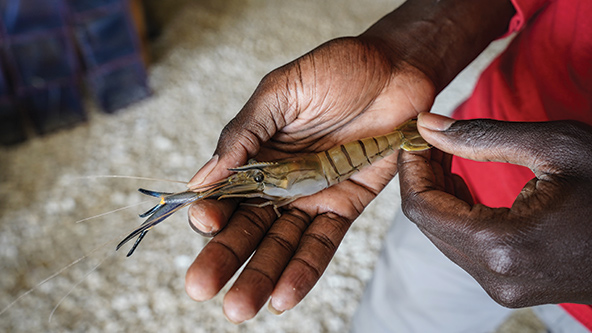
 One of the giant African river prawns from the Upstream Alliance’s trials. These natives of the Senegal River eat snails carrying parasitic larvae that cause schistosomiasis. (Photo courtesy of the Upstream Alliance)
Prawns are likely not the first answer that comes to mind when asked how to reduce rates of one of the world’s most persistent tropical diseases. And yet, in the Senegal River basin in West Africa, the crustacean is an unlikely ally of the global health community.
Schistosomiasis infects an estimated 200 million people annually and puts 700 million more at risk. Chronic infection is acquired through exposure to freshwater parasitic worms and leads to anemia, abdominal pain, and blood in the stool and urine. The disease causes “a lot of suffering, and that burden disproportionately affects the poor of the world,” says Susanne Sokolow, a disease ecologist at Stanford University. Ninety percent of schistosomiasis cases occur in sub-Saharan African countries like Senegal.
Disease rates spiked after the construction of a dam along the Senegal River disrupted the life cycle of the native African river prawn. Survival of the prawns hinged on a migratory journey to the brackish waters near the Atlantic Ocean. Impeded by the dam, the prawns became locally extinct upriver from the site.
The prawns had been predators of the freshwater snails that host the parasitic larvae causing schistosomiasis, which is transmitted when the larva leaves the snail shell and burrows into someone’s skin. With no predator, the snail population quickly grew, expanding prime territory for the parasite and increasing disease transmission.
Schistosomiasis is treatable with a drug called Praziquantel. However, the drug’s benefits are minimal in the Senegal River basin because people are consistently exposed to parasite- infested waters and are therefore unable to escape the cycle of the disease. “This is a population living in a subsistence economy with no access to clean water,” explains Giulio De Leo, a Stanford University biologist. “People have no choice but to go to the river for their daily chores, and if the water is contaminated, they get infected again.”
In 2015, a multidisciplinary team called the Upstream Alliance confirmed its hypothesis: that reintroducing freshwater prawns into the Senegal River could reduce schistosomiasis transmission. Field studies were supported by the Bill & Melinda Gates Foundation, the National Science Foundation, and Grand Challenges Canada.
The Upstream Alliance was cofounded by Sokolow, De Leo, partners in Senegal, and advisors in eight other countries. The group seeks solutions that not only reduce schistosomiasis, but also help restore ecosystems and alleviate poverty.
Their next step is to promote a locally run social enterprise that expands the prawn hatchery initially built for scientific studies. A portion of domesticated prawns would be sold at restaurants in Senegal’s major cities.
Profit generated from those sales would fund the social impact arm of the business: the free distribution of prawns in at-risk Senegal River village water-access points. Here, the prawns would provide lasting relief against disease transmission by keeping snail populations in check. Once fully grown, the crustaceans could be eaten or sold at market, improving food security and helping families edge away from the poverty line.
A challenge for the Upstream Alliance is the expansion into a nascent aquaculture sector in an emerging market. “It takes a good 7 to 10 years for aquaculture ventures to really scale and be a thriving business,” says Sara Minard, an economist who previously ran a fish aquaculture business in Senegal.
The Upstream Alliance’s business model is designed so that funding would come from different types of investors, including commercial lenders. The complex financing system is designed to be mindful of the venture’s longer timescale, greater and more complex business risks, and need to accomplish its social impact mandate.
“From a financial perspective, the complexity is designed to reduce risk. A reduction in risk means that [the venture] should be able to raise lower-cost capital,” says Constantin Gurdgiev, a professor of finance at the Middlebury Institute of International Studies at Monterey and the economist who developed the business model.
The model uses a financial mechanism called convertible equity, where ownership can be converted to immediately payable debt if the business doesn’t fulfill its social impact mandate of supplying prawns to villages to reduce human disease. Gurdgiev says the venture’s risk-adjusted returns on investment are comparable to those currently expected by commercial investors in West Africa.
The Upstream Alliance has found other parts of the world where dam building has increased schistosomiasis transmission risk. After testing its business model in Senegal, the organization could scale to other places where native migratory prawns have been affected by dams and where aquaculture operations could help restore them. Initial research in Brazil already shows promise.
“If it’s successful, we would have proven that impact investment can be used for a win-win-win—addressing a global health concern, helping the environment, and raising people out of poverty,” Sokolow says. “That could be a breakthrough.”
Read more stories by Hilary Duff.