


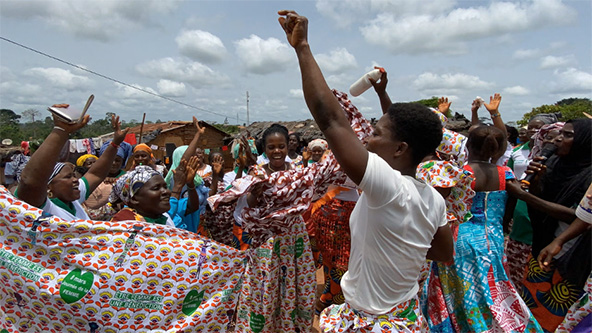
 Women in Côte d’Ivoire celebrate the completion of their Village Savings and Loan Association cycle. (Photo by Cheryl Djiro, courtesy of CARE)
In an era of shrinking global aid budgets and growing pressure to deliver lasting social impact, governments, funders, and NGOs face a common challenge: how to scale what works. Many leaders point to community-grown solutions as more trusted, sustainable, and embedded in local realities than top-down approaches. But few examples show what it takes to move those solutions into the mainstream or how public systems can scale them without diluting what made them effective.
One exception is village savings and loan associations (VSLAs), or savings groups. Since the humanitarian agency CARE first formalized the model in Niger in 1991, building on what women were already doing (pooling money, lending to each other, and supporting each other through life’s ups and downs), VSLAs have spread to more than 67 countries and helped nearly 21 million people access financial resources, typically in rural or impoverished places where banks can’t or won’t go. Dozens of other international and local NGOs have meanwhile adopted variations of the model, working with community members to train others on how to save, borrow, and build a future for themselves. These groups offer a useful, real-world example of how organizations can make strategic investments to scale community-led models through public systems while keeping communities in the driver’s seat.
The Policy Pivot From Oversight to Community Ownership
In many countries, savings groups initially grew and spread outside the direct purview of the state—quietly multiplying, building collective power, and meeting financial needs where formal systems couldn’t. But as their footprint grew, so did regulatory attention. Some governments, misclassifying them as microfinance institutions, introduced well-intentioned but ill-fitting rules, such as requiring groups to register as cooperatives, meet capital thresholds, or report like formal lenders. These processes often demanded fees, literacy, or documentation that exceeded the groups’ design. The result: Scaling efforts slowed, some groups feared extinction, and millions of women risked losing access to the only financial services available to them.
In response, NGOs, civil society, and, increasingly, group members themselves began a sustained effort to change the narrative and encourage governments to recognize their value, protect their autonomy, and invest in their growth.
That effort is now paying off. Today, governments in countries as diverse as Vietnam, Nigeria, Egypt, Rwanda, and Zambia are not only permitting savings groups to operate, but also launching their own; they’re training facilitators, embedding the model into national financial inclusion and social protection strategies, and allocating money to support them. In some contexts, ministries are mandating savings groups as delivery mechanisms for broader public programs, including ones focused on women’s economic inclusion, agriculture, health, and nutrition.
This shift occurred because governments saw the model working in communities they had long struggled to reach, and because civil society organizations helped build trust, support implementation, and generate evidence of impact. Together, these efforts created an enabling environment that allowed public systems to recognize the model’s value and take steps to adapt and sustain it at scale.
The Role of Government in Scaling What Works
Public systems are uniquely positioned to take a good practice further. Governments have the infrastructure, policy tools, and staying power that NGOs alone do not. And for governments working to close the financial inclusion gap and reach the last mile, savings groups offer a rare entry point. They’re locally led, and thus already present, trusted, and delivering results for women, as well as for the broader communities and systems they’re part of. The women at the center of these groups are already building economic resilience and social cohesion at the community level, making them natural allies for public systems seeking to expand their reach.
Governments can shape the scale and sustainability of these models in three main ways. The first is through policy and institutional support. By embedding savings groups in national development plans and systems, governments lend them legitimacy and long-term backing. This includes integrating groups into financial inclusion, poverty reduction, and social protection strategies; establishing regulatory frameworks that protect informal models while enabling voluntary pathways to formal services; and creating financial mechanisms, like entrepreneurship funds or agricultural inputs, that link groups to wider markets. Public funding for training and coordination, delivered through local partners or extension services, further supports sustainability.
Governments can also shape savings groups through infrastructure and digital access. As savings groups mature, so does their need for secure savings, reliable records, and broader financial access. Governments play an important role in ensuring that there’s infrastructure in place to support this evolution, particularly through investments in digital connectivity, national identification systems, and mobile networks. Public-private collaboration is essential to context-specific solutions. In Egypt, for example, the Central Bank worked with CARE, UN Women, telecom companies, and group members to co-design a mobile wallet that mirrored traditional group security practices. In Zambia, ministries partnered with mobile operators to create low-cost platforms that digitize savings while maintaining in-person group functions.
Finally, governments can play a role in institutionalizing monitoring and evaluation by equipping civil society and public officials with shared tools to track performance, strengthen accountability, and build lasting public capacity. The Savings Group Information Exchange data collection system, for example, provides standardized data on group performance across organizations and countries to help governments and NGOs monitor outreach, savings, loan repayment, and other key indicators at scale.
Rather than diluting the community-led nature of interventions, these practices strengthen the systems around them by preserving community agency, removing barriers, adapting to existing practices, and lowering entry costs. As a result, initiatives scale faster, last longer, and reach further.
Five Practical Lessons From Scaling Savings Groups
1. Lead with public priorities. Governments adopt community models for the long-term to meet policy goals, not solely based on the merits of the model. Savings groups gained traction primarily because officials recognized their presence in communities and their practical value.
In Uganda, for example, the model aligned with frameworks such as the National Financial Inclusion Strategy and initiatives for women’s economic empowerment. In Nigeria, it helped implement rural outreach components of the National Social Investment Program. And in Côte d’Ivoire, it served as a tool for social cohesion and economic resilience in post-conflict regions.
2. Incorporate peer learning. Creating opportunities for government leaders to directly observe interventions in action builds trust more efficiently than policy papers.
In Burundi, for example, the Central Bank revised its draft decree to better reflect the model’s strengths after leaders engaged with Uganda’s Ministry of Finance, Planning, and Economic Development (MoFPEP) and Central Bank during a CARE-facilitated visit. They observed a decentralized structure, where district authorities managed group oversight and Uganda’s Microfinance Regulatory Department under MoFPEP (formerly the Microfinance Regulatory Authority) served as a bridge between informal groups and formal systems. They also saw how digital tools improved transparency, accountability, and credit access.
And in West Africa, organic peer exchanges also drove momentum. The Ministry of Solidarity in Côte d’Ivoire received delegations from Senegal and South Africa, giving them a firsthand look at the country’s savings group scaling strategy, its ambitious goal to reach 25,000 people, and the partnerships supporting this effort. These direct encounters played an important role in shifting perceptions—from viewing groups as risks to recognizing them as ready-made infrastructure for inclusion.
3. Protect what works with light-touch policy. While too much regulation can undermine community-led models, some limited policy measures can help scale them by preserving the elements that make them thrive.
Vietnam’s Decree 19 formally recognizes informal savings groups as a legitimate form of mutual financial support, helping protect members from fraud while preserving the simplicity of group operations. The policy aligns with efforts by the State Bank of Vietnam, CARE, and others to support rural and ethnic minority women through community-based financial models. And in response to growing demand from Ugandan groups and women operating outside the formal system, which limited their ability to participate in state-sponsored development programs, CARE and others advocated for a policy solution that would formalize linkages with financial service providers without formalizing the groups themselves. The Microfinance Regulatory Department—in consultation with ministries, local leaders, and group members—developed guidelines for voluntary registration, clarified the role of local authorities, and coordinated outreach to groups across sectors.
4. Embrace collective action. Across countries, international and local organizations make the greatest progress not by championing their own models, but by working together to protect and strengthen the broader savings group network
Although international organizations like CARE, Catholic Relief Services, Mercy Corps, Plan International, World Vision, and many national NGOs each have different names for savings groups, they came together in coalitions to coordinate scaling efforts, serve as conveners, and speak with one voice to center the needs and experiences of rural women.
Meanwhile, with a mandate to narrow the gap in women’s financial inclusion, the Alliance for Financial Inclusion (AFI) developed policy frameworks and tools that positioned savings groups as drivers of women's economic empowerment. The frameworks linked women’s financial inclusion to broader goals like economic recovery, resilience, and equality, and were adopted by Zambia and other AFI member countries.
5. Share standards, not fixed models. The flexibility of savings groups allows them to work within different geographies, sectors, and policy environments. But scale still requires structure.
In many countries, CARE and other international organizations worked alongside government agencies to co-develop minimum standards—not to enforce uniformity, but to preserve core principles like transparency, self-governance, and group accountability while allowing for national adaptation. This process often involved months of negotiation, comparing savings group models and deciding what mattered most for impact and integrity, but it ultimately produced a foundation for governments to scale the model on their own terms, tailored to national strategies and local priorities.
In Rwanda, for example, savings groups supported refugee integration and livelihoods. In Bauchi State, Nigeria, they served as on-ramps to digital bank accounts and business registration. In fragile and climate-affected areas, governments used them as platforms for resilience planning and emergency response. None of these applications looked exactly the same but they were all based on group-led governance, collective savings, and trust. Scaling the principles rather than the packaging made these adaptations possible.
What Helped—and What Could Have Helped More
These lessons may seem straightforward, but they rest on years of persistent, often invisible work. Advocacy was rarely linear. Government champions shifted. Ministries merged or dissolved. Promising conversations stalled for months or years due to elections, budget cycles, or staff turnover. In some countries, progress took close to a decade.
CARE and its partners often encountered limiting assumptions. Some government agencies and officials, having been exposed to under-resourced or inconsistent programming, questioned the model’s relevance and instead looked for newer, flashier solutions. At the same time, the competitive nature of NGO funding made it harder to treat scale as a shared public goal. Many ministries still relied on NGOs for funding, implementation, and data, reinforcing the idea that savings groups were donor-driven projects rather than public infrastructure. The answer wasn’t a new model, but a new mindset—one that treated governments as co-investors, not end users.
Involving government stakeholders earlier in the design process, prioritizing women’s voices at every stage, and creating direct avenues for savings group members to engage with policy makers all would have accelerated progress. Earlier alignment among NGOs could have provided governments with more consistent messaging, and stronger investment in local data systems might have supported longer-term ownership.
Still, the groundwork paid off. Advocacy in places like Niger persisted through political transitions. Teams adapted to shifting mandates and identified new champions along the way. International organizations and civil society groups built coalitions to strengthen collective influence. Flexible funding supported not just programming, but the slower, foundational work of systems change. Over time, governments and communities began to co-create solutions grounded in local priorities—and women emerged as powerful advocates. In Côte d’Ivoire, for example, the Amazons formed savings groups networks and brought their demands directly to policy makers, helping shape national policies on inclusive financial systems, forced marriage, and other issues affecting women and girls.
This steady groundwork enabled governments to stop seeing savings groups as NGO projects and start seeing them as public infrastructure they could own, adapt, and scale to reach their most underserved citizens.
A Path for Other Sectors
The experience of savings groups offers a powerful challenge to traditional assumptions about scale. For decades, the social sector has seen scale as a matter of replication: expanding a fixed model through donor funding, technical expertise, and branded programming. But what if public systems could scale community-led solutions not by absorbing or reshaping them, but by recognizing their value and investing in the conditions that help them grow?
That is what happened with savings groups. Community members built something that worked. Civil society protected it. And governments, over time, came to see it not as a competing model, but as a strategic partner in reaching marginalized citizens.
This approach isn’t limited to financial inclusion; the same approach can apply to health, education, agriculture, or climate resilience efforts. The savings group story also suggests that scale isn’t just about size, but about staying power. It happens when institutions invest in local ideas that are already working—and let communities keep the lead.
Read more stories by Aisha Rahamatali, Vidhya Sriram & Maria Liu.