


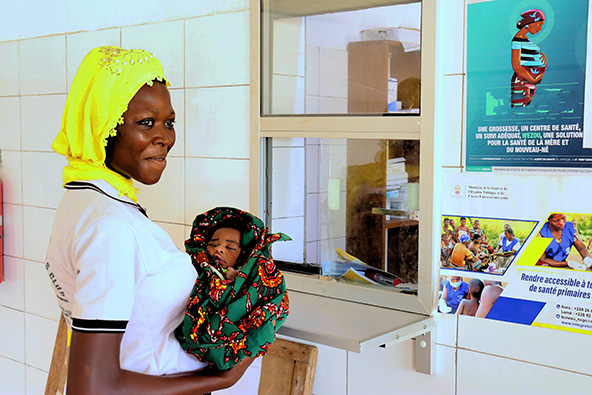
 A young mother at the Kpétab health center, Dankpen district, Togo. (Photo courtesy of Integrate Health)
Late in 2020, the Togolese Ministry of Health (MoH) put out a call for help. The office of the presidency had given the MoH a clear directive: Figure out how to make maternal health care free. Our NGO, Integrate Health (IH), has been working on innovative approaches to primary health care in Togo since 2004, and we’ve developed a strong collaborative relationship with the ministry over time.
This was a big opportunity, and our team mobilized in response. In a few short months, we developed package options, with cost and impact modeling to show the trade-offs of each. Following a presentation by IH, the MoH made its final recommendation. WEZOU, meaning “breath of life” in the Kabiyé language, was officially launched in 2021, and a core package of key maternal health care interventions became free for the first time to women across Togo, paid for wholly by the government of Togo. The example underscores how government can set an ambitious vision and then leverage NGOs as learning partners to drive positive change at scale.
This article goes beyond the success story to offer a compelling framework for how NGOs can act as learning partners to government, not merely implementers. By testing innovations, breaking down complex models into scalable components, and providing cost and impact data, NGOs like IH help governments make decisions in resource-constrained environments. As global aid declines, this partnership model may hold the key to sustainable, government-led health reform.
Why Do Governments Need Learning Partners?
While the role of NGOs is to show what is possible, the role of government is to decide what is doable. Governments hold the mandate for national health care delivery and are accountable to their citizens. While all governments have ambitious national plans, including specific targets around mortality reduction, governments in low- and middle-income countries face significant resource constraints. These constraints across budgets, human resources, and infrastructure make it uniquely challenging for governments to take on the risk of testing new ideas and approaches. With philanthropic money, NGOs can take on this risk, developing innovations useful to governments and serving an essential role in government adaptation and implementation. At Integrate Health, we realized early on that this only works if you are seen as a trusted collaborator, and we worked hard to make that happen.
The recent devastating collapse of foreign aid makes the efficient allocation of resources by government even more critical and the potential role of NGOs as learning partners even more valuable. Policymaking is, as Ken Opalo, professor of comparative politics at Georgetown, reminds us, the act of weighing trade-offs. And this creates an opportunity for NGOs, especially small, nimble, and entrepreneurial entities, to take on the risk of testing new innovations and approaches in concert with government partners. NGOs who position themselves as learning partners can accompany government with the cost and impact data needed to assess trade-offs and make informed decisions.
Togo, alongside other West African countries, has received significantly less US foreign aid, which makes it an especially relevant and inspiring case study for the present moment.
Proof of Concept
Operating in Togo since 2004, IH has piloted, tested, and replicated the Integrated Primary Care Program (IPCP). With a clear focus on scale, we first identified our endgame strategy: government. We then effectively designed and executed our scale strategy, beginning with a pilot, then replication, before entering the Big Shift (or le Grand Changement, as our colleagues in West Africa call it).
We built this model as a package, combining the most effective, evidence-based interventions that together would overcome major barriers and make high-quality care accessible to women and children in remote, rural communities. We conducted research to show the cost and impact of this integrated approach on mortality reduction. We published results showing a 30 percent reduction of under-5 mortality at a cost of $9 per capita. As a small organization, we had to generate this rigorous evidence to demonstrate the effectiveness of the intervention and secure funding. However, it was only after the pilot and replication phases of the IPCP were complete that our real learning on scale began.
Reframing the Problem
Impressive impact results achieved by a small, nimble, and innovative NGO are exciting, and they should not be overlooked for what they represent in human terms. However, the true challenge is to support governments to achieve the same results at national scale. By acting as learning partners, NGOs can help governments quickly and easily get their hands on the information they need to prioritize high-impact interventions and invest accordingly. This is the best and fastest way we can help governments deliver quality health care at scale.
To do that we must help them figure out 1) what to prioritize, 2) how much those things cost, and 3) how to make them work “on their hardware.” We look to the example of maternal health reform in Togo to show how this was done.
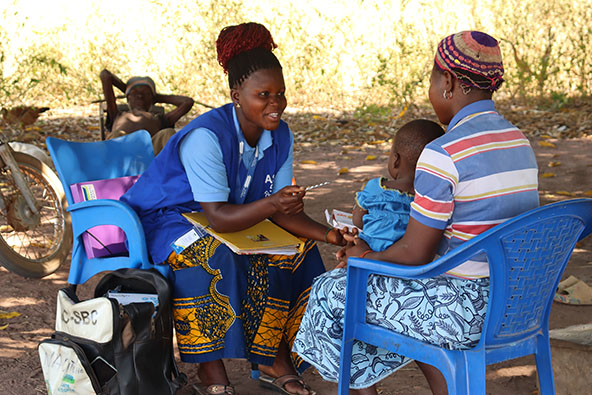 Community health worker Naoutche Malibe provides care to a child at the Kpétab health center, Dankpen district, Togo. (Photo courtesy of Integrate Health)
1. Chunk It: Find the Scalable Unit
Often NGO interventions are complex or multi-faceted. They have to be to maximize effectiveness for the end user (the beneficiary or patient). In our case, the IPCP is an integrated package, a bundle of evidence-based interventions intentionally designed to address all the major barriers to care. This comprehensive approach is required to improve patient care. After all, a trained provider with no supplies cannot deliver effective care. The integrated package is what patients need. It is what makes the most sense at the delivery level, and it is what we had to pilot and replicate to build the evidence base that would allow us to raise funds.
But when we looked to scale, we realized we needed a smaller unit that could help governments choose from among their many competing priorities. They couldn’t push through a new community health worker policy, user fee removal, and a new mentorship approach all at the same time. But they could do them separately, as they did when they removed user fees for maternal health care. We helped them do that, and that process helped us learn that we had to break up the components and scale them in parallel. While coordinated service delivery is a necessity at the last mile, we learned that we needed to break apart our detailed evidence and implementation plans by core model component to collaborate with the correct and corresponding actors to scale these innovations to the national level.
2. Cost It: Quantify the Unit Cost and Model the Impact at Scale
Then we had to look at the cost separately so that we could support the government to model different cost-impact scenarios. Looking again at the maternal fee removal example, our team developed a set of three options, then clearly outlined the projected costs and impacts of each. With these scenarios, the government could look directly at the trade-offs. The leanest package covered four prenatal consultations and a limited set of lab tests at a projected annual cost of $5 million. The most robust package covered eight prenatal consultations and all recommended lab tests, including ultrasound screening, at a projected annual cost of more than $11 million. This information helped the government to make strategic investment decisions. Government has limited resources, and they were looking to us to provide the information to help them decide how to best allocate those resources. Ultimately, the government decided to initially adopt a smaller package that they could fully fund with domestic resources and therefore not have to rely on foreign donors.
3. Test It: Use Iterative Learning Cycles to Test Implementation Strategies
Finally, with the components separated and costed, we can test different implementation strategies for each component. This allows us to engage in iterative learning and supply our government partners with ongoing information. In the free maternal health example, after the government rolled out its initial package, and enrolled 200,000 women in the first nine months, we continued to advocate for the next most important components to be added. We costed and scaled a rural ambulance program to ensure women reach critical health services in time, and an ultrasound program to ensure high-risk pregnancies are identified early, in collaboration with the regional MoH.
The ultrasound pilot showed that obstetric ultrasound screening could be effectively conducted by midwives, making it feasible and cost-effective in places like Togo with severely limited numbers of trained ultrasound specialists such as radiologists and obstetricians. Two years after the initial package was launched, the government announced that they were adding ultrasound to the initial package. This is an ideal example of how we want our ongoing learning efforts to continually serve government decision- and policy-making.
Conclusion
At IH, we have shifted our thinking from scaling via government, to serving as a learning lab for government. As an NGO, we leverage philanthropic funding to take on the risk of testing new innovations, then supply government with the cost and impact data they need to make informed decisions to most effectively allocate limited resources. This learning informs national policy implementation and funding, effectively ensuring scale. But it ceases to propagate the illusion that any government is looking to “adopt and scale up” a particular NGO’s intervention.
We are now working to provide equally valuable learning and insights on cost and impact for the other components of our integrated approach, including professional community health workers, clinical mentors, and expanded user fee removal. As these distinct policies get progressively adopted and implemented at scale, communities across the country will benefit from the full integrated approach. This is a radically different way of operating in support of governments and one that we hope others will emulate. As the future of US government and other bilateral funding is at risk, we hope governments will lead, and we stand ready to support them. Let the maternal health reform in Togo serve as an example of government vision and leadership that was advanced by key strategic support from an NGO working as a learning partner. The result is hundreds of thousands of women with improved access to maternal health care, which will contribute to driving down maternal mortality. This concrete, measurable outcome in lives saved is the common goal to which we all aspire.
Read more stories by Jennifer Schechter, Emily Bensen & N’Toumbi Tiguida Sissoko.