


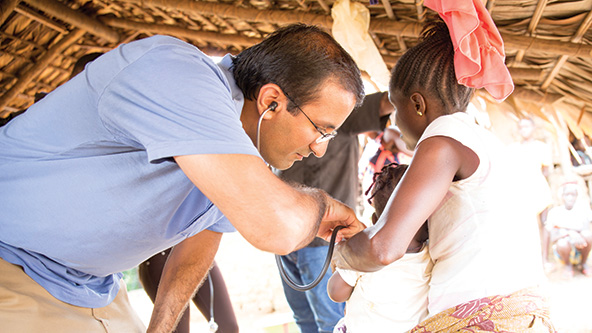
 Dr. Raj Panjabi of Last Mile Health examines a patient in Liberia via its community health worker program.
Joining forces with government can turn small-scale social efforts into large-scale innovations that benefit historically under-resourced and underserved communities. The most pressing challenges of our time—from global health crises to social, economic, and racial inequity—cannot be solved by any single sector. Delivering solutions at speed and scale requires a multisector coalition—and government plays a central role given its mandate, infrastructure, and unparalleled resources.
Social Innovation and the Journey to Transformation

Philanthropy has long invested in solutions to societal challenges like climate change and inadequate health care. Transforming entire ecosystems requires more investment in social innovators who can build bridges across sectors and between disparate parts of a system to drive collective action and impact all with a greater emphasis on equity, trust, and partnership. Sponsored by the Skoll Foundation
Read more stories and behind-the-scenes lessons about how social innovators shift systems through collective action in “Orchestrators of Change and the Journey to Transformation,” sponsored by the Skoll Foundation
As nonprofit leaders who have partnered closely with governments—Hyphen in the United States and Last Mile Health in four African countries and globally—we have seen firsthand how engaging with government can shift resource flows and decision-making pathways to accelerate and magnify lasting systems change. While we work in very different spaces, we’ve come to the same realization that everyone has a role to play, whether they are community leaders with lived experience and knowledge of the problems, or government, civil society, business, or philanthropic leaders.
Hyphen ensures that resources from historic federal policies like the American Rescue Plan accelerate systems change and improve the material conditions of families with low incomes, communities of color, and other underserved populations. Hyphen engages philanthropic and private-sector leadership and resources to leverage and drive federal dollars to where they are critically needed and can have long-term impact.
Last Mile Health works to save lives in the world’s most remote communities by professionalizing community health workers and embedding them in national health systems. Last Mile Health partners directly with government in countries like Liberia and also cofounded Africa Frontline First, a global partnership to make financing more available and effective for countries, enabling national community health worker programs to deliver at scale.
Unlocking the vast potential of government partnerships requires significant effort and fortitude. While our organizations have been fortunate to work with government leaders with a shared vision for the change we want to see in the world, collaborating with government also requires intense levels of coordination and relationship-building with all partners.
This is where the work of our organizations comes in. We act as system orchestrators who align the efforts of government, nonprofits, philanthropy, business, and communities to identify points of leverage and drive big, lasting change. We cultivate, build, and activate connections to form coalitions. We translate between public- and private-sector actors to help them uncover and align on shared interests and goals. We steward relationships so that government leaders, civil society actors, and private-sector partners can work together in ways they otherwise could not. We navigate complex decision-making structures, leadership transitions, changing priorities, electoral cycles, and other disruptive forces to maximize continuity for long-term initiatives. And in the case of Last Mile Health, we even embed ourselves in government teams.
Is partnering with government easy? No. Is it worthwhile? Absolutely. Successful joint public-private efforts can produce inspiring results.
At Last Mile Health, our partnership with the Liberian government resulted in the country’s first national community health worker program, which now reaches every rural and remote community in the nation. Community health workers now diagnose and treat 50 percent of malaria cases in children under five, and in places like Grand Bassa County, they are the primary caregivers for sick children. This progress required years of building evidence and relationships, seizing the right opportunity (post-Ebola rebuilding), mobilizing multiple funding institutions and implementing partners, and aligning various government priorities.
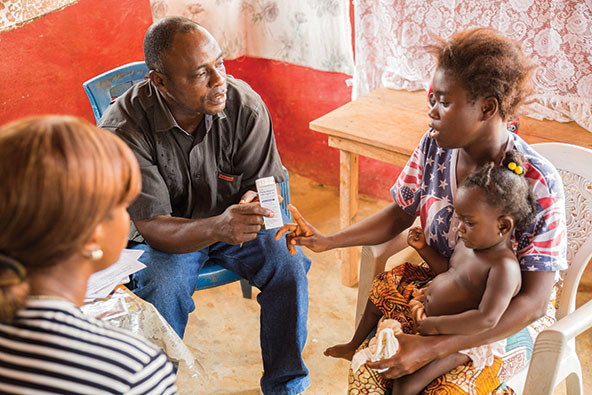 A community health worker explains a medication to a patient in rural Liberia.
Success in Liberia has led to broader partnerships. Through Africa Frontline First, we help 17 governments in Africa maximize financing for community health. That includes developing policies, plans, and alignment to ensure every dollar invested leads to more patients getting the care they deserve. Cofounded by the Financing Alliance for Health and the Community Health Impact Coalition, Africa Frontline First puts countries in the driver’s seat of their community health plans, backed by financing from partners like the Skoll Foundation, Johnson & Johnson Foundation, and The Global Fund to Fight AIDS, Tuberculosis and Malaria, coupled with technical expertise from peer organizations including Integrate Health, Living Goods, and Muso.
At Hyphen, the multisector public-private partnerships we have developed have driven nearly $1 billion in federal funding into communities in need. The Initiative for Inclusive Entrepreneurship (IIE)—an 18-month national pilot that Hyphen incubated in collaboration with the US Department of Treasury and small-business organizations—leverages Treasury’s State Small Business Credit Initiative (SSBCI) to generate more than $215 million in capital for small businesses owned by socially or economically disadvantaged entrepreneurs. The Community Violence Intervention Collaborative—another 18-month pilot that Hyphen incubated with leadership from community violence intervention (CVI) organizations and the White House Domestic Policy Council and Office of Intergovernmental Affairs—laid the groundwork for the formation of the Coalition to Advance Public Safety and the allocation of $100 million in grants from the US Department of Justice and more than $761 million in public commitments for CVI programs nationwide.
While Hyphen and Last Mile Health work on different issue areas in different places, we have distilled some key lessons for driving government resources into intended communities:
Bridging and translating are critical work. | When Hyphen launches a new public-private collaboration, we serve as the bridge between different sectors, helping government, philanthropic, and business leaders understand how the other sectors work, navigate limitations, align interests, and develop shared goals. It’s also essential to help government and donors grasp the challenges, lived experience, and wisdom of impacted communities. Rather than advocating on behalf of these communities, both Last Mile Health and Hyphen provide community leaders a seat at the table, whether that looks like community health workers serving on high-level councils or grassroots CVI leaders engaging directly with federal officials. Our organizations also help field leaders navigate the complex protocols, procedures, and expectations of government, philanthropic, and privatesector partners. This bridging and translating role is crucial to our success.
Timing matters. | We must take advantage of windows of opportunity when they open. We must also expect occasional failures, whether they are the result of external circumstances or a lack of stakeholder alignment. At Last Mile Health, we talk a lot about timing: When we fail to convince a government partner to support community health programs at the level we think is necessary, we remind ourselves, “It’s not the idea that failed. It’s just the wrong time. And we have to be ready when the window opens again.” In Hyphen’s experience, this is also true for our multisector partnerships.
Connect vision to action. | When it comes to moving from disparate visions to shared action, partnerships can drag under the weight of complex issues. At Last Mile Health, we try to listen for the “ next right move.” For example, at a recent global health initiative meeting, we challenged the group to show concrete action within 90 days and provided several suggestions. Meanwhile, Hyphen’s approach is to keep the focus on leveraging federal resources to benefit under-resourced communities and engaging partners across sectors to make their unique contributions to achieve that shared goal. At Hyphen, we always say that a vision without a plan is just a hallucination, and the stakes are too high to not be intentional about this work. This action orientation pushes progress and builds momentum for bigger change.
A systematic yet flexible approach is crucial. | Part of our work is methodically and continually checking in with all parties and banding together to tackle challenges. This often invisible work may mean raising additional capital or facilitating difficult conversations between partners. Effective governance requires effective policy implementation. To realize the full potential of new laws, civil society will have to flex new muscles, including coinvesting in policy implementation alongside the federal government. This once-in-a-generation opportunity to advance climate, workforce, and equity goals while ensuring that funds benefit underserved communities and achieve durable structural change will slip away without speedy and substantial philanthropic support.
Think long-term. | Shifting policies, securing large-scale funding, and ensuring service delivery and access do not happen overnight. Measuring success doesn’t either. We must employ innovative approaches to track the directional progress of change and determine if our solutions are still having impact over time, despite political, economic, and social uncertainties. For example, philanthropic grants are often awarded on an annual rather than a multiyear basis. But the federal SSBCI program’s time horizon is at least 10 years, and the associated funds will likely circulate through the US financial system for two decades.
We have seen firsthand the important role that government plays in driving deep systemic change. When funders support efforts to bring together public and private entities and individuals to achieve shared goals, their investment can be multiplied a thousand times and benefit real people in real communities around the world.
Training and equipping community health workers is a proven way to improve health outcomes in underserved communities. Learn how NGOs and governments are partnering to scale this solution across sub-Saharan Africa.
Read more stories by Nan Chen & Archana Sahgal.