


 A girls’ school in India is working to shift gender norms in partnership with Breakthrough.
We are all shaped by stories. But we are not all aware of how much we are influenced by dominant narratives—or who holds the privilege of producing and disseminating them.
Social Innovation and the Journey to Transformation
Philanthropy has long invested in solutions to societal challenges like climate change and inadequate health care. Transforming entire ecosystems requires more investment in social innovators who can build bridges across sectors and between disparate parts of a system to drive collective action and impact all with a greater emphasis on equity, trust, and partnership. Sponsored by the Skoll Foundation
Read more stories and behind-the-scenes lessons about how social innovators shift systems through collective action in “Orchestrators of Change and the Journey to Transformation,” sponsored by the Skoll Foundation
Many believe that storytelling lies exclusively within the province of the entertainment sector. But the truth is that narratives are everywhere and they influence how we see the world, the issues that matter to us, and even how we view ourselves, as we work to reinforce or change existing narratives.
In our respective roles at Breakthrough Trust and IllumiNative, we focus on replacing the narratives that have rendered our causes and people invisible and on deploying storytelling and narrative change as tools for engagement, education, and ultimately, movement building and systems transformation.
For the past 25 years, Breakthrough has worked to shift social norms so that discrimination and violence against women and girls are viewed as unacceptable. It engages directly with young people, their families, and their teachers—both in schools and communities—all with the goal of sensitizing the important people around them to gender-based violence. The goal is to equip future generations of young adults to build a better world. Breakthrough also creates and pushes for gender-equitable content in mainstream media and uses social and behavior change communication (SBCC), pop culture, and storytelling to shift culture, ideas, and thinking.
IllumiNative is a Native woman-led racial and social justice organization dedicated to building power and advancing equity, justice, and self-determination for Native peoples by increasing the visibility of—and challenging the narrative about—Native peoples. Historically, Indigenous people in the United States have suffered horrific violence and harm at the hands of society and government. We’ve seen our cultures and experiences erased. IllumiNative was founded to increase representation on multiple fronts: advocacy and political representation, popular culture and entertainment, research on Native issues, and storytelling, particularly for the young.
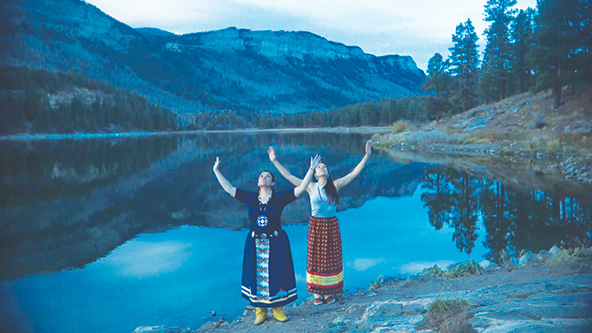 The above still is from the IllumiNative short film, Setting the Table, directed by Kyle Bell (Thlopthlocco Tribal Town). (Photo courtesy of IllumiNative)
Both organizations work to provide a map for others to build narrative power and capacity among underrepresented groups and on issues of vital importance to those communities. Although they work in very different cultural and societal contexts—Breakthrough primarily in India, IllumiNative in the United States—the organizations combat the same challenges, including erasure and disempowerment, faced by most people who have suffered grievous harm and injustice and been rendered largely invisible in historical narratives. Our partnership with the Skoll Foundation enabled both to successfully move beyond developing and sharing stories and media narratives to reach another level where we can invest in people and communities to build their capacity to tell their own stories. In this way, they gain the agency, power, and presence to positively influence harmful cultural stereotypes, and eventually, policies, laws, and systems.
Despite their progress, they still have several critical hurdles to clear, and they are especially salient for funders to hear, given the growing interest in funding narrative change strategies in the philanthropic sector (and the risk that skepticism about the efficacy of narrative change will relegate it to a fleeting trend).
Narrative change and storytelling are fundamentally about connection. People feel connected to each other when they see themselves represented, and they are encouraged to join movements.
Narrative change strategies must work in tandem with other strategies. The organizations use a multipronged approach to narrative change. Breakthrough produces content to dismantle toxic norms around gender and gender-based violence and engages in ongoing dialogue with parents, teachers, and young people. The content is largely driven by its work with young people, which demonstrates how they interact with media, what they consume, and how it influences them and facilitates youth-led progressive digital content that amplifies stories of change in their own lives. In this way, Breakthrough works to change systems from the inside out. IllumiNative uses its research to inform its narrative, cultural, and organizing strategies that advance Native representation. It does this via campaigns that build the advocacy and movement-building skills of Native Americans on a range of issues important to the community. In other words, narrative strategies are a powerful tool for change—but this tool cannot drive change on its own. Our organizations are intentional about building bridges to other parts of the systems we seek to transform in hopes that others will be inspired to act. This intentional bridge-building makes us effective partners and advisors to other actors seeking to change the same ecosystems. Breakthrough, for example, works closely with both the government school system and mainstream content creators in India, and IllumiNative fills the same role with actors in the entertainment industry.
We must reconceptualize what success and impact look like for narrative change. There are too many harmful narratives crowding the marketplace. In fact, there are too many narratives, period, shared through a dizzying array of platforms, channels, and media outlets. This can make it challenging for new narratives to take hold. But with the right mix of bridge-building to other strategies and patience with respect to storytelling, dissemination, and grassroots activism and engagement, we know that positive change is possible, and narrative strategies are a critical reason why.
In the United States, the Standing Rock Sioux Tribe’s fight against the Dakota Access Pipeline galvanized an ongoing movement in Native American communities around water rights. While the pipeline was eventually built, the narrative strategy employed inspired millions of Natives and non-Natives to become activists for Native American rights across a spectrum of issues, including accurately documenting the abuse suffered by Indigenous children who were involuntarily placed in boarding schools.
We also need different measurement and evaluation tools beyond the crude metrics often used to quantify storytelling efforts, such as media impressions, website traffic numbers, and open and click-through rates on emails and newsletters. While these metrics have some validity in the immediate term, they do not reveal if the story is being effectively shared, or if it has succeeded in changing something—be it people’s attitudes or mindsets about a particular issue, or the defeat of a specific legislative action under debate. Funders should support the development of new theories and instruments for measuring narrative change so we can learn what’s working and what’s not.
Funders should invest in infrastructure to support more narrative change efforts. Narrative change and storytelling strategies are fundamentally about connection. People feel connected to each other when they see themselves represented. And that feeling encourages them to raise their voices and join movements. This type of connection, however, requires support and structure. People need to be trained in understanding narrative and culture change, they need resources to develop and share their own stories, and they need to infuse narratives into on-the-ground organizing and community engagement.
These strategies are most powerful when they are authentic, developed and disseminated by the people at the heart of the stories. Much of what is produced in media and entertainment is driven primarily by profit concerns. The result is that too many groups of people have been shut out of and even harmed by traditional platforms.
Recently, IllumiNative announced the launch of IllumiNative Entertainment, a wholly owned subsidiary that will give more Native Americans the opportunity to shape stories in TV and film, both in front of and behind the camera. And Breakthrough launched a talk show developed, produced, and directed with creators from the entertainment industry to push conversations on gender-positive stories and what it takes to create them. The idea is to build a cohort of upcoming influencers and storytellers and engage with them regularly.
Narrative change work comes with its own set of challenges. Given the vast scale of content creation and storytelling, the industry dynamics, and the many people involved, our vision of making a dent in this universe is a monumental one. And the ideas around implementing this work are new and still evolving. We need more research on narrative shifts and how to flip the culture to make room for alternative narratives. We also need funders to embrace a long-term perspective when it comes to supporting innovative, collaborative approaches.
Narrative strategy work is a marathon, not a sprint. It requires sustained investment in building diverse networks of storytellers, supporting the development of new media platforms, and fostering partnerships across sectors. By providing flexible long-term funding and enabling partners to take risks, funders can create transformational change and challenge harmful stereotypes.
IllumiNative sits at the intersection of research, community organizing, and storytelling for and with Native communities in the United States. Learn more about its origin story and wide-reaching impact.
Read more stories by Sohini Bhattacharya & Crystal Echo Hawk.