


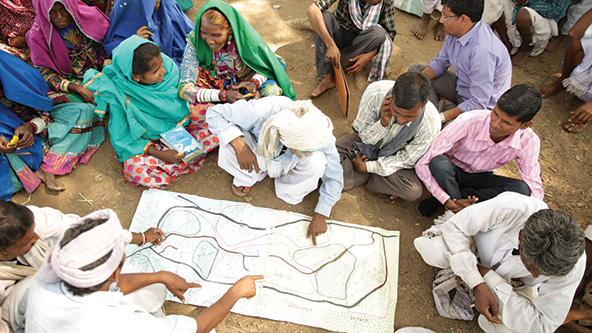
 Community members in India discuss their plan for land rehabilitation using methods from the foundation for ecological security.
Collaborative philanthropy has surged in the past decade, moving billions of dollars to high-impact ventures. It’s time to dream bigger and reimagine what’s possible. By improving how we unite funders, we can make faster, bolder decisions, raise more resources, and share knowledge—while easing the burden on ventures. While we’ve seen incredible progress, there’s room to refine and strengthen this approach for the long haul. Here’s what we’ve learned and where we believe collaborative philanthropy can go next.
Social Innovation and the Journey to Transformation

Philanthropy has long invested in solutions to societal challenges like climate change and inadequate health care. Transforming entire ecosystems requires more investment in social innovators who can build bridges across sectors and between disparate parts of a system to drive collective action and impact all with a greater emphasis on equity, trust, and partnership. Sponsored by the Skoll Foundation
Read more stories and behind-the-scenes lessons about how social innovators shift systems through collective action in “Orchestrators of Change and the Journey to Transformation,” sponsored by the Skoll Foundation
Rippleworks has participated in collaborative philanthropy across the spectrum of formal platforms and conveners to informal networks and information sharing. We’ve learned five lessons from this work:
Collaboration pushes funders outside their boxes. | By participating in platforms like The Audacious Project, we have stretched to fund organizations that we may not have otherwise. As part of the 2020 Audacious Project, we were introduced to the Humanitarian OpenStreetMap Team (HOT). Before HOT walked into the room, mapping was not the type of social innovation that we would have gravitated toward. HOT shared how the billion unmapped people are unseen. It is impossible to effectively dispatch first responders, plan a vaccination campaign, or trace the spread of diseases to the unmapped. By 2020, HOT had already mapped 100 million, and with the goal to reach 1 billion people, they required a large injection of funding. We realized then that if we cared about improving the human condition, we had to start with ensuring they were seen. The Audacious community funded HOT to map 1 billion people living in poverty and at high risk of disaster. Since receiving Audacious funding, HOT has mapped 707 million people in 24 countries and is on track to achieve its goal of 1 billion by 2025. HOT maps have been used to enable 95 percent vaccination rates for measles in the Democratic Republic of the Congo, helped reach 80 percent of homes in parts of Mozambique with malarial spray teams, and have been a critical threshold for preventing the spread of the disease. We wouldn’t have been informed or inspired to fund HOT without collaborative philanthropy.
Proactively sharing diligence reduces the burden on funders and ventures. | Rippleworks has invested in our own staff to find and conduct diligence on each venture we fund. We’ve discovered that by proactively working with other like-minded funders, we can support each other to expedite decision-making and reduce repeatedly asking ventures for the same information. One example of this is a group that we’ve started with other funders who all care about funding livelihood interventions. When Rippleworks conducted due diligence on a small agriculture venture working in West Africa, we identified an opportunity for Livelihood Impact Fund to leverage our diligence to also fund this venture. Leveraging trusted diligence is of value for funders who choose to keep support teams small. By sharing our diligence with like-minded funders along the way, we were able to crowd in a match for our funding for this venture and multiple others in the past year. Shared diligence stacks funding at critical growth points or creates a continuum of funding in a venture-friendly way.
We must support social ventures beyond grantmaking. | A common theme we hear from ventures is that there is deep value in “beyond funding” support: “It’s not just capital—you’re invested in us.” Rippleworks aims to support ventures with short-term, high-impact projects, where we pair social ventures with industry-leading executives to tackle top operational challenges. We applaud and encourage other funders to go beyond just the grant and think about what other challenges and speed bumps that venture might encounter along their scale journey. For proximate leaders, who have historically been under-resourced and under-networked, we need to be particularly intentional about layering in nonfinancial resources that are tailored to the needs of each venture.
We can build trust with others without a specific agenda. | Without an agenda, collaboration is easier. In the informal group of other livelihoods funders, we found that each of us was curious to discuss the merits of different poverty graduation approaches. To that end, we hosted a poverty-graduation learning call where we brought in experts on the topic and committed to collectively analyze our existing portfolios within a consistent framework in the hopes that each of us could make more informed decisions about ventures we support in the future.
We need the multiplier effect to scale impact. | Whether through collaborating to provide big-bet funding through platforms like The Audacious Project or coordinating follow-on funding with other funders, we have seen funding successfully multiplied and moved to impactful ventures around the world. Audacious alone has moved billions of dollars since its inception. Other collaborative platforms, including Blue Meridian, Co-Impact, and Forests, People, Climate (FPC), have similarly enabled large checks to be written for social ventures. Without funding at this volume and on a continuum, the most impactful social innovations will not be able to scale.
Despite these incredible successes, there are limits of this approach—limitations and opportunities that are true for philanthropy broadly. When we, as funders, fail to consider and support organizations along the full continuum of their scaling journey, funding gaps become insurmountable barriers to growth. Many organizations, after receiving large funding injections, are hitting a fiscal cliff—an abrupt halt in growth as they struggle to find a sustainable path forward once the initial support dries up. Since receiving funding in 2020 through The Audacious Project, HOT grew from mapping 100 million people to 707 million people and will reach its goal of mapping 1 billion people. It has consistently hit all of its targets over the last four years; that said, they’re finding that as they come to the end of their funding term, other sources of philanthropy are drying up despite their proven impact. Without collaborative philanthropy having a clear strategy for long-term sustainability, even the most impactful ventures can stall.
Our experience both directly in funding and supporting social ventures and with some of these collaborative platforms has illuminated some of the pathways forward to address these limitations and define what the next iteration of collaborative philanthropy looks like. There are some deeply practical things we can all do, starting today, including:
- Identify a plan upfront to bridge the gap between philanthropy and potential government or market mechanisms for sustainable funding.
- Reconsider funding timelines to align with each venture’s unique path to scale, and be realistic about the time it takes to work with government or establish alternative revenue streams.
- Coordinate with other, larger funders on behalf of the venture to help build the bridge to future resources instead of leaving the onus on the ventures.
- Provide expertise and other nonfinancial support mechanisms to make sure ventures are supported to build sustainable operating models for themselves, with sustainability being defined on their terms—not the funders’.
- Center the venture’s experience in everything we do, starting with making diligence processes less burdensome or duplicative.
- Continue what is already working: inspiring each other to give more, reduce time spent for ventures and funders by leveraging each other’s diligence, and accelerating funders’ wisdom by sharing lessons learned with each other.
Collaborative philanthropy has already unlocked incredible potential for ventures like HOT, but it’s time to take it further. To ensure lasting impact, we need to go beyond just initial funding and build long-term strategies that foster resilience and growth. By working together, we can reshape what it means to support social ventures—making sure they’re not just surviving but thriving for the future. The next evolution of collaborative philanthropy can truly help these organizations reach their full potential.
The Humanitarian OpenStreetMap Team (HOT) works to ensure underserved communities aren’t overlooked by literally putting them on the map. Thanks to collaborative philanthropy, HOT is on track to map 1 billion people by 2025.
Read more stories by Doug Galen.