


 (Illustration by Joan Wong)
After serving 14 months in a California correctional facility, 39-year-old Latonya Mosby was homeless and dealing with depression and anxiety. Like many formerly incarcerated individuals, Mosby ordinarily would have received very little support upon reentering society. Without assistance to secure housing, job training, and counseling, returning citizens are more likely to remain ensnared in the justice system. It is no wonder, then, that recidivism rates in the United States are among the highest in the world: 44 percent of formerly incarcerated people return to prison within a year. This dynamic is unjust, deprives families of breadwinners, and is expensive for California taxpayers to maintain: $132,860
annually per incarcerated individual.
The state of California was eager to break this cycle. In 2020, the California Department of Corrections and Rehabilitation (CDCR) worked with the Department for Social Services and a group of nonprofit and philanthropic organizations to develop a new approach called Returning Home Well (now called Returning Home Well Housing) to offer formerly incarcerated people housing, job training, mental-health and substance-abuse support, and cash assistance to ease their reintegration into society. Thanks to this public-private partnership and the wraparound supports she received, within months of her release Mosby was reunited with her two children and thriving in her community.
Returning Home Well Housing was possible only because of California’s partnership with more than 20 national funders of criminal-justice reform—including the Ford Foundation, Meadow Fund, the Charles and Lynn Schusterman Family Philanthropies, and Rosenberg Foundation. Their unrestricted private capital provided the flexibility for government to move quickly with this novel approach, with operational support from more than 200 well-established service providers organized by the Center for Employment Opportunities and Amity Foundation. California piloted the program in 2020 for 13,817 individuals across the state. The state tapped into flexible American Rescue Plan funding to allocate $22 million toward short-term housing for the newly released. The philanthropic community invested $20 million in job training and health care, in addition to $1,500 in monthly cash assistance for formerly incarcerated people to cover basic living expenses while they were in the workforce-development programs. Together, these programs helped participants obtain the long-term jobs they needed to help break the cycle of recidivism.
Returning Home Well Housing has been so successful that Governor Gavin Newsom allocated approximately $30 million over three years to the state’s 2023 budget to turn the pilot into a more permanent program. Newsom also recognized that the monthly cash assistance to cover living expenses was an essential component of workforce training and signed a policy—the first in the nation—that permits workforce-development organizations to distribute state funding (here, CalHIRE grants) as cash assistance.
Just as common as the lack of services for formerly incarcerated people is the conundrum that governments face in testing out new programs like Returning Home Well Housing. While innovation always comes with risk, failure is not an option for officials trusted with taxpayer dollars. In addition, government programs are often stifled by bureaucracy that halts the engine of innovation.
The ability to move strategically and efficiently from pilot to policy is the holy grail of the social sector. Yet private-sector efforts, whether spearheaded by philanthropic organizations, nonprofits, or even corporations, are always going to achieve small-scale gains in comparison with government programming and are often too disconnected from government to be implemented at scale through policy change. In short, this chipping away at social problems is never going to garner the scale of change required to address them. Government programs are huge, but they need the nimbleness of the private sector to innovate and bring new models to scale. We need both.
Over the course of my career, I’ve invested in community-based organizations as a founder, volunteer, donor, lawyer, and board member. I teach social innovation at Stanford University and have spent years researching how the best nonprofits scale—research that I published as my book, Social Startup Success: How the Best Nonprofits Launch, Scale Up, and Make a Difference. What I’ve come to realize is that from climate change to poverty to homelessness, there’s no shortage of either big problems or incredible leaders who stand ready to solve them. But even the most successful organizations with cutting-edge ideas for how to improve people’s lives and staff working tirelessly to achieve them reach only a sliver of the population they aspire to serve.
Leading public-private partnerships while serving as California’s first senior advisor on social innovation from 2019 to 2022, I witnessed firsthand that when you govern through partnership—practicing social innovation inside government and drawing on the strengths of the public and private sectors—the impact is both immediate and exponential.
In California we’ve helped build the muscle for public-private partnership that allows both sectors to draw on each other’s strengths and resources to help more people by working together.
Working with Governor Newsom, I helped lead more than 50 public-private partnerships totaling $4.2 billion in investments, changing millions of Californians’ lives. In those partnerships we helped 27 departments and agencies partner with 202 corporate and philanthropic partners and more than 1,600 community-based organizations. But our success isn’t just about the numbers—it’s about how we did the work. While in most jurisdictions the public and private sectors work in silos, in California we’ve helped build the muscle for public-private partnership that allows both sectors to draw on each other’s strengths and resources to help more people by working together.
In what follows, I detail the tools that made governing through partnership so successful in California. Specifically, successful public-private partnership has four essential ingredients: relationship building, public and private leadership, crafting real solutions to real problems, and communicating impact. I also offer lessons drawn from our successes and challenges to inform leaders of local, state, and federal governments, as well as nonprofits, philanthropic organizations, and companies, in their own public-private partnerships.
What Are Public-Private Partnerships?
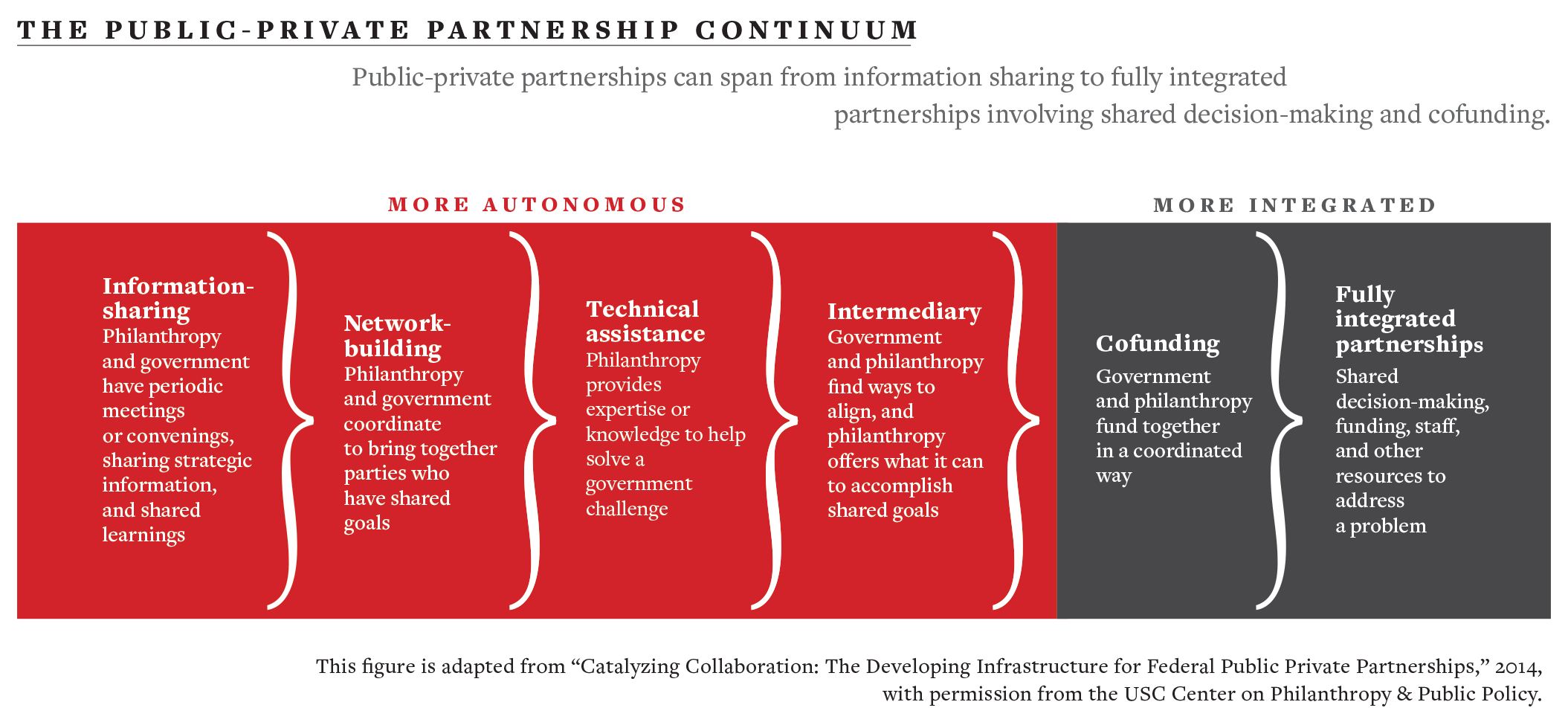
I define public-private partnership as a strategic relationship between government, business, philanthropy, and/or the nonprofit sector to solve social problems in a collaborative way. Such partnerships can take many forms that vary according to the nature of investment and involvement required from the government and the private sector. Some partnerships allow for greater autonomy, such as information sharing, while others are more integrated, such as coinvesting. Regardless of where a partnership falls on this continuum, it is always essential that public and private partners regularly communicate, share resources, and align strategically.
 (Click to enlarge)
Over the past two decades, local, state, and federal governments have built the infrastructure required to take a partnership approach. From 2002 to 2013, New York Mayor Michael Bloomberg led one of the most successful local partnership efforts through the Mayor’s Fund to Advance New York City, which raised nearly $400 million and worked with 40 city agencies and offices to support more than 100 public programs, from launching family-justice centers that coordinated services for more than 93,000 victims of domestic violence to raising more than $60 million for Hurricane Sandy response efforts. Following his tenure, Bloomberg Philanthropies, Bloomberg’s philanthropic organization, established a dedicated team to promote this model by advising municipal leaders on partnership structures and strategies in cities across the globe from Los Angeles to Athens, Greece.
At the state level, Michigan was the first state to establish a Governor’s Office of Foundation Liaison (OFL) to identify and broker innovative funding partnerships and strategic collaborations between state government and philanthropy. Since its inception in 2003, the OFL has raised private support for initiatives to increase Michigan’s economic competitiveness through reforms in early childhood development and education, K-12 education, college and career readiness, health and well-being, and workforce development. Building on Michigan’s model, California, North Carolina, and Maryland have created similar offices of strategic partnerships and/or liaison roles to build partnerships between government and the private sector. These have collectively brought in billions of dollars in private support to leverage tens of billions in government funding that have advanced dozens of partnerships on policy priorities ranging from child poverty to housing affordability.
At the federal level, President Barack Obama in 2009 established the first Office of Social Innovation and Civic Participation, which sought to advance policy priorities through outcomes-driven approaches that identified and scaled effective solutions with public and private capital. In addition, federal agencies including the Department of Housing and Urban Development (HUD) and the State Department created senior-level strategic-partnership positions to coordinate partnerships with the federal government. For example, in 2014, HUD’s Office for International and Philanthropic Innovation created the National Disaster Resilience Competition in partnership with the Rockefeller Foundation to help communities develop solutions to recover from natural disasters. More recently, the State Department’s partnership office collaborated with the US Chamber of Commerce to align private businesses with the federal government to support Ukraine’s economic recovery.
Despite the rise and success of public-private partnerships across all levels of government, they are not suited to every government problem. For example, certain functions, like providing basic social benefits, education, or public safety, should remain the responsibility of government. Additionally, commingling relatively small amounts of philanthropic capital—which, when invested alongside government programs, can be more flexible in purpose and more quickly deployed—with greater amounts of public dollars does not optimize the use of private funding. Instead, partnerships are best suited for leveraging less restrictive private-sector resources as risk capital to design and test new approaches that can then be quickly scaled by the government.
Furthermore, partnerships are not a substitute for government policy. Sometimes the most effective way to improve a government program is not to put more resources behind it but instead to change the policies that are failing to produce positive outcomes.
Finally, partnerships are not about finding private dollars to fill gaps in government funding. Rather, they aim to utilize the collective diversity of partners’ resources—from expertise to funding to coordinated communications—to align on policy and programming for greater impact.
Four Elements of Success
For every single partnership opportunity I helped create during my time as senior advisor to Governor Newsom, I took hundreds of other meetings for potential partnerships that never came to fruition. From this extensive partnership-building experience, I identified four elements of a successful partnership: relationship-building, public and private leadership, addressing real problems with real solutions, and communicating impact.
Relationship-Building | The success of a partnership hinges on building a strong relationship based on trust. This requires meeting multiple times in person, sharing experiences and learning from each other to identify mutual priorities, and staying in close communication to seize ripe opportunities. I’ve worked with many government and private partners who wanted to develop partnership strategies but hadn’t yet built the relationships necessary to work in close alignment across sectors. As a result, they were never able to get their partnerships off the ground. Every collaboration we developed in California came with continuous relationship-building efforts before, during, and after a partnership was formalized.
During my first six months in the Newsom administration, I met with more than 100 philanthropy CEOs and embarked on a 16-city, border-to-border listening tour to meet with Indigenous tribes on the northern California border of Del Norte County, immigration organizations on the southern border in Tijuana, and more than 750 community-based organizations in between. Getting to know community leaders in their local settings was critical to my understanding of how communities devised solutions to their problems.
The rapport and trust established through the continuous process of relationship-building proved invaluable resources for future partnerships, especially during the COVID-19 lockdowns, when I could not meet partners or communities in person. For example, the success of Homekey, a program Governor Newsom created in 2020 to purchase motels to house unsheltered Californians and those at risk of homelessness, and to provide services to support them on the path to longer-term housing, originates in these relationships, as well as those Governor Newsom made with the private sector to address California’s housing crisis. In 2019, he met one-on-one with CEOs of some of the largest California-based companies in the state, including Apple and Facebook, and negotiated a $3.5 billion commitment from those companies to invest in affordable housing. Dozens of large companies also wanted to help but couldn’t give nearly as much. In the fall of 2019, we organized a housing roundtable with Governor Newsom and the CEOs of those companies—Airbnb, United Airlines, Ripple, and Stripe, among others—to explore partnership opportunities to build affordable housing. The participants left the meeting energized, but at the time we didn’t have a specific call to action.
Six months later, when California went into lockdown during the COVID-19 pandemic, we found our call to action. One of our biggest concerns was the virus’s potential to spread throughout homeless shelters—refuge for more than 40,000 unhoused people. Since tourism had stopped, we also had empty hotel and motel rooms across the state. Drawing on these assets, Governor Newsom proposed using Federal Emergency Management Agency funding to pay the nightly rate for individual rooms for unhoused people for up to two-week stays, a program he called Project Roomkey, which served people experiencing homelessness who either tested positive or were exposed to COVID-19 or who were at higher risk of contracting the virus.
The program was so successful in housing people quickly, Governor Newsom proposed that the state enable local jurisdictions to purchase these hotels and motels and use them for permanent transitional housing and new interim housing, for a program he called Homekey. He allocated $3.75 billion from the American Rescue Plan and State General Fund toward purchasing the properties. Despite the benefit of added housing, local jurisdictions remained skeptical of the proposal because of the significant ongoing funding that housing would require for wraparound services such as mental-health and substance-abuse support, job training, and counseling to help residents secure more permanent housing. Furthermore, several motels needed additional funding for renovations.
Homekey exemplifies how relationship-building between state and philanthropic leaders catalyzed a collaboration that led to enormous impact. Regular communication and coordination ensured the successful distribution of funds.
Fortunately, because of the preexisting relationships Governor Newsom had established with the California-based CEOs, we were able to raise $65 million from Blue Shield of California, Kaiser Permanente, the Chan Zuckerberg Initiative, Meta, the Crankstart Foundation, and the Conrad N. Hilton Foundation to support those services and renovations. We engaged Enterprise Community Partners, a nonprofit affordable-housing developer, to host the funds and work closely with the California Department of Housing and Community Development (HCD) to allocate philanthropic funding to supplement continued operations. This partnership gave many of the local jurisdictions extra flexibility and stretched their Homekey funds further for capital renovations, construction, and services.
Homekey was able to fund 250 local projects totaling more than 15,000 housing units that will serve more than 160,000 of California’s most vulnerable residents over the life of the projects. In addition, the average per-unit cost to Homekey was approximately $200,000—well below the average cost of the more than $500,000 necessary to build a new housing unit in California. And according to Governor Newsom’s top housing advisor, Jason Elliott, the biggest impact of this partnership is how it has contributed to long-term systems change. “Because of Homekey, we will never go back to the old paradigm of building housing in this state because we have shifted perceptions of what’s possible and opened people’s minds about how we can quickly and efficiently generate affordable housing,” he says.
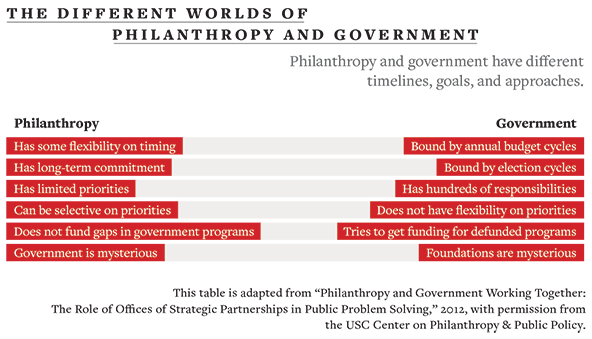
Homekey exemplifies how relationship-building between state and philanthropic leaders catalyzed a collaboration that led to enormous impact. First, my listening tour enabled me to understand community needs more deeply and establish relationships throughout the state to advance this project. Second, I was in regular communication with partners through roundtables, one-on-one meetings, and our housing-and-homelessness working group, so that when the partnership opportunity arose, I could quickly identify which partners might be interested in this work. Third, and perhaps most important, I acted as a translator for both my state colleagues and philanthropic partners, since the goals of philanthropy and government leaders are often opaque to each other. (See “The Different Worlds of Philanthropy and Government” on page 46.) Through relationship-building and as an expert in both policy and the nonprofit sector, I was able to discern the goals and pain points of each sector, help them identify where each could be most impactful, and facilitate coordination. Finally, regular coordination between Enterprise and HCD was critical to ensuring the successful distribution of philanthropic funds to state projects.
Entities wanting to build and deepen relationships to advance partnerships should identify someone in their organizations who can serve as an external liaison to stay in regular communication with public and private partners, to be an internal translator to help colleagues identify and take advantage of partnership opportunities when they arise, and train both internal and external-facing staff.
Public and Private Leadership | Successful partnerships require public- and private-sector leadership. While this observation may seem obvious, I have witnessed several partnerships fail to move forward because one side was too solicitous or overbearing, attempting to push through its project without buy-in from all partners.
Three actors must play a leadership role in fostering this mutual buy-in: an internal government champion to create alignment with government programs and policies; an external philanthropic champion to help raise and coordinate foundation dollars; and an intermediary champion—often a nonprofit organization, a community foundation, or a fiscal sponsor—to administer the partnership and ensure that it is grounded in the community being served.
 (Illustration by Joan Wong)
Take the California Immigrant Resilience Fund, a $150 million emergency relief fund for undocumented communities. In March 2020, the US Congress passed the Coronavirus Aid, Relief, and Economic Security (CARES) Act, giving Americans up to $1,200 per adult and $500 per qualifying child. However, the relief funding excluded undocumented residents—who comprise 10 percent of California’s workforce. Governor Newsom was committed to extending emergency cash assistance to all Californians, including undocumented workers, who were often on the front lines of our COVID response in food services, health care, manufacturing, construction, agriculture, and transportation. At the same time, I had learned in my conversations with philanthropic leaders that Grantmakers Concerned with Immigrants and Refugees (GCIR) was considering developing a fund for cash assistance for undocumented communities, so I initiated conversations between those philanthropic leaders and the state to explore a potential collaboration.
Just one month later, those discussions led to the creation of a partnership between GCIR’s philanthropic California Immigrant Resilience Fund and the California Department of Social Services’ (DSS’) Disaster Relief Assistance for Immigrants, which collectively invested $150 million—with seed funding from Emerson Collective, Blue Shield of California Foundation, The California Endowment, The James Irvine Foundation, the Chan Zuckerberg Initiative, and, later, MacKenzie Scott and nearly 70 other foundations—to provide more than 322,000 undocumented Californians with one-time cash assistance of up to $1,000 per household. The partnership was so successful in helping families to stay in their homes—according to GCIR, 64 percent of cash went to rent—and keep food on their tables that it was replicated in dozens of cities and states around the country.
The California Immigrant Resilience Fund would not have happened without internal state champions in Governor Newsom and DSS committing to this new initiative and distributing $75 million in cash assistance; an external champion in GCIR, which helped raise $75 million from philanthropic partners; and intermediary organizations—more than 70 grassroots community-based organizations, who distributed the cash assistance via debit cards to families in need.
Strong leadership from all partners grounds the continuous communication that is necessary to coordinate operations. I was in daily communication with GCIR for months to help raise money for the program, and we held regular meetings between DSS and GCIR to coordinate funding distribution to reach as many California communities as possible.
Community leadership, whether through CBO partners, intermediaries, or whoever is closest to the problem, also plays a central role. In this case, the combination of public and private funding meant that we could work with larger statewide organizations like California Rural Legal Assistance Foundation, as well as smaller community-based organizations that lacked the capacity to apply for government funding but that served as trusted messengers to undocumented workers.
Crafting Real Solutions to Real Problems | Successful partnerships are rooted not only in strong relationships and leadership but also in a shared determination to delve below the mere appearance of problem-solving. I heard a story of a well-known leader in federal government who asked a foundation leader for funding that he could mention in a forthcoming “big policy announcement.” Unfortunately, the funder refused to give because the federal official missed the point: A press release is not a partnership. True partnerships are about addressing social problems with cocreated solutions and substantive resources.
The COVID-19 lockdowns resulted in an economic downturn and widespread job losses around the world. In California, approximately one in four Californians, or 10 million people, experienced food insecurity—a figure closer to one in three among Black and Latinx families. At the same time, once most restaurants were closed, farmers in California held millions of pounds of fresh produce that they could not sell. They wanted to donate the fruits and vegetables to those in need, but they couldn’t afford to hire workers to pick, pack, and deliver the produce to food banks.
Working with the California Department of Agriculture and the California Association of Food Banks, I helped develop a targeted partnership to support the Farm to Family program by employing $2.86 million from state and federal funds and $2.75 million in philanthropic support to pay farmers a pick-and-pack fee to hire workers to harvest the excess produce and drivers to deliver it to food banks. The state of California provided additional funding supports to food banks to distribute the fresh produce at the local level. The combined efforts of this partnership resulted in 22 food banks receiving more than 30 million pounds of fresh fruits and vegetables, providing 25 million meals to Californians facing food insecurity. The infusion of funds established new relationships with contributing California farms and helped to grow the Farm to Family program, which now sources 40 percent more produce annually than prepandemic, supplying more than 270 million pounds of produce to food banks in 2023 alone. The US Department of Agriculture has also applied lessons learned from this success and invested $900 million into a new program called the Local Food Purchase Assistance program to allow state and tribal governments to procure and distribute nutritious local and regional foods and beverages.
True partnership is what happens after the public announcement of the collaboration. All of the coordination that goes into implementation—making sure that funding needs are met, state and local programs are coordinated, and communities’ needs are supported—requires work. We aligned around the challenges we wanted to solve—food insecurity, a surplus of produce, and agricultural workers in need of jobs—and utilized flexible private dollars to support an innovative strategy to provide healthy food to Californians in need while also enabling farmworkers who would otherwise not have been working to stay employed. And we held weekly meetings with the California Department of Agriculture and the California Association of Food Banks for months to guarantee that this program remained operational beyond its launch.
Communicating Impact | While partnerships are about more than a press release, communicating impact is critical, not only to give partners credit but also to protect the future of the partnership. Our successes must become open-source solutions for others to replicate.
During the 2020 US Census, California partnered with philanthropy to collectively deploy $217 million to convince communities—particularly racially marginalized communities who are less trusting of government because of the historic misuse of data or the fear of potential deportation for sharing citizenship status—to complete the census form. The campaign engaged trusted messengers like Ethnic Media Services and community foundations and community-based organizations like United Ways of California and California Rural Legal Assistance to get the word out about how the census informs the distribution of federal dollars to their communities.
Little did we know at that time that those same trusted messengers would play a crucial role in the effort to encourage communities to get vaccinated for COVID-19. In California, one of our top leaders from the state census office and other census staff moved to the Department of Public Health to lead what became one of the nation’s most comprehensive state COVID-19 public awareness and outreach campaigns. We collaborated with one of our main census partners, The Center at Sierra Health Foundation, to help distribute $23.3 million in state grants to 157 nonprofits to educate vulnerable communities on the safety and effectiveness of the vaccine. We also worked together on the center’s $21.1 million philanthropic Vaccine Equity Campaign to fund 116 organizations working to increase access to appointments and vaccines and provide transportation, interpreters, childcare, and other supports to Black, Brown, and Indigenous communities. The center and the state also partnered with the Public Health Institute (PHI) on Together Toward Health, a $35 million philanthropic initiative with leadership from The California Endowment and the California Health Care Foundation that worked with more than 548 community-based organizations for services including creating and delivering community-specific messages about COVID-19 testing, vaccination, and safety protocols; hosting pop-up and mobile testing and vaccination clinics; and arranging transportation to and from vaccination sites.
As with the census initiative, communication was essential to getting people vaccinated. The flexible philanthropic dollars we helped raise with Together Toward Health and the Vaccine Equity Campaign were critical to reaching small organizations that had deep connections to California’s most vulnerable communities. As a result of this outreach, we saw a 34 percent increase in vaccine uptake in those zip codes. TODEC Legal Center in the Inland Empire relied on the trust it had built over decades of service to immigrants to convince them to get vaccinated, hosting accessible pop-up vaccine clinics in the crop fields for as many as 250 workers a day during their shifts to avoid lost wages. Leadership Council for Justice and Accountability offered bilingual registration services, hosted mobile clinics, and incorporated on-site food distribution, facilitating the vaccination of more than 3,000 Central Valley residents. And the California Consortium for Urban Indian Health worked closely with Indigenous communities to increase vaccinations through practices reflecting and celebrating Native cultures, by sharing information about vaccine safety through town halls and talking circles and incorporating Native artwork in the consortium’s educational materials.
While partnerships are about more than a press release, communicating impact is critical, not only to give partners credit but also to protect the future of the partnership. Our success must become open-source solutions for others to replicate.
Before Governor Newsom held a press conference to talk about our vaccine outreach, I briefed him on the impact of our Vaccine Equity Campaign and Together Toward Health partnerships so that he could speak publicly about our 870 CBO partners and their extraordinary work. Newsom used this information to illustrate how California was focused on the health of its most vulnerable communities. It also boosted the power of the partnership because those trusted messengers were recognized as part of a broader effort.
At the local level, vaccine-safety messaging to underserved communities was so effective that a recent survey of public-health departments around the state reported that they have adopted this same community-focused outreach strategy in their work. The effort was so successful—informing more than 27 million individuals about vaccine safety and assisting 1.4 million people with vaccine appointments—that in 2022 Governor Newsom established a new Office of Community Partnerships and Strategic Communications (OCPSC) to support additional high-priority issues, such as water conservation and extreme heat. OCPSC’s trusted messenger network of CBO partners (many of whom were also partners in the census and vaccine-rollout efforts) currently covers 91 percent of the most vulnerable zip codes in California, providing services in 34 languages and reaching nearly 18 million people.
Because we knew that we had to work to overcome misinformation about vaccines, we thought about our overarching message from the very beginning of the partnership development. We knew that the more trusted messengers we could fund, the greater our reach in vaccinating vulnerable communities would be. Accordingly, my colleagues in the governor’s office and I coordinated with The Center at Sierra Health Foundation and PHI communications teams early in the process to create culturally appropriate and consistent messaging for press releases. We constantly updated the governor’s talking points with the number of CBOs involved, how many people they were reaching, and the creative outreach strategies they were employing. The governor’s social media team regularly posted stories about our partner organizations’ creative community outreach strategies. Our partner organizations also posted publicly about the efforts to raise awareness about the importance of getting vaccinated. The all-hands-on-deck communications approach was critical to making this partnership—and our vaccination efforts—a success.
Challenges and Limitations
Despite the promise of public-private partnerships to amplify impact by bringing together the strengths of various sectors, they must overcome several barriers to succeed. Leaders could follow all the elements of this approach and still not achieve the level of success that we had in California. I have identified six of these barriers:
Lack of Urgency | The COVID-19 pandemic catalyzed urgency and innovation like never before. The risk of illness and death to all established a universal vested interest in preventing the spread of the virus. As a result of this crisis, the outpouring of support from companies, nonprofits, and philanthropic organizations was extraordinary. One of the biggest challenges that governments face in motivating the private sector is creating this same level of urgency around long-standing crises like poverty, homelessness, and climate change. Now that more than four years have passed since the start of the pandemic, many governments are returning to their siloed approaches to problem-solving. We have an opportunity to reverse that trend by learning from and building on the collaboration that the pandemic demanded of us.
Despite the promise of governing through partnership, this approach is still nascent, and all sectors must lay the foundation for this work to become a success. Innovation at scale is the promise of public-private partnership.
Conflicts of Interest | Both real and perceived conflicts of interest are obstacles to partnership. First, when government works with private entities, those entities might misconstrue financial contributions as entitling them to enhanced access to public officials and the ability to barter for their own favorite program or policy initiative. Donations, too, always present the potential of a conflict of interest, since donors and the public might presume that financial donations for a partnership program might equate to political advantage. To avoid these impressions, governments and donors must set clear boundaries between partnership and advocacy.
Governments and private partners must work with their legal teams to identify the legal limits of partnership and operate with transparency. In California, we addressed conflict-of-interest concerns by, among other steps, reporting and publishing all donations to the California Fair Political Practices Commission in accordance with the law of behested payments so that the public had free access to donation records. Additionally, we equipped our communications team with talking points about the importance of partnerships in increasing resources for taxpayers and those in need.
Lack of Internal Capacity | One of the biggest barriers to governments engaging in public-private partnerships is a lack of understanding about how to advance them and a lack of capacity to undertake all four elements. I devoted my time to building partnerships, from meeting with state agencies, nonprofits, foundations, and companies to identifying areas of synergy and opportunities to developing a shared agenda. I worked closely with a team from Freedman Consulting, a strategic consulting firm supported by philanthropy, to help coordinate partnerships in California. Before I left my role, I worked with Governor Newsom to establish partnership liaisons in a dozen state agencies to develop additional capacity throughout state government. Federal, state, and local governments that seek to build strategic partnership initiatives must establish internal capacity and infrastructure to ensure success.
Lack of External Capacity | Governments also need capacity from participating companies, nonprofits, and foundations to help build partnerships from the private side. In California, one of our primary partners was Philanthropy California, a membership-affiliate group for 600 charitable foundations that helps to strategize, identify, and communicate partnership opportunities and coordinate their members to engage with the governor’s office. Additionally, private capacity can be built by hiring policy liaisons and mandating that they work with government to develop partnerships. Finally, none of these partnerships would have happened without a firm commitment from nonprofits and intermediaries to help implement the partnership.
No Motivation | Another barrier to partnerships is a lack of motivation to participate in them. When I began working in my role, I had to sell the idea of partnerships to several of my colleagues. Bureaucracies have a deep attachment to the status quo, and people often don’t like change because they are already overwhelmed with work and don’t have the time, expertise, or risk tolerance to try new ways of doing things. Many state leaders also worried that tapping into private dollars would require a lot of work and for minimal return, given that foundation dollars are a drop in the bucket compared with California’s state budget, which was as much as $300 billion annually. Potential private partners also said that investing in government relationships could be a waste of time if they had to rebuild those relationships after the next election. Early in my tenure, I focused on identifying leaders eager to partner with us so that we had a few early partnership successes to sell the case for public-private partnerships to both my colleagues and external stakeholders. By the time I left the administration three years later, we had worked with more than 1,800 private partners and 27 departments and agencies, all of which had learned the value of partnerships and built the muscle to continue this work in the future.
Political Factors | We also faced several political challenges that were difficult to foresee. Unions protested our vaccine outreach strategy to fund community-based organizations to be trusted community messengers because those partnerships hired nonunionized nonprofit leaders to do work. In addition, they demanded that Homekey hire union labor to do the hotel and motel renovations. Governor Newsom also faced a recall election in 2021, which meant we had to be very politically cautious, and some of the potentially more politically controversial partnerships that I had developed were paused until he prevailed. Through all these challenges, I worked closely with our policy team to avoid any missteps with powerful interest groups.
Finally, political transitions can result in partnerships’ being deprioritized in new administrations. Even when politicians create the infrastructure to advance partnerships within their administrations, partnership liaisons and offices can be dismantled upon the arrival of a new administration. President Donald Trump, for example, disbanded President Obama’s Office of Social Innovation shortly after his inauguration in 2017. The long-term success of partnerships requires that institutional guardrails be established to sustain these positions through political transitions.
Innovation at Scale
Despite the immense promise of governing through partnership, this approach is still nascent, and all sectors must lay the foundation for this work to become a success. We need communities of practice so that the experts leading partnership development can learn from each other and connect with peers working on the ground. We need more partnership liaisons at the federal, state, and local levels to build government capacity, and we need asset-mapping research to understand the strengths and opportunities that each of these jurisdictions brings to partnerships. The field must also coordinate on strategic communications to promote the value of public-private partnerships. All of these areas are ripe for philanthropic support.
I am encouraged that the partnerships we started in the Newsom administration have continued to thrive and to improve the lives of millions of Californians. Now that a few years have passed since the launch of many of these partnerships, I can see that the impact reaches far beyond the work of the partnerships: Systems and communities have changed for the better. Innovation at scale is the promise of public-private partnership.
Read more stories by Kathleen Kelly Janus.