


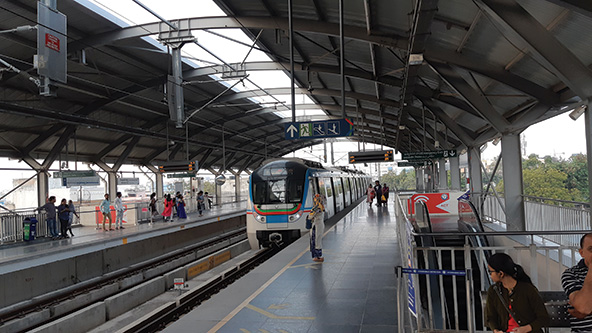
 Commuters wait for a train at the Secunderabad metro station on December 27, 2019. (Photo by Arunpnair Via Wikimedia Commons)
In the early aughts, workers from all over India were heading to Hyderabad. The south-central metropolis was fast becoming one of the country’s leading export hubs and a capital for big pharma and IT services.
But the city’s economic boom left a wake of congested roads and pollution. By the middle of the decade, Hyderabad needed to accommodate nearly three million passenger vehicles. The city’s growing middle class would want even more cars: Forecasters estimated that the number of vehicle owners would triple within a decade.
Public transportation had its own challenges. Buses were the most popular means, with more than three million residents riding them daily. Many of these buses overflowed with riders. Female passengers were frequently harassed, but they had few safer alternatives.
Government officials saw clearly that the city needed affordable, safe, and convenient public transportation options beyond buses. They considered adding metro rail as an engineering procurement and construction (EPC) project—i.e., the government would fund the entire budget for the design and construction of metro services. But they concluded that it was not affordable. So, they shelved the idea.
But in 2006, Nallamilli Venkata Satyanarayana (NVS) Reddy, a senior government official in Hyderabad’s municipal corporation, proposed an alternative: The metro rail project could be funded through a public-private partnership (PPP) using a special-purpose vehicle (SPV)—an entity that would pool capital from many different sources, including public and private investors. The new organization could coordinate the metro rail initiative and manage the participation of all government, semi-government, and private organizations involved in its design and implementation.
The next year, the Indian government established the Hyderabad Metro Rail Limited (HMRL) and named Reddy the managing director. HMRL would oversee the project as the government entity and find a private partner to design, finance, build, and operate the entire system for an initial period of 35 years that could be extended for another 25 years as needed. The metro rail system would eventually be transferred to the local government after the private partner had realized sufficient returns on its investment. Through a mix of debt financing, private equity, and government investment, the project would eventually cost nearly $3.6 billion, making it one of the largest public-private partnerships (PPP) of any kind in India and the largest metro rail PPP in the world.
As a PPP, Hyderabad Metro Rail would tap into the vast financial resources of the private sector and leverage the private partners’ innovation, expertise, efficiency, and business networks. The private partner would also be given the right to work on developing the real estate at three depots in the metro rail network. Beside the land on the ground floor of the depot, which was to be used for maintenance, the space above could be used for commercial real estate. This aspect of the project was not novel: The Hong Kong Metro included real estate development in its own successful PPP model.
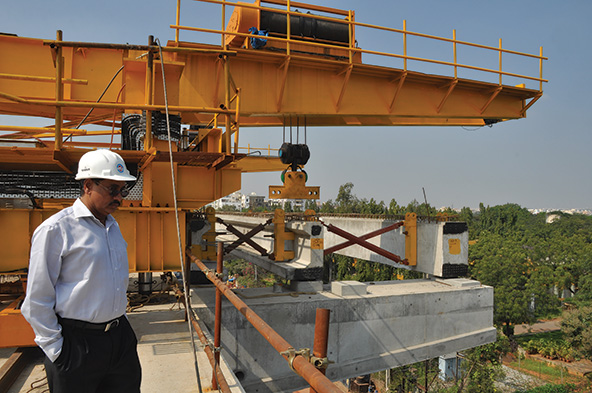 NVS Reddy, the managing director of the Hyderabad Metro Rail project, examines the ongoing work on one of the elevated platforms. (Photo courtesy of Hyderabad Metro Rail Ltd.)
The initiative was intended to support mass transit-oriented development in the city, an approach borrowed by other metro rail projects worldwide, such as in Tokyo. It was designed not to obstruct road traffic, because it used an elevated rail with two tracks on a deck, erected on pillars set in the central median of the road. Apart from being functional, the pillars and stations were meant to enhance the area’s aesthetics. The design also helped in ensuring natural ventilation while enabling energy conservation. The initiative sought to follow international safety and quality standards in its design and execution.
Despite the compelling logic of public-private partnership, PPP initiatives in general, and infrastructure PPPs in particular, are rife with challenges that can derail them. The Hyderabad Metro Rail project was no different. In what follows, we tell the story of the twists and turns in the initiative, and how Reddy and the HMRL team navigated them. To build a massive public transportation project in the heart of an Indian metropolis by partnering with a private company demands weighing and balancing numerous diverse religious, cultural, and political interests and invites scrutiny and opposition. The HMRL team’s ultimate success highlights the vital importance of stakeholder management in large, cross-sector initiatives.
Selecting the Private Partner
Once HMRL was established, its first two tasks were to map the metro rail network for the city of Hyderabad and initiate the bidding process to identify a suitable private partner. The leadership team prioritized covering all the major metro areas and providing last-mile connectivity to existing major transportation terminals like rail and bus.
After giving this some thought, the metro rail teams identified three high-density traffic corridors that would cover about 72 kilometers and include a total of 65 metro rail stations. The first corridor was 29 kilometers long and included 27 stations to connect the northwestern end of the city to the southern end. The second corridor was 28 kilometers long and included 23 stations that horizontally connected the city’s western and eastern ends. The third corridor was 15 kilometers long and included 15 stations that cut vertically through the second corridor. The project was ambitious: The HMRL leadership team estimated the material and labor costs at approximately $2.5 billion.
Bidding processes managed by the Indian government are not easy; they require numerous documents and approvals from multiple ministries. So, developing a clear set of technical, legal, and financial documents was critical, since the bidding process could begin only after everyone was satisfied about the initiative’s technical, legal, and financial viability. Since this was the first metro initiative in India to use a PPP model, HMRL leadership faced the added challenge of developing, for the first time in India, a set of documents that were tailored to the needs of an Indian metropolis. These documents included the concession agreements, the manual of specifications and standards, the financial model for the initiative and the private partners, the traffic projections for metro rail usage, and other matters. Such documents then had to be presented to potential bidders for their initial review. Pre-bid conferences also had to be conducted for feedback from potential bidders, so that they and their financial and business models could be revised as needed. Given the newness of the initiative to the government, HMRL leadership needed to look outside India in many cases for models of documentation and processing.
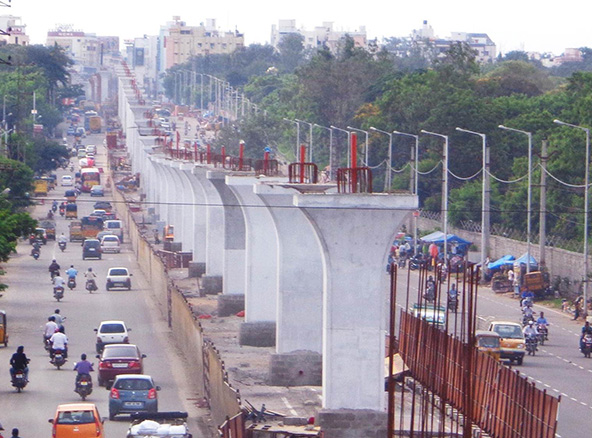 The Hyderabad Metro Rail project adopted an elevated rail with two tracks on a deck, erected on pillars set in the central median of the road. In this way, it would avoid obstructing road traffic, enhance the city’s aesthetics, and ensure natural ventilation. (Photo by Sunilraj.Raj via Wikimedia Commons)
The HMRL team prepared the concession agreement and manual of specifications and standards with the help of experienced lawyers and Indian Administrative Service (IAS) officials who were working with the national planning commission at that time. The group sought to convert the technical specs of the project into performance indices that could be measured and evaluated, to keep the project on track. By focusing on performance indices, the private partners were expected to have a great deal of engineering flexibility in implementing them. For example, they would be expected to introduce the latest design innovations related to the layout of the metro stations, the pillars supporting the metro lines, and the series of bridges (or viaducts) that carried the trains. Additionally, the metro construction had to avoid traffic disruptions, which meant working at night. Finally, the partner was also expected to deploy the latest communications technology to manage the number of trains required and their frequency in running on the same track to serve a city of Hyderabad’s size.
The initiative’s vision for private partners was to “fund your own city”—government funding would be kept to a minimum. The HMRL team had to make it clear that the PPP was being constructed so that the private sector would provide most of the project funding through a combination of equity investment and debt. The government would provide a onetime grant that would fund the rest of the project.
The private partners would receive the land for free for a period of 35 years that could be extended by another 25 years if needed. During this period, the tariff on electricity would be kept constant at the rates that prevailed at the start of the concession agreement. While the government was willing to provide up to 40 percent of the total project costs as a grant, the HMRL team preferred a private partner that asked for the least amount. Moreover, escalations in project costs would be borne by the private partner and not be covered by the government.
The private partner’s income during the concession period would be the fares paid by commuters, as well as non-fare revenues from real estate rentals and advertising income. Throughout the duration of the concession period, while the government did not get any share of the non-fare revenues, it was entitled to 0.5 percent of the fare revenues per year from the 21st year onward, subject to a maximum of 10 percent of the total revenue over the remaining years of the concession period.
The bidding process was initiated in 2008, with the documents in place and several consortium groups expected to bid for the multibillion-dollar initiative. In early 2009, a consortium headed by Maytas Infra Ltd. won the contract with a $2.87 billion bid that would develop about 72 kilometers of a metro network in Hyderabad through a design, build, finance, operate, and transfer (DBFOT) model over a concession period of 30 years.
Maytas was part of the Satyam Group, a family-owned conglomerate that also included Satyam Computers, one of India’s largest IT services firms. Unfortunately, Satyam Computers became engulfed in a financial scandal in July 2009 when the group’s founder, Ramalinga Raju, confessed to committing accounting fraud by manipulating the company’s accounts by nearly $1.5 billion. The scandal tainted the metro rail contract, with critics alleging corruption in the bidding process that selected the Maytas consortium. The Indian government canceled the contract and initiated a fresh bidding process.
The Larsen & Toubro (L&T) Group, an end-to-end infrastructure services firm, was eventually awarded the concession in July 2010. It had asked for only 12 percent of the total project cost as a government grant, which meant that it was willing to shoulder 88 percent of the total project costs. L&T’s investment was based 70 percent on debt financing and 30 percent on equity investment.
L&T Metro Rail (Hyderabad) Limited was incorporated as an SPV to implement the metro initiative. Under the terms of the financial agreement that closed in March 2011, the SPV was expected to take on a debt of around $2.5 billion that would be provided by a consortium of banks led by the State Bank of India, the country’s largest public sector bank. The L&T Group would invest around $750 million as equity into the SPV, while the central government would provide a grant of around $320 million through the Andhra Pradesh state government to make the project viable at a total cost of $3.6 billion. At nearly $3.25 billion in debt and equity financing, the Hyderabad Metro Rail PPP was the biggest investment in a single project made by the L&T Group.
Land Acquisition
After the concession agreement was signed in 2010, the HMRL team turned their attention to the project’s next major phase: acquiring land. They had already acquired most of the land required for construction of the viaduct and the pillars to carry the metro lines. But they had yet to procure land for the widening of roads around the metro lines to enable motorized traffic to flow freely during and after construction. They also had to acquire land for constructing the stations, depots for parking and maintaining the trains, and other infrastructure. Acquiring land for building public transportation in a highly packed, centuries-old city with people of different religions, social groups, and varied vested interests proved be an enormously complex task.
While land acquisition by a government agency can often be enforced through eminent domain laws, the HMRL leadership team needed to persuade landowners to voluntarily sell their land, and land users such as hawkers, trade associations, religious institutions, local businesses, and other renters to voluntarily give up their land use. A highly public initiative such as metro rail made governments and their agencies at the local and state levels wary of opposition by political parties, local institutions, the public, and local communities that could gather momentum and create widespread disaffection, thus jeopardizing their own popularity. Importantly, the bases for opposition varied in each locality affected by the metro rail, so the HMRL team had to tailor its land acquisition to the idiosyncrasies of each of them. Specifically, the team employed several different strategies.
Providing better compensation | First, they had to make attractive offers. Take, for example, Uppal, a less developed suburban area in eastern Hyderabad. The project needed a substantial piece of land for a depot for parking and maintenance of the metro trains, and a large swath of grasslands in Uppal seemed an ideal location. The HMRL team therefore began the process of land acquisition in 2011. But this area was being used by nearly 900 farmers for horse grazing. The grasslands were also stuck in a decades-long legal dispute over ownership. To complicate things, the HMRL team felt that political parties opposed to land acquisition for the metro were stoking the farmers’ ire.
The HMRL team responded by organizing meetings with the farmers, both one-on-one and in groups, either at the proposed building sites or at the HMRL office in the city. During these meetings, they discussed the plans for the metro and the advantages that it would bring to the area. The team offered attractive compensation packages for those whose land would be affected by the depot’s construction.
At this point, the properties were being used only as grasslands, without any other construction such as homes and commercial buildings. In addition, most of the farmers belonged to the Reddy caste. Since NVS Reddy was also from this community, he used his own personal and professional contacts to gain their trust and loyalty.
As the opposition to the metro plans began to grow, the situation became increasingly sensitive. Local traders even threw chairs at the HMRL team during one of the community meetings.
The team proposed that the farmers pool their lands together and sell them to the government. Those who did so would be compensated with 1,000 square yards of developed land for every acre they sold. Since grass was not a valuable crop, the average income of the farmers was only about $400 per year. The offer proved irresistible to many of the farmers, since the compensation packages included money to offset loss of annual revenue, as well as land ownership in a developed area that was rapidly growing in value. The process of land acquisition, and fencing of the acquired land, was completed in July 2012.
Showing a brighter future | The team also had to promote the sunnier vision of the project. Take the fight over Sultan Bazar, a critical site for land acquisition because of its central location. Its roads were only 10 meters wide, with many shop owners, roadside hawkers, and customers routinely causing traffic congestion and sidewalk bottlenecks. When land acquisition began in 2011, local traders and hawkers organized a bandh (shutdown), because they felt that the metro lines would cost them business. They shouted slogans such as “Sultan Bazar, Badi Chowdi ka heritage bachao, Metro Rail mat lao” (“Save Sultan Bazar and Badi Chowdi’s heritage, don’t bring the Metro Rail”) and demanded that the metro lines be rerouted. The HMRL team also faced strong local political opposition because the area had many educational and cultural institutions that invited political leaders and lobbyists to the fight.
As the opposition to the metro plans began to grow, the situation became increasingly sensitive. Local traders even threw chairs at the HMRL team during one of the community meetings. Govind Rai, a local politician and chairperson of the Traders’ Joint Action Committee from Sultan Bazar, led the opposition who demanded that the HMRL team take the metro line underground or bypass Sultan Bazar altogether.
“We started our agitation in 2011, when we asked them to not take the metro from [Sultan Bazar], and we showed them alternate routes,” Rai says. “They said, ‘No, it is not feasible,’ and did not agree to it.”
To address their concerns, the HMRL team organized presentations of three to four hours to show how the initiative would benefit the city as a whole, as well as the local community. The metro rail was expected to create 50,000 new jobs and bring in around $10 billion in investment into Hyderabad. Moreover, it would be a symbol of equality that unified people from all classes and castes in Hyderabad because they would be using the same air-conditioned coaches while sitting next to one another. Metro rail would also provide benefits to the kinds of groups that were present locally, such as landowners, hawkers, and shop-owning traders.
The HMRL team then invited representatives of the opposing associations and other groups for negotiations. The team emphasized that the metro would enable them to widen the roads and open up the area for more development, which would increase property values.
“Everything was in writing,” Rai recalls. “The metro will use only 19 meters to go through Sultan Bazar. Municipal shops in this locality were also given in writing that the shops will be intact. … Then there were the hawkers, about 300 of them. To accommodate them, about 200 stalls were built below the viaduct.”
The team even proposed to get special permissions and exemptions for the landowners in Sultan Bazar. Existing restrictions would be waived, and the landowners could now construct additional floors in their homes and buildings. The hawkers’ association was also promised a central location in Sultan Bazaar that would be dedicated to them. Instead of hawking their wares on the streets, they would now have cabins with private enclosed areas to run their businesses, thus creating a hawkers’ paradise. The traders, who owned their own shops, would also benefit since it would free the area in front of them of hawkers; along with wider roads, there would be more space for their shops and stalls, with increasing customer traffic due to metro commuters. Through this larger space and greater spatial organization to the stores, the commercial area would become a more organized and better-looking shopping complex for customers.
Sultan Bazar had established a template for addressing opposition to the initiative in other localities of Hyderabad, according to L&T senior executive Mendu Naidu: “One strategy is to allow the other parts of the city to see the benefits of the metro. Then you create a positive impact from the public, so they ask why don’t they get a metro.”
Court-facilitated acquisition | Finally, the HMRL team sometimes had to rely on the courts, such as in their dealings in Miyapur. The fast-developing suburb in Hyderabad was chosen in 2010 for land acquisition, because it was located on a planned route for the metro lines. The area had several residential communities, and acquiring the land was complicated because a large portion of it could be considered government-owned land. The original owners of many of these properties had left for Pakistan after the Partition of India in 1947. This meant that their land was officially considered to be “enemy” property that could now be seized by the government. However, because of the poor state of landownership records, especially dating back to the 1940s, it was difficult to establish whether an existing landowner was a lawful owner of this land or had illegally occupied unclaimed land that had reverted to the government.
Given the immense complexity in unraveling these claims, the issue ended up in the courts. In 2012, the Andhra Pradesh High Court ruled in favor of HMRL in all the cases that had come before them. In exchange for ownership of the disputed land, HMRL was required to deposit $40 million in a trust to compensate any lawful claims by landowners in the future. This was a rare instance where HMRL chose to go to the courts rather than persuade landowners to sell their land to the initiative. The complexity in evaluating whether a piece of property was “enemy land” and whether the claimant was the rightful owner of “non-enemy” land was so great that HMRL preferred a legal route to acquiring the land en masse.
Of the 72 kilometers originally planned, the HMRL team were successful in acquiring and building on 69 kilometers of land for the metro rail by 2023. The last three kilometers are still being negotiated. They cover the Old City area of Hyderabad, where political and religious opposition has been holding up the acquisition.
Winning Support
Acquiring the land for the metro rail, complicated though it was, pales in comparison to winning over critical stakeholders to build the system or at least to permit it to go forward without opposition. The HMRL leadership team created a supportive context for the project by deftly addressing religious and caste-based issues, shaping public opinion, and obtaining political endorsement.
 The Hyderabad Metro Rail’s blueline runs east to west between the Nagole and Raidurg stations. (Photo by Imahesh via Wikimedia Commons)
Addressing religious issues | One of the most challenging issues in implementing the initiative, particularly during land acquisition, was dealing with religious institutions such as churches, temples, and mosques. Altogether, the construction of the metro involved more than 30 religious institutions, a portion of whose lands had to be acquired. Aside from showing why the metro rail lines needed to pass through their lands, NVS Reddy had to appeal to their religious sentiments.
“You have to have different strategies for different groups,” he recalls. “For Hindu religious structures, a person from the team [who was a Hindu] would go and touch the feet of the [religious] head and say, ‘Please do not come in the way of this project.’ This took time, but after one and a half years, he signed on the dotted line. For a Muslim or a Christian structure, I would send in my chief engineer (who was a Muslim) and Christian officers, respectively.”
In another illustrative example, the team had to acquire land from a temple in Secunderabad to widen the road to accommodate the metro rail. A purchase agreement was made, and the method of payment was settled in court. But prior to making the payment, HMRL had also asked the temple to shift a flagpole because it was coming in the way of the metro rail’s electrical fixtures. However, the flagpole was considered sacred and could be shifted only under extraordinary circumstances and after following extensive rituals. The temple officials conferred with religious experts, who gave approval for the shifting and provided a detailed protocol for doing so. The temple officials also developed a detailed budget for the relocation, which was submitted to the HMRL team.
“They [HMRL] agreed to all the terms and conditions and bore all the expenses of the moving,” Alladi Gowrishanker, the chair of the temple’s committee, recalls. “They made sure to carry the entire process through without any challenges and issues and prioritized a speedy resolution.”
The HMRL team also became adept at deploying the commercial carrot and stick in order to resolve land-acquisition issues. If the offer of compensating the institution for acquiring the land was refused, the HMRL team wielded the stick of “islanding” the religious structure. To island a structure meant that the restrictions placed on traffic and commerce on the roads around the religious structure would severely limit access to it by devotees. While the structure was being islanded, negotiations on land acquisition would continue, with the religious authorities under duress because of reduced access to their property.
Addressing caste issues | Caste is another critical aspect of Indian settings, as the HMRL team realized early on in their land-acquisition efforts. According to the 2011 census of India, 16.6 percent of Indians self-identified as scheduled castes (SCs)—i.e., social groups who had traditionally been marginalized in Indian society because they were not considered part of the caste system. Bhimrao Ramji Ambedkar, a freedom fighter and framer of the Indian Constitution, was a revered leader from the SC community. Statues of him, like those of Mahatma Gandhi, have been erected everywhere in India since his death in 1956.
His legacy collided with the metro rail project beginning in 2011, when members of the SC community began protesting plans to remove an Ambedkar statue in an area where land had to be acquired for the metro. Some of the protesters were burning effigies of NVS Reddy, and the situation threatened to spiral out of control. The HMRL team arranged for a meeting with all the community leaders.
“During the meeting, before we could even make our demands, the HMRL leaders themselves offered to build a bigger and better statue of Dr. Ambedkar and develop the area surrounding it into a park,” says Napari Chandrasekhar, one of the protest leaders. “We were allowed full freedom to choose the material, placement, and design of the statue … they even provided us with an engineer and a landscaper to help us.”
Within 45 days of the meeting, the statue was erected. This resolution provided a way for future statues and structures to be relocated and rebuilt for the construction of the metro and for the team to gain support from local communities.
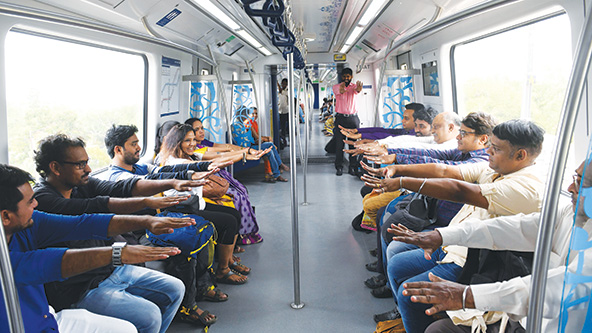 Indian yoga instructor Pratibha Agarwal (center left) conducts a yoga session for commuters on the Hyderabad Metro Rail to mark International Yoga Day on June 21, 2019. (Photo by Noah Seelam/AFP via Getty Images)
Shaping public opinion | After their experience with local opposition to the metro, the HMRL team decided to take a more proactive approach toward shaping public opinion in their favor.
“We started campaigning on TV and in radio debates,” says Narsayya Rajeshwar, chief general manager of HMRL. “Every fortnight, we used to have two-hour debates, engaging stakeholders, asking their opinions, clarifying their doubts.”
As opposition politicians began to get involved, NVS Reddy realized that HMRL had to build greater public support for the metro rail initiative.
“Every weekend, I would address a TV channel, an open forum where anybody can ask any questions—it was a phone-in program,” Reddy says. “Then I wrote poetry and sang folk songs in Telugu [the local language of the state]. You can motivate and convince a lot of people through folk songs.”
Obtaining political support | Politicking was also essential to the project’s success. The metro rail initiative faced political opposition from the very beginning, with critics claiming that it would drain the state’s resources. The political support that mattered the most was that of the state’s ruling political party, specifically the backing of the state’s chief minister. During 2004-09, the chief minister of Andhra Pradesh (prior to its bifurcation in 2014) was Yeduguri Sandinti Rajasekhara Reddy (YSR), a politician from the Congress Party. YSR had become interested in funding the initiative in part due to criticism that he was neglecting the urban regions of the state in favor of the rural regions. However, YSR died unexpectedly in a helicopter accident in 2009, just as the metro rail initiative was going into a new round of bidding, resulting in L&T as their partner.
The new chief minister, Konijeti Rosaiah, was facing a lot of opposition in 2009-10 within his party and from other parties and was hesitant to forcefully support the metro rail. Given that continued financial support from the state was critical for the initiative to move forward, the HMRL team composed a letter in 2010 for Rosaiah
to send to Manmohan Singh, the prime minister of India at that time, and to Sonia Gandhi, the leader of the Congress Party, which ruled India and Andhra Pradesh. The letter outlined the plans for the project and emphasized the successful bidding process that L&T had won at minimal costs to all involved. Throughout his tenure as prime minister during 2004-14, Manmohan Singh and the Congress Party had been advocating for the private sector in India’s development. The PPP model of infrastructure investment aligned well with their priorities. The project was also heavily endorsed by members of the nation’s Planning Commission.
After seeing this support, the chief minister became willing to provide state funding to initiate the construction of the metro once L&T had been selected as the private partner in 2010.
“Politicians associate themselves with the project if it has a significant positive impact in the minds of the people,” says L&T senior executive Mendu Naidu. “And once we started construction, the fast pace of construction mobilized [popular support].”
Leadership Lessons
By 2023, the Hyderabad Metro Rail had been in operation for more than six years. It spanned 69 kilometers and was poised to expand in Hyderabad by providing connectivity to the oldest parts of the city and to the airport. Ridership stood at 750,000 passenger trips (600,000 passengers) per day and on track to reach a million riders per day.
As Hyderabad continues to grow, the metro rail will undoubtedly play a vital role in shaping its future, offering an enduring example of democratic leadership that dared to dream big for the common good.
While ridership and real estate occupancy had been severely affected during the COVID-19 years (2020-22), they began to show signs of growth afterward: Annual revenues to L&T totaled $57 million, of which 55 percent were from passenger fares and the remaining 45 percent from non-fare revenues such as real estate rentals and advertising. Aside from fare revenues due to increased ridership, non-fare revenues were also expected to pick up as the remaining 4.2 million square feet of real estate began to be developed. As a result, the internal rate of return for the project, now at 2.5 percent, was also expected to grow in the coming years.
In short, the project looks poised for long-term success. How did its leaders manage this Herculean feat? The HMRL experience suggests that leaders of large-scale PPP initiatives need to develop a stakeholder mindset. The HMRL leadership team had to be inclusive, relational, entrepreneurial, and purposeful with the various constituencies they needed to win over. Specifically, we identify four kinds of tendencies or modes of conduct that we summarize with the acronym WELD: The leadership team widened, engaged with, leveraged, and distributed benefits equitably to the set of stakeholders.
Widening the set of stakeholders | A stakeholder mindset requires the leadership team to know who its stakeholders are, and what are their interests and attitudes toward the initiative. These are the individuals or groups whose interests are affected by the initiative and in turn have the power to influence the initiative’s success. Because these impacts are not easy to predict, it is important for the leadership team to consider as wide a set of stakeholders as possible. For example, a political party that is in opposition today at the central or state government level could become the ruling party after elections and be able to thwart the initiative.
The leadership conduct of widening the set of stakeholders implies going beyond the usual set of direct stakeholders that include commercial private partners, political leaders in government, and the government agencies overseeing the initiative. It includes considering indirect stakeholders, such as political parties in opposition; religious, cultural, and environmental groups; business associations for hawkers, shop owners, developers, and commercial property owners; associations of private property owners; and the print, broadcast, and digital media that can influence public opinion. The ability and desire to keep track of the interests and attitudes of a large set of indirect stakeholders requires a determination to be inclusive and engage all parties and players, including those who are initially hostile or ambivalent or appear to be.
Engaging deeply with stakeholders | A stakeholder mindset also requires the leadership team to engage continuously, patiently, and flexibly with important stakeholders throughout the initiative. Given the uncertainties, such a deep engagement ensures that partnerships with stakeholders adapt successfully to the inevitable changes that beset every large-scale initiative.
In just the first four years (2007-11) of HMRL’s existence, the leadership team had weathered a financial scandal, political opposition, public protests, two bidding processes, an extensive search for a fallback partner, and intense negotiations with the new private partner and banks, all to get to financial closure where the resources were in place to get the infrastructure onto the ground. Moreover, during the land acquisition process (2010-15), while the deep engagement with L&T and the central and local government agencies had to be sustained, the HMRL team now had to forge and sustain over several years their partnerships with new stakeholders, such as the religious, caste-based, and socioeconomic groups whose monuments, commerce, and land were affected by metro construction.
For large-scale public initiatives, deep engagement requires moving from a primarily transactional to a deeply relational orientation with direct stakeholders, as well as with indirect stakeholders who are likely to be powerful in the future. Even where formal contracts govern the relationship with direct stakeholders, such as those between the government and the private partners, the high uncertainty due to unexpected changes in the political, socioeconomic, religious, and cultural context will require openness and flexibility in sharing information, coordination in dealing with other stakeholders, and renegotiation of existing contracts. Even with signed contracts among the parties, relationship-building and trust should be seen as critical for dealing with unforeseen complications, uncertainty, and change. This is especially true for indirect stakeholders, such as political, religious, cultural, and socioeconomic groups that require patience and persistence in building deep relationships.
Leveraging stakeholder resources | Furthermore, a stakeholder mindset not only sees stakeholders as having economic interests (or “stakes”), such as financial investments, property, means of livelihood, and so on that may be affected by the initiative, but also sees them as sources of influence and resources that could gather (or lose) other stakeholders and determine the overall value and success of the initiative. In effect, the resources that stakeholders bring to the initiative can be leveraged positively (or negatively, if they are not careful) by project leaders to engender success (or failure).
For example, in the Hyderabad Metro Rail initiative, indirect stakeholders such as religious leaders, leaders of the scheduled castes, opposition political leaders, leaders of environmental groups, farmers, trade associations, and the print and TV media had not only interests in terms of land, livelihood, and local support to protect, but also the power to publicly protest and hold up progress on the initiative. Their public protests and withholding of support in turn could influence other stakeholders, such as the ruling political party or government agencies, to withhold support for the initiative.
Infrastructure initiatives such as the Hyderabad Metro Rail often confront the risks of economic, social, cultural, religious, and political forces unleashed by indirect stakeholders spilling out of control. The HMRL team managed these risks and leveraged the support of these stakeholders to build positive momentum for the initiative, through one-on-one meetings, a willingness to have others take credit for the initiative, persistence in advocating the benefits of the initiative, and proactively growing public support for the initiative.
Especially in large-scale PPP initiatives, leveraging stakeholder resources requires leaders to move from a bureaucratic to an entrepreneurial orientation toward stakeholders. Stakeholders are not simply independent entities that have discrete and unconnected interests. Rather, they are interdependent and have fungible interests and resources that can be tapped to build positive momentum for the initiative. An entrepreneurial orientation seeks extraordinary returns from relatively limited resources through the multiplier effect of influential stakeholder support. Such a mindset also recognizes that opposition from indirect but influential stakeholders, such as religious institutions and trade associations, could rapidly erode the support from direct and powerful stakeholders, such as the government and political party in power, which in turn could quickly result in the failure of the initiative.
The entrepreneurial orientation also finds innovative solutions to assemble the informational, financial, and partnering resources to begin, sustain, and complete the initiative; negotiate successfully with stakeholders; and use social and digital media creatively for building public support. It also leads to persistence in confronting threats such as financial scandals, public protests, and opposition from a variety of groups who are affected by the initiative.
Distributing benefits equitably | Finally, a stakeholder mindset keeps the leadership team focused on creating shared value through the initiative and distributing the benefits more equitably among all the stakeholders. Throughout the metro rail project, stakeholders who initially opposed the initiative were eventually persuaded to support it when the HMRL team persisted in highlighting the benefits of the initiative for Hyderabad in general and for their interests in particular. This alignment between the interests of individual stakeholder groups and Hyderabad as a whole was crucial to eventually getting stakeholders on board.
Distributing benefits equitably further requires leaders to move from a utilitarian to a purposive orientation toward stakeholders. By ensuring that every stakeholder (including the implementation team) could achieve their individual and unique purpose from the initiative, while also contributing to the larger purpose of developing the infrastructure, PPP leadership ensured alignment, identity, and ownership between individual stakeholders and the larger project. The larger purpose for urban transportation initiatives includes better mobility options; safety and air-conditioned comfort of travel of women, the poor, and other marginalized segments of the population; greater investment and development in the city; and an enhanced reputation as a modern metropolitan city. Individual stakeholder benefits included increased local property values, better commercial facilities locally, a larger statue or religious structure, greater value for the exchanged land, better institutional facilities, a better image as a modern political party, and involvement as a team member in a cause that was exciting and for the greater good.
The Common Good
The Hyderabad Metro Rail stands as a testament to the power of a stakeholder mindset in the leadership of complex infrastructure projects. In a large, diverse democracy, the effective governance of public initiatives depends greatly on ongoing support from political and public stakeholders. By widening the circle of stakeholders, engaging deeply with their concerns, leveraging their resources, and distributing benefits equitably, the HMRL team delivered a transportation system that, despite working through a private company, obtained public buy-in. As Hyderabad continues to grow, the metro rail will undoubtedly play a vital role in shaping its future, offering an enduring example of democratic leadership that dared to dream big for the common good.
Read more stories by Ram Nidumolu, Vijaya Sunder M & Pavitra Madhira.