


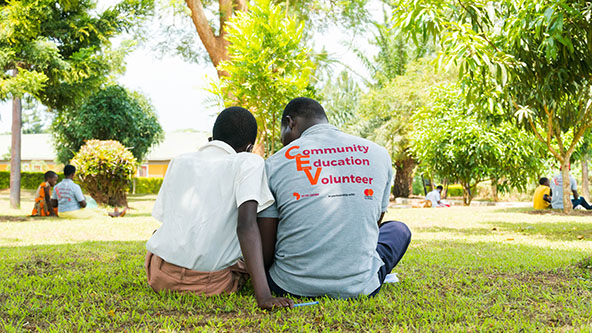
 A Building Tomorrow Community Education Volunteer works with a learner at St. Kizito Kijaguzo Primary School in Nakaseke District, Central Uganda.
When 8-year-old Gloria arrived at her first day of a Building Tomorrow “Roots to Rise” literacy camp in Iganga District, Uganda, she was (like over 90 percent of her Ugandan peers) struggling to master the basics of reading, writing, and arithmetic. Over the course of a few weeks, guided by a community volunteer, Gloria began sounding out words, forming sentences, and even comprehending short paragraphs. More than that: She was learning to be joyful again. Gloria found herself not only helping her classmates but dreaming of becoming a teacher herself.
Today, across sub-Saharan Africa, nearly nine out of 10 children cannot read or write a simple text by age 10, a condition the World Bank terms "learning poverty." The obstacles to reversing this are substantial. The region already faces a shortfall of nearly 15 million teachers, declining education spending as a share of GDP, and deepening post-COVID learning gaps, but the crisis has been further intensified by the recent cancellation of 99 percent of USAID’s global commitments to basic education, amounting to an estimated $1 billion in cuts. In low- and middle-income countries, these cuts come as ministries are already stretching limited budgets across multiple urgent sectors, often against the backdrop of double-digit percentage losses in bilateral aid revenue.
Gloria represents not only the potential of more than 600 million learners worldwide who lack foundational learning skills, but her progress was the result of a promising but underutilized approach for delivering education, a community-led and volunteer-based model that could be the key to solving the global education crisis.
The Power of Proximity
To date, more than 900,000 Ugandan children like Gloria have participated in Roots to Rise camps, guided by a grassroots network of over 20,000 Community Education Volunteers. Trained through decentralized models and rooted in local communities, these volunteers demonstrate what other sectors, such as health and livelihoods, have already taught social impact practitioners: proximity and purpose can deliver powerful results. As a scalable, sustainable solution, community-powered education models offer a compelling answer to the intertwined crises of student academic underperformance and the ever-widening teacher shortages in LMICs.
While community-powered solutions are not groundbreaking, their deployment can be. In Latin America, for example, TECHO mobilizes tens of thousands of young people to address housing and livelihoods through a three-phase model that centers local agency, volunteer-led advocacy, and partnership to transform informal settlements. Working across 19 Latin American and Caribbean countries, nearly 750,000 volunteers have built over 100,000 homes, not only putting a roof over the heads of families in informal settlements but fostering a deep sense of dignity and civic participation.
In western Africa, Tostan’s lauded Community Empowerment Program (CEP) flows out of an intensive, three-year deep dive process, in which communities engage in dialogue, craft their collective vision, and design a development agenda of their own. Tostan’s model has resulted in impressive behavior change, including significant reductions in child marriage, female genital cutting, and other health indicators. Each community’s collective declaration is a testament to the power of proximate engagement: when the people closest to a challenge are equipped with the tools to lead a transformation, change endures.
Volunteer-led, community-rooted models are among the social impact sector’s most successful interventions, and the current global state of education requires the sector to harness the same collective imagination to stem the tide.
CEVs in Education
At Building Tomorrow, an education-focused social impact organization, our Community Education Volunteer model catalyzes education through the formation of locally-identified CEV networks, which boost a community’s available assets toward education. With training and pedagogical support from Building Tomorrow, CEVs enroll out-of-school children, champion inclusion of populations such as girls and children with disabilities in education spaces, build the capacity of school leaders, and facilitate Building Tomorrow’s Teaching at the Right Level-inspired literacy and numeracy camps called Roots to Rise. No two communities will do this in exactly the same way, but a common thread in our experience is that when communities have increased access to training and pedagogical materials, local participants can draw on their existing connections and place-based understanding of students’ environments to impart change and shift mindsets. The results speak for themselves: reducing learning poverty for nearly two-thirds of participants in the over 25,000 literacy and numeracy camps since 2022.
The impact of our CEVs has been validated by a randomized controlled trial (RCT) conducted by Youth Impact, which remarkably showed that less than three hours of individualized instruction by CEVs led to learning gains equivalent to more than one school year of classroom instruction! CEVs accurately targeted instruction to learners’ ability level 81.5 percent of the time, a higher percentage than any other implementers (all of whom were professionally trained) studied in the RCT’s five replication contexts. The recipe for this success is no secret; CEVs were able to leverage the trust they’ve built within the communities they serve to increase learner engagement and parental involvement for vastly improved outcomes.
Across low- and middle-income countries, organizations are already independently deploying volunteer-based education models that show promise. Educate Girls in India harnesses community volunteers to identify and enroll out-of-school girls; ARED in Senegal leverages community tutors; Kenya’s Zizi Afrique and the Learning Generative Initiative are both experimenting with community facilitators in foundational skills acquisition. These approaches vary in design, but they share a belief in the value of community ownership, cost-efficiency, and sustainability. Moreover, Educate Girls successfully enrolled over 245,000 learners into school in 2022-2023 (and their goal is to improve access and quality of education for over 15 million children cumulatively by 2025); these numbers should do away with any misconception that community-driven change is confined to small-scale interventions.
While community-led solutions can flourish independently, they often reach their full potential only when brought together in shared purpose, accelerating government policy. No greater example exists than in public health where community health worker coalitions, like those such as the Community Health Impact Coalition, have advanced shared standards, secured government buy-in, and scaled best practices on a global scale. Similarly, in environmental justice, the Amazon Headwaters Sacred Alliance brought diverse local groups together in their fight to protect millions of acres of rainforest, strengthening their leverage.
Education must follow suit, because the future is collective. A coalition approach offers more than alignment; it enables co-learning, representation, and systems-level coordination. It allows for shared principles, open methods, and interoperable tools. It provides the structure for community-based models to shape—not just supplement—education systems.
To build such a coalition, we propose grounding our efforts in a common vision: that every child, regardless of geography or wealth, deserves to master basic literacy and numeracy. Ample proof exists that we can get there. CEVs have delivered impressive learning gains through Roots to Rise with approximately 80 percent of learners reaching minimum proficiency levels in literacy and numeracy. And while CEVs now reach a new Ugandan learner every 90 seconds, far more work lies ahead. To register such gains at scale and with quality, a community education volunteer approach should:
- Emerge organically from within communities with local buy-in and leadership;
- Leverage existing skill sets among teachers, youth, retirees, and civic leaders;
- Complement and strengthen formal systems, not compete with them;
- Be accountable to both communities and learners through data and feedback;
- Be designed for cost-efficiency, adaptability, and replication.
The moment is urgent. The opportunity is real. As organizations, funders, policy makers, and advocates, we must resist the instinct to go it alone. The education crisis will not be solved by isolated pilots or siloed innovations, but it might be met by a committed, collective, community-powered movement.
We welcome the opportunity to co-create this movement with like-minded peers—toward a future where every child learns, and every community leads.
Read more stories by George Srour, Joseph Kaliisa, Grace Musiimire & Luke Tyburski.