


 (Photo courtesy of nafda)
Even before recent hostilities between Hezbollah and Israel turned the whole of Lebanon into an unimaginably horrifying killing field, the school system in Lebanon had been in steady decline for decades. In particular, a devastating economic and institutional meltdown that began in 2019 has taken a huge toll on schools and on education in the country.
In 2020, a group of Lebanese citizens took on the challenge of building a grassroots movement, nafda, to support schools, and importantly, to use the crisis as an opportunity to inspire schools in Lebanon to become the torch bearers for change in the country. nafda is an Arabic word referring to “deep spring cleaning, typically including shaking things up vigorously.”
Three years into this effort, more than 50 schools have joined the movement, all aligned around a commitment to living the values of active citizenship, social justice, and good governance. The integration of these values has led to transformative changes in many nafda schools. Other schools are observing the energy and momentum, and they are eager to join the movement.
The effort is still a work in progress, and it is too early to tell whether it will achieve what has emerged as a galvanizing ambition of nafda: healing and transforming a broken society through schools.
What is clear, though, is that the foundations of trust, solidarity, and hope that emerged through this work have positioned nafda schools to play a critical role in the most recent calamity befalling the country and its education sector. For 60 days, 60 percent of public schools in Lebanon were converted to displacement centers for families from various (predominantly Shiite) parts of the country seeking shelter in slightly safer areas. In addition to the obvious challenge this posed to the education system, this sudden and forced displacement of 25 percent of the population created serious strains on social cohesion in a country where memories of its late-20th-century civil war are still vivid.
Students in many nafda schools organized community efforts to provide support to families in displacement centers, including basic needs and emotional support for children in these centers. Perhaps more importantly, principals, teachers, and students at nafda schools leveraged the forced co-mingling of communities to create connections and to mitigate inter-communal fears and tensions.
We, the authors, have accompanied this effort from its inception—one as an enabler and founding board member, another as both a school principal and after that as a member of the nafda support team, and the third as a leader of the support team. Our main purpose is to share the initial insights from our experience, to outline the challenges the movement faces as it moves towards scale, and to speculate about the possible implications of this for changemakers in troubled countries. Along the way, we will highlight the response of nafda schools to the dramatically escalating violence that the country has endured in recent months.
Looking Into the Abyss—Unprecedented Institutional and Financial Meltdown
Once a beacon of hope for social progress and individual fulfillment, Lebanon’s education system now lies in ruins. This decline extends beyond crumbling infrastructure and underpaid teachers, threatening the very foundations of engaged citizenship and a sense of belonging to a unified society.
Historically fragmented, Lebanon’s school system reflects the country’s diverse communities. The post-war Taef Agreement attempted to address this fragmentation to foster unity, leading to a reorganization of the sector in 1995 and a new curriculum in 1997 that was only partially implemented. Like other MENA countries facing instability, Lebanon’s government spending on education has been insufficient—less than 2 percent of GDP as of 2020, well below the OECD average of 3.3 percent.
Since 2019, Lebanon has endured an acute economic crisis marked by hyperinflation and widespread instability, devastating the education sector. Public schools, which serve about 40 percent of Lebanon’s 1.1 million students, have been particularly affected. Teacher salaries have dropped from $1,500 to less than $100 per month, and there has been a 23 percent decline in civil servants, increasing reliance on lower-paid contractual staff. Between 2019 and 2023, these severe disruptions drove significantly lower learning outcomes for Lebanese students, with average learning-adjusted years of schooling (LAYS) falling to 4.6-4.9, far below the previous level of 10.2 years. In a country where education has traditionally been highly valued, the collapse of the school system is having profound societal impacts.
A 2021 public opinion survey by Konrad Adenauer Stiftung (KAS) revealed that nearly half of Lebanese citizens were considering emigration. The government’s failure to address the education crisis is undermining civic engagement, eroding the social contract, and leaving parents questioning the system’s ability to secure a better future for their children.
nafda, Enabling Principals to Lead Transformational Change
It was against this backdrop that a group of Lebanese citizens, several of them in the widespread Lebanese diaspora, decided to take matters into their own hands. The initial focus was on a dual strategy of “salvage and transform.”
From the outset, there was a commitment to approach this effort differently. Instead of creating programs and introducing them in schools or earmarking budgets for specific activities, the “enablers” (the term adopted to describe the supporting members of the nafda community) of this effort placed school principals at the center, respecting their agency and independence above all else.
Twenty principals from around the country were invited, after an elaborate screening process, to become “founding principals” of nafda. The enablers looked for principals who (a) had not lost hope in the country and in the possibility of transforming learning in their schools; (b) were willing and eager to integrate the three values of social justice, good governance, and active citizenship in their schools; and (c) welcomed the opportunity to support other principals and to act in solidarity with them.
Together with the founding group of enablers, the founding principals sketched out a way forward for their schools, began supporting each other on their respective transformation journeys, and started to shape a broader advocacy agenda for transforming the education sector as a whole.
 (Photo courtesy of nafda)
Two and a half years since these principals first met, nafda schools in all corners of the country are becoming beacons of hope for students, teachers, and the communities around them. The movement has grown from 20 to 55 schools, and nafda principals have become a sought-after voice in policy conversations about the future of the education system in the country. Importantly, the recruitment criteria for nafda school principals became a springboard for collective action and impact.
The recent hostilities considerably slowed the pace of transforming learning in nafda schools. However, peer solidarity and the core values of social justice, active citizenship, and good governance became even more prominent and essential, especially considering the rapid deterioration of inter-community social cohesion brought about by the massive displacement crisis.
Each of the three recruitment screens blossomed into a body of work in the nafda network, and it manifested in different ways in response to the most recent crisis.
Transforming Learning Within Each School
Each nafda founding school organized its own catalytic 100-day project, where a team of students, teachers, and parents zeroed in on a theme of their choice and then pursued progress on this relentlessly. The projects aimed at propelling the school forward towards one of the thematic priorities that emerged through consultation with its community stakeholders. Each was organized around 100-day deliverables and followed a structured rhythm, adapted from REINSTITUTE’s 100-Day Challenges.
Here’s one example of the 20 catalytic projects that were organized by the nafda pioneering schools.
The Case of the Disappearing Bees
In Rashayya, located in the southeast corner of the country, an urgent environmental and social challenge emerged as the region grappled with a multitude of issues, including wildfires and excessive pesticide use, that posed a threat to its natural resources. As one indicator, the bee population in Rashayya had dwindled to dangerously low levels.
The Rashayya public high school, serving more than 300 students, chose this as the theme for its catalytic community service project. The nafda support team connected the school with a local nonprofit organization that focuses on nature preservation, which provided training to 75 students from grades 10 and 11. Utilizing 8,000 square meters of land adjacent to the school, the students, along with teachers and community members, planted native herbs in the plot. With guidance from a local beekeeping expert, they also built 12 beehives, and they began caring for bee colonies in their herb gardens.
The students devised and implemented a plan to market and sell their honey production. The proceeds from the sale of honey and herbs, combined with donations raised through fundraising events, were used to assist local residents in need.
The teacher who mentored the student team on this project proudly described the impact of the project on the students involved, and in the community:
“The beehives became a great attraction at the school. And the beehive obsession has now infected the community. Eight families adopted the practice and have started their own bee colonies.
“The students organized themselves to rotate responsibilities for tending to the herbs they planted. Prior to this, students had not shown any interest in the land. Now, they feel more aware of—and connected to—the land in their village.”
One of the students, a young woman, said this about her experience:
“When I joined the team, my mother told me that this is a silly thing and that I should concentrate on my studies. But after she saw how her once shy daughter was now leading other students with confidence, she was proud and happy. Now she asks me what she can do to help me and the project team.”
Most nafda schools were poised to get new transformation projects underway at the start of the new school in September 2024, but all of these projects, and in many cases the opening of schools, were paused till early November. Some nafda schools became too dangerous to access, several became displacement centers, and others scrambled to adjust to the new realities on the ground and to the massive influx of displaced students into their communities.
Nevertheless, even in the midst of the chaos and the rubble, hope would not be extinguished! Students of Rashayya public school who worked on the beehive project worked with their teacher/mentor on a new project in the summer, and they entered (remotely) a world-wide climate change competition organized by the Said Business School at Oxford University. In mid-November, four Rashayya students and their teacher/mentor braved the shelling between their school in Southeast Bekaa and the airport in Beirut and traveled to Baku to present their project at the COP29 Summit, along with four other finalist schools from around the globe.
Spreading nafda Values in the Schools and Beyond
Even though the themes of the nafda school transformation projects varied from school to school, all of them were leveraged by school principals to reinforce one or more of the shared values of engaged citizenship, social justice, and good governance. This “values integration” was not left to chance. The nafda team provided coaching support to help make the bridge from project to values. For example, in the Rashayya school, students practiced engaged citizenship by actively taking responsibility for their ecosystem. They practiced social justice and good governance by the way they allocated the proceeds of the sale of honey and herbs to members of the community who were most in need.
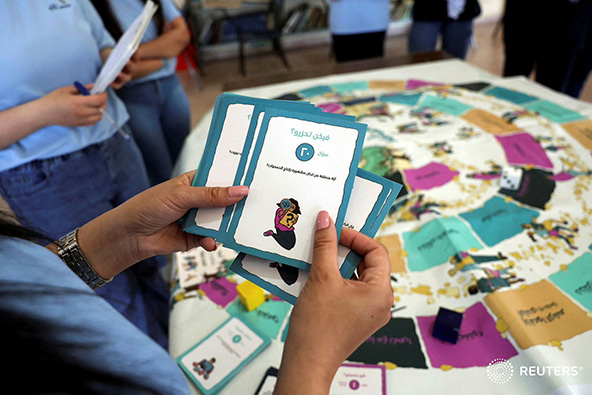
To accelerate the promulgation of the nafda values, the nafda support team, in collaboration with the pioneering principals and local pedagogical and cultural experts, developed a board game, called Aal Seha, that challenges student teams to respond to scenario-based questions involving choices related to the three values.
 (Photo courtesy of nafda)
Amidst the most recent war raging in Lebanon, Aal Seha took on a new urgency. As an engaging way for fostering critical thinking and dialogue among youth, it has become a powerful tool for enabling cathartic conversations among students in schools about the atrocities they are seeing around them. Aal Seha is offering students a safe space to nurture empathy, insight, and collective responsibility.
One of nafda’s responses to the crisis has been to accelerate plans to deploy Aal Seha in schools outside of the nafda network. The aim is to help strengthen social cohesion that is quickly eroding as each community prioritizes self-preservation above all else in the face of existential threats.
Peer Support and Solidarity
Lebanon is a small country, but it is fraught with divisions and sub-national identities: geographic, religious, and political. By design, nafda founding schools crossed all possible fault lines in the country. Despite these differences, nafda founding school principals, total strangers at the start, quickly bonded into a tightly knit support group. Several report that part of their daily routine has become a call to a nafda peer principal to “check on how they were handling the crisis of the day”—sadly, a hallmark of life in Lebanon in recent years.
The 20 founding nafda schools developed and implemented their own rubric for screening new schools that were interested in joining nafda. The nafda network expanded from 20 to 55 schools at the start of the 2023-2024 academic year. The new nafda schools were then inducted into the process of developing catalytic projects by the founding schools—with school teams visiting other schools around the country.
Peer support has become a lifeline for nafda principals in the ongoing nightmare turned daily reality. This includes sharing creative solutions to their daily problems. For example, teachers in one school recorded short video lessons and sent them to students who had gotten displaced and dispersed around the country. Peer support also included listening to each other with empathy as they shared their grief about lost family members, teachers, and students.
The Secret Sauce: Making Connections
It is tough to pin down the factors that have enabled nafda schools to defy the odds and spread hope, energy, and innovation in their schools and communities during one of Lebanon’s darkest periods. There is, however, one theme that stands out as a possible catalyst for the shifts we are seeing: making connections. This has also positioned nafda schools to more effectively respond to the present calamity in the country.
nafda as a movement and as a network has made several types of important connections:
Schools Connecting With Their Communities
Each nafda school began its transformation with a collaborative community visioning process, with concepts and tools based on a toolkit developed by the Brookings Center for Universal Education. These structured conversations focused on identifying learning priorities and building support for catalytic projects. nafda principals and teachers also used these forums to subtly promote the idea that schools play a role in shaping societies, not just preparing students for future jobs.
Priority themes such as equitable learning, STEM/STEAM, experiential learning, community service, and critical thinking emerged out of this process.
Schools also discovered untapped potential within their communities. Some parents donated materials for STEM/STEAM labs. Others volunteered to assist teachers practicing differentiated learning methods in their catalytic projects.
In the current crisis, this has translated into nafda schools engaging with a broader community that includes groups of families that had been displaced into their community. Often these are whole villages that took refuge in another village in a different region. The connections that had been built with their own community enabled nafda students to spearhead community efforts to support their displaced compatriots. In one nafda school, for example, the team used the skills gained in their STEAM transformation project to create and market a free app that displaced families could use to locate available shelter and other resources in their region.
nafda Schools Connecting to Each Other
The day they first met, nafda founding principals talked about their schools and the possible future they wanted to create. At the end of their second day together, the school principals developed and signed a joint manifesto pledging to embark on transformation journeys in their respective schools, to support each other, and to work together to plant the seeds of the three nafda values in their schools and communities.
The nafda experience included several inspirations for strengthening peer relationships:
- To advance their initial catalytic projects, nafda schools clustered into peer groups of 4-5 schools (with similar thematic interests). Teams from these schools progressed through their catalytic project journeys together.
- nafda principals took an active role in co-creating the continually unfolding nafda journey. This included:
- Developing a process for screening other schools before inviting them to join nafda.
- Developing a “values compass”—surveys of students and parents to assess how well a school is living the three nafda values.
- Jointly shaping policy change agendas and advocacy plans.
- Organizing peer learning sessions where principals from two or three schools showcased some of the practices and innovations in their schools.
In the most recent crisis, these technically-oriented connections became more existential: How do we maintain the integrity of our school and the continuity of learning when our students are dispersed all over the country? How do we adapt the curriculum to the realities that our students are seeing around them, so we do not contribute to normalizing what should be inherently abnormal and repugnant?
nafda Schools Connecting to Civil Society Organizations
Each nafda school was allocated a small block grant based on its size. The school had full agency to use this grant to fund its 100-day catalytic project. Most schools used this to contract with NGOs and other subject matter experts that could help them conceive and implement these projects.
To facilitate this, a marketplace model was used. Multiple NGOs were invited to “show their wares” to nafda schools, and then schools decided who they wanted to work with. This yielded connections with about 30 local NGOs in the education sector. This also spurred another layer of connections—linking educational NGOs in the country to each other.
In the midst of the most recent crisis, connections to humanitarian relief NGOs became especially critical. nafda principals, with the support from the broader nafda community, connected with these NGOs. and many nafda schools became focal points for coordinating distribution of relief supplies in their respective communities.
nafda Communities Connecting With Each Other
The most recent connection thread emerged from students. In one of the nafda schools, students initiated the formation of a national "nafda student council" to organize joint community service projects in each others’ communities.
The students articulated a bold aspiration as their impetus for initiating this effort: “Building bridges across communities in the country, and countering the dominant narrative in the country that the Lebanese mosaic of religions and cultural communities can no longer form a unified national identity.”
As unlikely as it is, this aspiration reflects the essence of nafda: bringing about profound societal change by believing in—and supporting—school principals, students, and educators as the architects and catalysts of change.
This particular type of connection became the signature of the nafda network in response to the most recent crisis. As Lebanon has grappled with escalating hostilities that displaced more than a quarter of its citizens, the fabric of society is fraying under the strain of sectarian fears and polarization about the war. These deepening fractures highlight the urgency of building social cohesion as a pathway to avoid internal strife during the crisis and to prepare for a healthy recovery after it.
nafda schools pioneered student-to-student activities bringing together displaced and host communities to connect and collaborate through trust-building initiatives. These often take the form of non-competitive games, tasks, and community service projects that provide a platform for shared experiences.
These initiatives are spreading rapidly across the nafda school network and beyond, and they have continued even as many displaced families have started to relocate closer to their decimated villages and homes. Whether they spread fast enough to counter the centrifugal forces and the polarizing narrative pulling the country apart is yet to be determined. What is clear though is that where they are taking place, bridges are being built across community divides.
The High-Wire Act of Scaling
The chilling effect of the current calamity notwithstanding, those of us involved in supporting this effort often marvel at the depth and speed of the multifaceted transformations taking place in nafda schools:
- Principals shifting the culture in schools towards inclusive and distributed leadership and supporting each other—across all fault lines in the country.
- Teachers shifting their classroom style toward student-centered learning.
- Students learning by solving community problems they have identified themselves, and building their own agency and confidence.
- Shifts in mindset and behaviors in schools and in the communities around them: more listening; more acceptance of the “other,” and more open dialogue.
The direction of travel of nafda schools is aligned with what appears to be a global trend to rethink learning, schools, and educational systems. We were inspired early on by the work of the Brookings Center for Universal Education on family and community engagement. We were also both inspired and encouraged by the movement for learner-centered education that Education Reimagined is building in the United States.
What seems to be unique about nafda is the speed at which these shifts are happening, the particularly tough context that nafda schools are operating in, and the possibility these shifts hold for influencing this context in a profoundly positive way.
We believe that making connections was a catalyst for these shifts. There is another related theme that keeps coming up when we ask nafda principals about what made these shifts possible:
- “You believed in us.”
- “You did not tell us what to do, but you trusted us to decide on what is best for our schools.”
- “You gave us a nudge, and now there is no stopping us.”
We, as enablers and support team members, believe that this “way of showing up” was essential to making so much progress in so little time. It will also be the most difficult aspect of nafda to sustain as the movement grows.
In order to bring about societal change, assuming the country survives this most recent crisis, we will need to grow the nafda school network from 55 to at least 250 schools (about 10 percent of schools in the country). This will provide widespread geographic coverage in the country, and it may help the nafda approach reach a tipping point in the educational system.
As we grow the team to support more schools, and as we begin to shift the funding sources from individual donations to development institutions, there will be tremendous pressure and temptation to standardize nafda support activities and to begin to act like a more traditional nonprofit organization.
The humility that was so central in building trustful relationships with nafda principals may begin to erode and to give way to preoccupations with efficiency, with counting what is measurable versus what is really important, and with prioritizing what works for all schools versus what works for each school.
We managed to walk safely on this tightrope as the movement grew from 20 to 55 schools. Growing from 55 to 250 schools will be a more challenging high-wire act.
nafda remains a long-shot attempt to transform a country. Even if it fails to do so in the unforgiving environment of Lebanon, it has already demonstrated the possibility of societal change emanating from—and through—schools. Supporting principals, educators, and most importantly students to find their voices and their agency may be our best bet to heal our broken societies and our broken planet.
Read more stories by Nadim Matta, Jinan Karameh Shayya & Youmna Helou.