


 (Illustration by Mar Hernández)
Philanthropic support for the K-12 education reform movement is not immune to the institutional dysfunction and gridlock emblematic of American politics. This impasse disbanded the long-standing bipartisan K-12 reform coalition that advanced accountability in schools, which led to notable improvements in student achievement scores, especially for disadvantaged students.
The coalition’s demise has affected education philanthropy’s giving patterns. A 2019 Grantmakers for Education (GFE) member report shows that member investment in organizations advancing issues related to school accountability plummeted from 33 percent in 2015 to 5 percent in 2018. Arguably, donors who supported the accountability agenda reduced giving as the coalition dissolved.
However, donors haven’t entirely abandoned education funding. A growing number have shifted their giving to two areas: postsecondary education and preparation for the workforce and careers, which rank 1st and 14th, respectively for share of grantmaking dollars allotted to educational causes, according to GFE’s 2015 survey. Trends indicate that giving for workforce education increased dramatically, from 22 percent in 2015 to 42 percent in 2018.
At the K-12 level, career pathways programs prepare young people for college and professional life by connecting both schools and students to employment. The shift gives education philanthropy a unique opportunity to create new and wide-ranging school and career coalitions of donors, advocates, and other stakeholders across multiple sectors: K-12, postsecondary, workforce training, and employers.
The mission of this endeavor is to ensure that all young Americans, regardless of background, develop and deepen their knowledge and personal and professional networks—what I refer to in this article as habits of mind and habits of association—that build their capacity to pursue opportunity. The challenge is to then create an investment framework that unites diverse donors and other coalition members in support of pathways programs while also affording them the freedom to develop and fund different models.
These career pathways programs are unlike former vocational education programs which placed students in different tracks and occupational destinations depending largely on their family background. This sorting approach often carried with it racial, ethnic, and social class implications, with immigrant, poor, and minority youth more often enrolled in low-level academic and vocational training, and middle- and upper-class white youth more often enrolled in college-preparatory classes. These programs were often described as dumping grounds for students stereotyped as incapable of serious academic work. In their 1992 report, Educational Matchmaking, education researcher Jeannie Oakes and her colleagues at RAND Corporation contended that the causes of this inequity “stem[med] as much from a shortage of good schools as from an uneven distribution of opportunity within schools.”
This article articulates a way to meet the challenge of creating an equitable approach to pathways programs. I begin by describing the now defunct K-12 school accountability program and the federal and state policy coalition that advanced it. I then analyze why the coalition collapsed and offer four lessons learned from that experience. An important idea emerges from these lessons: Opportunity is the foundation for a new civic vocabulary about education success that can unite diverse donors and other stakeholders to create pathway programs. From this discussion, I offer a framework for understanding opportunity linked to pathways programs, which I illustrate through examples of the framework’s salience to innovative program models, a proposal for a program success vision based on these examples, and an analysis of the demand and potential market for creating more pathways programs. This article concludes by linking pathways programs to a young person’s development of an occupational identity and vocational self that prepares them for life.
The Consequential Accountability Reform Program
The K-12 reform movement focused on what was called “consequential accountability.” Originating in sociologist James Coleman’s 1966 study, Equality of Educational Opportunity, this idea aimed to shift policy attention, Coleman explains, from “inputs (per pupil expenditures, class size, teacher salaries, and so on) to a focus on outputs,” and specifically student academic performance. This shift influenced the Reagan administration’s US National Commission on Excellence in Education’s 1983 report, A Nation at Risk: The Imperative for Educational Reform, which asserted that America’s schools were failing and needed fixing. The objective was to improve student academic performance—the mantra was “focus on results”—through four strategies that policy makers and other K-12 stakeholders developed over the years: setting rigorous education standards, tracking student progress through testing, holding schools accountable for poor test results, and building capacity by fostering a fairer distribution of resources.
The general policy contours of this approach were formally adopted in 1989 by the nation’s governors at the National Education Summit. The governors undertook its early implementation by using the resources and influence of the National Governors Association, along with organizations like the Council of Chief State School Officers; the Council of the Great City Schools; the American Federation of Teachers, under the leadership of its president, Albert Shanker; and many other K-12 stakeholder organizations. The consequential accountability reform program was supported by the George H. W. Bush administration through its nonlegislative and voluntary effort called America 2000, which encouraged national organizations and local communities to develop community-wide K-12 improvement plans. Because of its measurable success, fundamental parts of it became the core of federal K-12 policy through legislation spanning three presidential administrations: the Clinton administration’s Improving America’s Schools Act; the George W. Bush’s administration’s No Child Left Behind Act; and the Obama administration’s Race to the Top (RTTT) fund.
The Coalition’s Demise
Although the school accountability movement saw some success, the coalition that supported it collapsed. Major pushback began against the Obama administration’s RTTT fund, a $4.35 billion US Department of Education grant competition to spur and reward innovation and reforms in K-12 education funded under the American Recovery and Reinvestment Act of 2009. States competing for grants were awarded additional competitive points for enacting reform policies such as performance-based teacher and principal evaluations; education standards under the guise of a Common Core State Standards Initiative developed by K-12 experts and stakeholders; the expansion of charter schools; and turning around the lowest-performing schools, including converting them into charter schools.
After several years of program implementation, an unconventional opposition emerged, uniting teacher unions and other K-12 stakeholders on the left with Tea Party populists and other conservatives on the right. Both argued that the RTTT version of the consequential accountability program was a federal overreach that usurped a state’s or community’s K-12 school decision-making authority. They succeeded in drastically reducing the federal role in standards and testing decisions and the US secretary of education’s authority over state and local policymaking.
There are three additional reasons for the coalition’s demise. First, the bipartisan consensus required compromises that gave each side some but never all of what they wanted. This made implementation difficult and, on some issues, impossible. Moreover, when implementation of the consensus did occur, results were seldom what policy makers promised or stakeholders envisioned. Consequently, those who supported the reforms were criticized by disappointed stakeholders and by those who disagreed with the majority consensus, and thus reform supporters soured on the policies.
Second, the K-12 reform coalition’s focus on measuring results had unintended consequences. Basing learning goals on quantitative measurements turned education reform into technocratic deliberations on issues like testing validity, measurement error, and negative consequences. This approach precipitated a groundswell of opposition from different coalition members. Their criticisms saw this technocratic effort as narrowing instruction, teaching to the test, overlooking more holistic, child-centered approaches to education, and penalizing teachers whose students didn’t do well on tests for reasons over which they had no control. As a result, federal, state, and local policy makers retreated from the consequential accountability program.
Finally, the polarization and gridlock that have poisoned the nation’s politics and many aspects of American culture have also affected the education reform movement, making it impossible to resurrect the consequential accountability reform coalition. But they do offer an opportunity to think about how a new coalition might be created, based on the lessons that demise taught us.
Lessons Learned
For 23 years, I’ve had the privilege to work as an educational advisor at two private foundations (the Annie E. Casey Foundation and the Walton Family Foundation) that participated in the K-12 reform coalition. From this experience, I have identified four lessons germane to any donor interested in 21st-century education reform.
Lesson 1: Develop a new civic vocabulary of success. Consequential accountability focused on short-term, quantifiable measures of student success in the form of test scores. This objective often made education policy debates an abstract and technocratic endeavor. Today’s arguments about education’s role in advancing social and economic mobility, inspired by economist Raj Chetty and his colleagues at Opportunity Insights, raise broader issues for K-12 education, such as how these schools lay the foundation for an individual’s social and economic mobility and life success. This broader definition of success requires a new civic vocabulary for talking about education.
An important source for developing this civic vocabulary is the work of Todd Rose, cofounder and president of the think tank Populace, who created the American Success Index with Gallup, Inc., which describes how Americans view their personal success contrasted with those same individuals’ perceptions of how others define success. The index includes perspectives on education’s role in achieving success and illustrates three core beliefs Americans have on this subject. First, Americans generally say that other people’s view of success is based on rank, prestige, and status. Conversely, their personal view of success is rooted in a different orientation, focused on relationships and the networks and institutions that nurture relationships—social capital. Second, Americans view personal success as crucial to achieving opportunity. Finally, Americans believe education is one of the most important avenues for achieving this personal success.
In effect, Americans’ perspective on personal success is neither technocratic nor oriented toward rank or status. It’s focused on opportunity—especially on how schools, relationships, and networks have significant roles to play in helping people garner the knowledge and networks they need to pursue opportunity. This orientation is the basis for a new civic vocabulary about how schools must be at the center of community efforts to prepare young people for opportunities.
Lesson 2: Create place-based civic campaigns. A significant part of the Walton Family Foundation’s legacy K-12 strategy is a new-schools start-up grant program, now focused primarily on a dozen or so urban areas with a history of advancing school reform. The program has created a supply of independent public charter schools and district innovation schools, which remain under school district control but have a measure of autonomy similar to that of charters, such as hiring their own personnel. Other foundation grants go to organizations for advocacy, technical assistance, and capacity building that support the start-up grant program. Since the program began in 1997, more than 2,500 schools have received financial investments totaling more than $480 million, and more than 1 in 5 of the 7,500-plus US charter schools that exist today received start-up support.
Redefining success in terms of opportunity emphasizes the aspirations of young people, including pathways to a self-determined life.
This urban-focused strategy of supplying new schools is creating fewer schools in these places than in the past, because jurisdictions have limited the number of new charter schools that can be opened. This situation calls for new thinking on the foundation’s place-based work. For example, how can donors support the emergence of new places where education improvement is nascent or nonexistent but where community improvement efforts and other assets exist? How can they back local leaders creating a demand for effective schools?
A donor-originated supply strategy requires a complementary, community-developed and community-led demand strategy. The goal is to create a civic campaign where philanthropic resources follow a community’s lead in building a new source of persistent grassroots power for effective schools. That campaign should especially cultivate the voices of parents and students who demand that schools better prepare young people for opportunity.
Lesson 3: Utilize local intermediaries. The first two lessons have implications for the way any foundation understands the relationship between current work, new work it undertakes, and a program operating model. First, there’s a foundation’s legacy work—for example, the Walton Family Foundation’s school start-up grants and other grants supporting them—that will develop incrementally with new circumstances and insights. Such legacy work is likely to involve conventional program leadership, including managing proven activities in predictable ways. Second, there’s emerging work—for the Walton Family Foundation, this is the community-developed and community-led demand strategy in new places—that’s likely to be more disruptive, raising new issues and questions. Such work requires a more agile approach to program leadership—more opportunistic and risk-taking—and offers unanticipated learning opportunities. Both kinds of foundation work are important, creating what I call a split-screen operating model for a foundation, or what Harvard Business School professor John Kotter calls a dual operating challenge of working with two different systems in one organization—one managing proven or legacy activities and one managing emerging or new activities.
This operating environment requires a foundation’s program officers to work differently in this split-screen environment when making local programmatic investments for both types of work. Rather than doing grantmaking directly, program officers should delegate the work to local intermediaries, such as community foundations, United Way, or Goodwill. This approach reinforces the knowledge and other assets that local organizations possess to develop a community-led and developed improvement strategy. Program officers are primarily in a support role, learning about and tracking progress on that work. This approach requires that those who are not local residents, such as donors and others who are from outside the community, do their local homework by talking to community leaders and local residents about their frustrations, problems, and hopes for a better future.
Lesson 4: Invest in new places. Redefining success in terms of opportunity emphasizes the long-term aspiration of young people for opportunity, including varied pathways to a self-determined life typified by social and economic mobility. This approach requires creating new and durable political and advocacy coalitions, institutions, and programs to support this effort. Education policy makers and donors should adopt a strategy framework for investment in new places that embraces at least four aspirations: support “catalytic communities,” build new advocacy coalitions, invest in career pathways programs, and engage new funders.
Catalytic communities are those that aspire to increase equitable access to K-12 opportunities but lacked previous allied philanthropic and school-reform efforts. This approach is based in the community: Its design is grounded in community demand, led by local citizens united under an opportunity-oriented vision of success, and driven by community-informed solutions. When a foundation’s vision aligns with a community’s vision, it will make investments. When that’s not the case, it can connect the community to aligned philanthropic and program partners. Ultimately, the vision is to enlist new places in a movement that creates education change for K-12 children.
Place-based career pathways programs are multiyear efforts that respond to local contexts and build on local assets, connect to local social and labor market needs, and foster public and private partnerships to solve the education and training problems a community faces. The Walton Foundation is testing this approach by investing in career pathways programs in three of its legacy urban areas: Indianapolis, Indiana; Denver, Colorado; and Washington, DC. The work is supported by a national and local funders consortium whose goal is to accelerate upward mobility for underserved students. Entangled Solutions was the initial national intermediary coordinating work with funders and local organizations across sites on program development, information sharing, and policy advocacy. The nonprofit intermediary New America, through its Partnership to Advance Youth Apprenticeship, is now involved in this initiative, working to build high-quality youth apprenticeship programs that promote inclusive economic development and create new opportunities for young people. Finally, another example is an investment in New Profit, an intermediary directing the Postsecondary Innovation for Equity (PIE) initiative. PIE organizations are working to create access to postsecondary and career opportunities serving young people ages 15 to 30 for whom traditional school, college, or other training programs have not worked.
Retooling education philanthropy by engaging new funders to support this placed-based approach is another dimension of this work. This trend is illustrated by The 1954 Project, a new education philanthropy initiative to recruit and inform an intergenerational donor community of Black philanthropists. Its goal is to encourage greater investment in emerging Black education leadership by giving those leaders ample, flexible financial and technical support in their work to improve student outcomes. Named for the 1954 Brown v. Board of Education Supreme Court case, the project is committed to raising at least $50 million over the next three years.
An Opportunity Framework
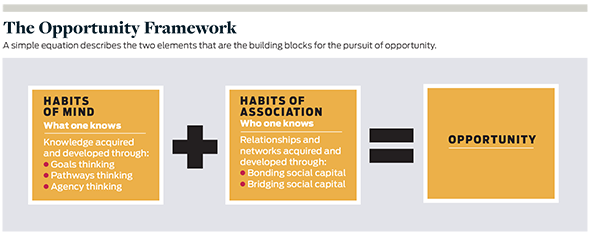
If opportunity is the center point of a civic vocabulary to guide place-based civic campaigns, an opportunity framework can outline the types of investments donors can make to create K-12 career pathways programs. The framework I propose includes the complementary idea of opportunity pluralism, which describes the need to make the opportunity structure multidimensional by offering individuals a greater range of pathways to opportunity. This framework can unite donors under a robust set of investment categories while also allowing them wide latitude for investing in different pathways program models. This latitude is what allows donors the ability to create an opportunity structure with a range of education and training pathways for people to pursue.
The essential elements of the opportunity framework are what students know and who they know—knowledge and relationships. It recognizes that cultivating habits of mind and habits of association are the building blocks of individual opportunity. They are habits because pursuing knowledge and relationships requires behavior learned and internalized through practice. A combination of these habits leads to prosocial behavior, which enables the pursuit of opportunity.
Habits of mind comprise three modes of thinking: goals thinking (defining and setting achievable outcomes), pathways thinking (creating a route to these outcomes), and agency thinking (pursuing goals and pathways through personal agency and self-efficacy). Pathways and agency thinking together foster the pursuit of goals, helping students overcome life obstacles.
Habits of association include two kinds of social capital: bonding and bridging. Bonding social capital occurs within a group, reflecting the need to be with others for emotional support and companionship. Bridging social capital occurs between social groups, reflecting the need to connect with individuals different than we are, expanding our social circles across demographics and interests. Bonding and bridging social capital are complementary. Bonding social capital is for “getting by,” social scientist Xavier de Souza Briggs observes, while bridging social capital is for “getting ahead.”
Social capital operates on multiple levels, spanning from relationships between individuals to relationships with midlevel groups or firms to relationships with large local and national institutions that order society. Social psychologists Jonathan Haidt and Selin Kesebir describe how these elements intermingle as “the puzzle of cooperation,” beginning with those “who share the same gene because of descent from a recent common ancestor, [expanding to] non-kin cooperation in large groups.”
Understanding opportunity in terms of knowledge and networks is a way to establish a nonpartisan conversation about the role of schools and other community institutions. It can unite divergent political orientations and beliefs under themes that elicit initial agreement. It also offers a theoretical foundation for developing ways in which individuals, community organizations, like schools, and other local enterprises expand their relationships, networks, and social circles to advance opportunity. It can create an understanding of relationships as resources that lead to the development and accumulation of human capital and opportunity networks.
University of Texas law professor Joseph Fishkin has written about how people access and structure opportunities, including how education’s credentialing process for work and career contains bottlenecks that deter opportunity. His argument for opportunity pluralism provides a structure that offers multiple education, training, and credentialing pathways to work and career that include, but are not limited to, a four-year college degree. Instead of struggling to equalize opportunity on a single pathway, Fishkin contends, the range of opportunities for people at all life stages must be broadened and deepened. Within a career pathways program, opportunity pluralism focuses attention on a systemic issue: how a society structures the institutional preparation and credentialing of individuals to access opportunity.
Career Pathways State Models
Examples of pathways programs illustrate the varied approaches that the opportunity framework encompasses at the state and local levels. The state examples highlight approaches by governors of different political parties, while the local examples highlight how organizations from many different sectors have united to create these programs. They all accentuate the importance of acquiring knowledge and creating and leveraging social networks, the two key dimensions that work to place someone on a pathway to opportunity.
Delaware Pathways was established in 2014 by then-Democratic governor Jack Markell to provide college and career preparation for youth in grades 7 to 12. Its goal was to create pathways from school to careers aligned with state and regional economic needs, especially for middle-skills jobs, such as dental hygienist or electrician. They require more education than a high school diploma but not necessarily a four-year degree.
Middle school students learn about career options and later take career-related courses as high school sophomores or juniors. High school students can take college classes at no cost to families, serve as interns, and earn work credentials. Beginning in the summer before senior year, students participate in a 240-hour paid internship that lasts through the academic year.
The program engages K-12 educators, businesses, postsecondary education, philanthropy, and community organizations. For example, Delaware Tech is the lead agency that arranges work-based experiences. United Way coordinates support services for low-income students. Boys & Girls Clubs and libraries provide after-school services.
Currently, Delaware offers pathways in fields such as advanced manufacturing, engineering, finance, energy, environmental science, and health care. More than 9,000 students are enrolled, around 45 percent of the state’s high school students. Many also take career-related courses at institutions of higher education and earn credits that can be applied to an associate’s degree or other academic certificates.
Together, the United Way of Delaware and the Rodel Foundation of Delaware have been the lead agencies in coordinating financial support for the pathways program. As a support organization of the Delaware Community Foundation, Rodel solicits and accepts grant funding for the program, including state and federal dollars and corporate and private foundation support. The goal is to secure 60 percent of the funding from public sources and the balance from private sources.
Tennessee’s Republican governor, Bill Haslam, established the Drive to 55 Alliance in 2015, a partnership between the private sector and nonprofits intended to equip 55 percent of Tennesseans with a college degree or training certificate by 2025. Its five programs, three pertaining to K-12, create partnerships among school districts, postsecondary institutions, employers, and community organizations.
Tennessee Promise Scholarship provides last-dollar support—financial awards toward tuition and fees after other aid has been applied—for high school graduates attending community or technical colleges, including linking these scholarship students with private-sector volunteer mentors and nonprofit partners. Tennessee Reconnect, a counterpart to TN Promise, offers last-dollar grants for adults to earn an associate degree or technical certificate, tuition-free. Tennessee Pathways promotes a college-and-career approach to K-12 schools and grants a Tennessee Department of Education pathways certification to programs with strong alignment among high school programs, postsecondary partners, and regional employment opportunities. The Seamless Alignment and Integrated Learning Support (SAILS) program is for high school students who did not reach ACT college-readiness benchmarks in mathematics. It provides in-person and online learning so that students can complete math modules for postsecondary credit and don’t need remedial math in college. And Tennessee Labor Education Alignment Program (LEAP) is directed at four-year postsecondary institutions. It connects students with employers so colleges can offer programs aligned with actual employer workforce needs. Linking all these programs together is an online portal called College for TN, which gives students, counselors, and educators planning tools for career and college.
All five programs are supported by funds from the state’s budget, with supplemental funding from the federal Carl D. Perkins Career and Technical Improvement Education Act. Additional support comes from national and Tennessee-based foundations, and individual donors.
Career Pathways Local Models
Current innovations by schools and other community organizations and enterprises are creating new partnerships and approaches to K-12 schooling and further education. They also create novel forms of social capital for young people by initiating new relationships that expand their knowledge and social networks. They combine habits of mind and association to lay a durable foundation so young people have the knowledge and relationships that help them pursue opportunity, including developing an occupational identity and vocational self.
Here are six types of partnerships that illustrate how programs can blend the acquisition of knowledge and networks to educate young people to pursue opportunity:
School district, charter school, and university partnerships | The Wiseburn School District in Los Angeles County and its partner Da Vinci Charter School have more than 100 business and nonprofit partners offering students programs that comprise internships, mentorships, workshops, boot camps, and consultancies, including student mental health and counseling services. Students can also pursue associate’s or bachelor’s degree programs through UCLA Extension, El Camino College, or College for America. The K-12 program is supported by public dollars from per-pupil allotments and other state and local program support. Postsecondary Pell grants fund tuition and other allowable expenses. Additional support comes from foundations and individual donors.
Charter school and university partnerships | In Boston, Match Charter Public School, in partnership with the academic coaching nonprofit Duet and Southern New Hampshire University (SNHU), assists students with college completion and career placement, including student coaching and mentoring and accredited associate’s and bachelor’s degrees. The program includes comprehensive career services like job searches and support through the hiring process for up to two years after graduation. Duet receives fee-for-service income from SNHU for counseling and other student support services. Students receive federal student aid through Pell grants to pay for postsecondary education costs. Private dollars supplement these revenue streams. Duet projects that when enrollment doubles from its current 400 students to 800 students, the program will no longer need private dollars.
Catholic schools and corporate partnerships | Cristo Rey is a network of 35 Catholic high schools in 22 states that integrates four years of academics with work experience through its corporate work-study program. This separate nonprofit places students in an entry-level professional job at one of its 3,400 corporate partners for five days per month. Forty percent of students are non-Catholic, and 98 percent are minorities. Students earn 60 percent of tuition through employment; the balance comes from fundraising and a small family contribution. In some states, Cristo Rey can access public dollars from K-12 school choice programs.
Public-private partnerships | The Atlanta business community, Fulton County Schools, and the nonprofit Junior Achievement partnered to create 3-D Education (3DE). This project-based learning approach includes a six-week case study, beginning in 11th grade, that pairs students with coaches in off-campus industrial and professional settings. Examples of the workforce pathways 3DE offers students include business and technology, entrepreneurship, marketing and management, and financial services. Support for 3DE’s operational costs comes from local philanthropies, and the school district’s per-pupil allocations cover all school-related program costs.
Citywide partnerships | In New Orleans, the education, business, and civic partnership YouthForce NOLA works with open-enrollment charter high schools, offering career exposure and work experiences, soft-skills training, coaching for students, and paid student internships for seniors. This is followed by 90 hours of work placement in a career pathway where opportunities include biology and health sciences; digital media and IT; and skilled crafts, like architecture and water management. YouthForce NOLA also has a family engagement program that educates parents about the career pathways program. Financial support comes mostly from philanthropic giving, though local government support pays for workforce youth intern stipends.
Postsecondary acquisition | Indianapolis-based Kenzie Academy began as a venture-funded technology-and-apprenticeship program for students from varying backgrounds, including high school graduates, formerly incarcerated individuals, and those with master’s degrees seeking new occupational opportunities. It offers credentialed online programs in software engineering and UX design with an apprenticeship in Kenzie Studio, the company’s consulting arm. To make the $24,000-per-year program accessible, students have an income-share agreement delaying that payment until they have a job that pays at least $40,000. The organization was recently purchased by SNHU and became a nonprofit operating division of the university.
Remote learning | Finally, many communities use technology platforms to build virtual mentoring opportunities and networks between students and community partners. Examples include CommunityShare, ImBlaze, and Nepris. All of these programs use online networks and resources to connect community members, industry professionals, parents, and organizations with educators who want to create real-world learning opportunities for their students.
Uniting the Coalition
These examples raise three strategic issues about coalition leadership, partnership inclusiveness, and vision of success. The identity of those who take initiative and then leadership for these programs depends on scope. In the Delaware and Tennessee models, governors launched the programs. In Los Angeles County, leaders in the Wiseburn K-12 school district partnered with a new charter school and local postsecondary institutions to get their program off the ground. In New Orleans, it was civic leaders. In Indianapolis, it was two entrepreneurs. There is no one answer to who initiates and leads the effort to create a pathways program. But leadership—a person or persons who describe the problem to be solved, articulate a vision of success, then recruit coalition members who implement that vision—is essential.
These examples show that coalition members include a broad array of constituencies, from those who provide education, training, and support services to those who are willing to use those services. For example, education and training providers have arisen from multiple sectors, including K-12 schools, community colleges, four-year postsecondary institutions, and other nonprofit and for-profit organizations. There also are providers who offer family and students support services for program participants. Then there are consumers—the families and students who use these programs. Some span both categories—employers, for instance, who offer education, training, and apprenticeship programs and who also hire graduates from these programs. Finally, there are other important stakeholders, such as policy makers, advocates, individual donors, and foundations.
Important to the ultimate success of coalition work is member commitment to a program vision of success. The examples above illustrate how career pathways models incorporate different ways to integrate knowledge, relationships, and networks into K-12 schools. These methods can be based on the needs of a location or regional labor market or on the types of community organizations available to provide education, training, and other services—e.g., a community college with multiple certificate or associate’s degree training programs.
The pathways approach provides more subtle social and psychological benefits to young people, such as habits of mind and of association.
These programs also include student-employer apprenticeships and internships, career and technical education, dual enrollment in high school and postsecondary institutions, job placement and training, career academies, boot camps, and student staffing and placement services. Underlying these multiple approaches are four features that define a pathways program’s success structure to guide coalition members working to create these programs:
Academic core and a credential | Programs have an academic curriculum aligned with labor-market needs. A well-defined timeline for program completion is in place. Upon completion, participants receive a recognized career credential.
Exposure to work and careers | Programs are structured to introduce young people to work and careers no later than middle school, through guest speakers and field trips. High school includes career exposure through work placement, including mentorships and internships. Work learning is integrated into classroom instruction and also used as a motivational strategy that challenges young people with tasks so they can understand labor-market demands—both academic and technical knowledge and communication skills.
Authentic partnerships | Employers, industry associations, and other local institutions join together in this effort. Employers and affiliates help set program standards and define skills and competencies needed for a certificate and employment and provide paid apprenticeships. Others assist with convening, planning, and work-placement navigation and social-support services for participants (and their families). Written agreements between partners delineate roles and responsibilities. Partners also have a governing and management structure that allows access to policy makers and program supporters.
Supporting policies | Policy leaders play a critical role in these programs, since local, state, and federal policies create a framework for program growth. The policy framework includes executive orders and federal, state, and local directives. For example, a policy that offers incentives for K-12, postsecondary institutions, labor, and workforce groups to integrate their distant funding streams and budget categories creates a new approach to long-term financial support for pathways programs.
Identity, Vocation, and Citizenship
Discussions about the merits of pathways programs often focus on their practical value, especially the career options they expose to young people that better prepare them for good jobs. And they are far less expensive than a traditional, four-year postsecondary approach to readying young people for the world of work.
For example, researchers at Georgetown University’s Center on Education and the Workforce have analyzed the education pathways to the nearly 65 million existing “good jobs,” defined as those paying at least $35,000 annually for people ages 25 through 44 and at least $45,000 for those ages 45 through 64. (This was in 2016, when Americans’ median earnings were $56,000 for workers without a college degree and $65,000 for those with at least a college degree.) Researchers found three pathways to these jobs, two of which do not require a four-year degree.
Similarly, analysts at the Federal Reserve Bank of Cleveland, along with their colleagues in Atlanta and Philadelphia, examined labor-market differences for those with and without bachelor’s degrees in 121 metro areas where 103.5 million workers were employed in 2015 and again in 2020. Almost 22 percent of the jobs held were “opportunity” jobs, defined as positions filled by people without four-year degrees who were paid at least the 2019 national annual median wage of nearly $38,000 (adjusted for regional differences).
These are certainly important aspects of pathways programs. But the pathways approach also provides more subtle social and psychological benefits to young people, such as knowledge and networks—habits of mind and association—that help them develop an occupational identity and vocational self. Developing knowledge and awareness of oneself as a worker within the broader sense of one’s abilities, personality, and values is an important foundation for adult success and a lifetime of opportunity. These ideas are important to a proper sense of adult character that includes an expanded sense of how one belongs to a larger community where one has responsibilities to those with whom one is living, as well as to future generations.
Moreover, the pathways approach offers two broad value propositions that may be politically bipartisan, even nonpartisan, and important to creating new coalitions dedicated to preparing young people for life success. First, knowledge and networks empower them to access opportunity and become responsible adults in a larger community of citizens. Second, local initiatives and mediating institutions that foster personal relationships and networks, including the familiar organizations of civil society, are vital not only for ensuring lasting programs but for creating civic coalitions of responsible citizens.
The need for K-12 school reform is still great. While some progress has been made, learning gaps between white and minority students remain, achievement trends have flattened in some domains, and the COVID-19 pandemic has brought on its own learning losses. The approach suggested in this essay could rekindle a renewed coalition that unites former members with new allies to create a school- and career-improvement partnership of diverse donors, policy makers, advocates, and other stakeholders who believe expanding opportunity for young people includes developing their knowledge and networks.
Read more stories by Bruno V. Manno.