


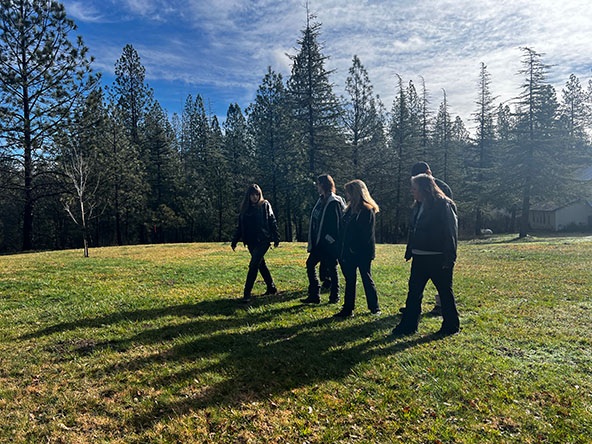
 NCR Nisenan Tribal members gather on recently rematriated ancestral homelands of Yulića. (Photo by CHIRP)
Over the past decade, an awareness of harm to Native communities in this country has grown within the social sector. In our work at the Kataly Foundation, we now often hear people offer land acknowledgments, naming the tribe on whose land they live, at the start of calls and webinars. Events and conferences we attend also frequently begin with tributes and celebrations of Indigenous people. Alongside these acknowledgements is an increasing recognition of the movement to return Native land to Native communities, often referred to as Land Back.
The NDN Collective, an Indigenous-led organization, defines land back as “a movement that has existed for generations with a long legacy of organizing and sacrifice to get Indigenous Lands back into Indigenous hands.” This process is also often referred to as rematriation, defined by Corrina Gould, co-founder of Sogorea Te’ Land Trust and Tribal Chair for the Confederated Villages of Lisjan, as “work to restore sacred relationships between Indigenous people and our ancestral land, honoring our matrilineal societies, and in opposition of patriarchal violence and dynamics.”
These efforts aim to reestablish Indigenous self-governance and political authority over territories, to advocate for communal land ownership, and to preserve language and traditions.
Interest in this movement is growing and philanthropy has the potential to play a much greater role in resourcing Native communities for land rematriation. As funders consider how to engage, it is essential to understand that the journey through rematriation is as delicate and complex as it is powerful and restorative.
This article explores the background, process, and lessons learned from one land back initiative with the Nisenan (nee-see-naan) Tribe, as well as key takeaways to consider for future efforts.
The History of the Nisenan Tribe and Yulića
For tribes like the Nisenan, who have long been erased from both land and legal systems, reclaiming ancestral territory moves beyond justice. It is cultural survival.
The Nisenan are the Indigenous peoples of what is now referred to as the Sierra Nevada foothills. Their tribe and way of life was severely impacted by the 1849 gold rush, which reduced their population from 9,500 tribal members to 500 in the span of less than two decades. In 1913, the Nisenan Tribe was granted “federal recognition” and allotted 76 acres for their reservation, the Nevada City Rancheria. But in 1964, the federal government used the Rancheria Act to overturn that recognition and auctioned off their reservation. Afterwards, the Nisenan Tribe became nearly invisible on their own homelands. Because land is foundational to every Indigenous community’s way of life, without a continued connection in the coming generations, the tribe would cease to exist.
Yulića (you-lee-cha), one of many sacred Nisenan sites, was part of a 232-acre parcel of land that the Quakers owned and where they built the John Woolman School at Sierra Friends Center. Founded in the early 1960s by visionary Quakers from the San Francisco Bay Area, the school, retreat center, and gathering place was a living embodiment of Quaker values of peace, simplicity, stewardship, and equality. For more than half a century, the campus served as a hub for Quaker education, gatherings, youth programs, and spiritual development.
In 2020, a devastating fire severely damaged the land and infrastructure of the center. This fire, in combination with the effects of the COVID-19 pandemic, led to mounting financial strain for the Woolman School. In 2022, the Woolman board decided to shut down all programming at the center and sell the property. When they began considering potential next steps, they were guided by both their Quaker values and the land’s deeper history, beginning their exploration of rematriating the land to the local Nisenan Tribe.
The Land Back Process and Challenges
Shelley Covert, Nevada City Rancheria Tribal Council Secretary and executive director of California Heritage: Indigenous Research Project (CHIRP), first met the Quaker community through a Quaker initiative called “Right Relations.” This initiative provided Quaker community members opportunities to learn about the Quaker’s history with Indigenous communities, including their role in running Indian boarding schools and the deculturalization of Indigenous communities, from Indigenous community members. When the Woolman board decided to sell the center, Shelly reached out to contacts she had met through the initiative to ask them if they would be willing to rematriate the land to her tribe.
Initially, the Woolman board and broader Quaker community understood rematriation primarily as synonymous with gifting land. However, they came to understand that rematriation can take multiple forms, especially when it prioritizes Indigenous sovereignty, equitable terms, and long-term healing. Some in the greater Quaker community wanted Woolman to gift the land to the tribe, but in order to settle Woolman’s debts, the board ultimately decided a sale would be necessary.
CHIRP entered the rematriation discussions with intention and respect for multiple perspectives. While they acknowledge the legacy of Indigenous Americans’ genocide and many Indigenous tribes being landless in their homelands, they also understand the reality that many private property owners cannot afford to gift their homes or land to Indigenous tribes, as was the case with the Woolman School. For this transaction, rematriation meant the tribe was given the first right of purchase, creating space for CHIRP to raise funds without competition, and the land was offered to the tribe at a price roughly half of the estimated market value.
Yet before any funds were raised, the tribe had to gain consensus on accepting donations for the capital campaign, which they called “Homeland Return.” Some members saw the funds as an act of goodwill, while others did not want to be recipients of what they viewed as charity. However, once there was an agreement amongst the tribe, CHIRP launched its campaign and began reaching out to allies and the broader community to participate.
Because the Nevada City Rancheria Nisenan Tribe is not federally recognized and not able to directly hold land or accept funds to purchase land, CHIRP, with its nonprofit status, became the legal vehicle for this land purchase.
Lina Shalabi, program officer for the Restorative Economies Fund at the Kataly Foundation, first learned about the land back effort from a Quaker in her community who grew up going to the retreat center. The Kataly Foundation, whose mission is to support the self-determination of Black and Indigenous communities, as well as all people of color, has funded multiple rematriation and land back efforts since it was founded in 2018. Each one has been unique and required different levels of involvement.
When Lina heard the Woolman board was offering the tribe the first right of purchase, she shared the funding opportunity with Kataly’s Restorative Economies Fund and the Mindfulness and Healing Justice program. Both collaborated to fund this effort, making a $565,000 grant to CHIRP in early 2024.
Despite strong goodwill from both the tribe and Woolman board, there were tense moments that stalled negotiations throughout the process. Cassandra Ferrera, a realtor, facilitator, and co-founder of Center for Ethical Land Transition (CELT), was brought in as a mediator after the process had reached a stalemate. CELT brings technical knowledge and a deep cultural awareness to land transitions, ensuring transactions are reparative, relational, and rooted in justice. Since no two transitions are the same, CELT’s approach is grounded in openness, trust-building, and the honoring of Indigenous leadership.
Using CELT’s framework, A Compass for Ethical Land Transitions, Ferrera introduced a shared vocabulary that emphasized relationship over transaction, and healing over haste.
 (Click to enlarge)
This new, more relational lens allowed negotiations to move forward. When local concerns, such as casino development, forest management, and numerous regulatory challenges emerged, each was addressed with respect and shared intentions for the land. CELT’s role also ensured that the real estate and legal mechanics did not overpower Indigenous intention and sovereignty. Throughout the process, Ferrera centered Shelly Covert’s leadership and voice.
With CELT’s guidance, the Woolman board and CHIRP navigated a demanding, 12-month journey involving extensive coordination surrounding infrastructure, insurance, permitting, land conditions, and maintenance. Everyone involved, including the real estate professionals, recognized it as one of the most complex transactions they had ever encountered.
After the two groups entered into a contract, the broader community, including private and public funders and donors, rallied around the tribe’s vision of land justice. Yulića was successfully transferred into Indigenous hands.
The relationship that formed between the Nisenan Tribe and the Quakers during the land sale provided a deepened mutual understanding of their respective communities and continues beyond the land transfer. As part of the final negotiations, it was agreed upon that one of the Quaker elders would continue to live on the land and that the local Quaker group could gather on the land as tenants of the meeting house. Several Woolman board members and Quaker community members remain active supporters of CHIRP and its mission to preserve, protect, and perpetuate Nisenan culture.
Yulića now provides a safe and private place for ceremonies that have not been performed publicly in over a century. Cultural revitalization, especially amongst the Tribe’s youth, is central to CHIRP’s vision for the land and growing community. Most recently, CHIRP was awarded a three-year youth programming, substance abuse, and culture revitalization grant as they continue to inhabit the land.
In the long term, the vision is for Yulića to serve as tribal housing, with elders having first access to any completed structures. There is also a plan for an internal wellness hub where tribal members can come together for cultural practices and healing from historical trauma. The ultimate hope is to piece together enough parcels of land with springs, wetlands, and burning grounds to reestablish a full cultural landscape that will allow the tribe to live in harmony on the land as their ancestors once did.
Lessons for Future Rematriation Efforts
Since Native communities carry the heaviest cultural and emotional burden in land back initiatives, it is imperative to center Indigenous voices and experiences throughout the entire process. Dominant systems can often override or minimize Native leadership, so a more relational process should supersede legal and logical steps.
Funders should defer to Indigenous leadership to offer guidance for how much or little engagement they desire, instead of making assumptions about what the tribe wants or needs. Building strong, trust-based relationships with Native communities before a land deal is discussed is enormously beneficial in this work. The dynamics that follow allow for proactive communication and respect for boundaries that can lead to successful rematriation efforts.
In many cases, facilitators are essential for trust to be established and maintained during the process. For this project, CELT was invaluable. Cassandra helped to create a shared language and understanding between the tribe, the funders, and others when talks stalled. If real estate and legal professionals, for example, are unfamiliar with Indigenous values or lack cultural sensitivity, facilitators can step in to offer explanation and repair. Without this unique support, rematriation efforts can stall or, even worse, replicate harm.
Involved parties must also be open-minded about how expectations for what works in the dominant culture must be adjusted to each unique circumstance. Western real estate systems and legal norms are not designed for Indigenous ways of relating to the land. This process is slower, more intuitive, and more holistic. Flexibility and boldness to engage in new, helpful ways are necessary.
As tribes continue to build out their vision for their people, allies have many opportunities to come alongside this work. Landowners can consider donating land or offering it to Indigenous communities at a discounted rate. Individuals and organizations can stay connected to the journey of healing the land after the sale to learn about their evolving needs. Some choose to make ongoing financial contributions to tribes; for example, the Shuumi land tax is a voluntary payment made by non-Indigenous residents of the Lisjan Territory in the San Francisco Bay Area that helps Sogorea Te’ Land Trust sustain its work of education, advocacy, and stewardship.
A New, Strategic Vision for Philanthropy
Rematriation is not a new idea in philanthropy, however there is much more that can be done. Namely, funders can shift their mindset to the longer term through their grant-making. The biggest lesson Kataly has learned in rematriation efforts is the amount of support that is needed beyond the process of purchasing the land. Land transitions tend to rally a lot of excitement and support, as the need is definable and obvious. But the momentum and celebration tend to drop off quickly after the title transfer. It is a huge milestone, but it is only the beginning of cultural revitalization and community care.
A much longer, more emotionally taxing chapter follows—one of healing the land, and nurturing the emotional and spiritual healing of the tribe. Many Indigenous groups are descendants of those who have survived genocide and, despite living in modern times, are not fully assimilated into Western culture. Shelly Covert shared that “getting the land has given us space to process how much is gone and who is gone.” Rematriation is undoubtedly cause for celebration, but being on the land also brings grief; there is a reckoning of all that has been lost in both traditions and generations.
Funders can support land back initiatives by strategically making more multi-year grants to tribes after land has been rematriated, alongside one-time capital contributions. Funding can go beyond the requisite expenses of insurance, property taxes, and fire mitigation into a more interconnected perspective that supports Indigenous communities’ healing with their ancient ties to the land. Nwamaka Agbo, Kataly Foundation’s CEO, believes that to do this work on a generational scale, it needs “a response commensurate with the harm you are trying to solve.” Funders can shift into a longer-term vision involving patient investment that will make this work truly successful.
While no formal dynamic model exists for land rematriation, Yulića added to a growing body of lessons and frameworks CELT is translating into case studies and public learning tools to support the broader land justice movement. By showing up consistently, listening deeply, and respecting sovereignty as non-negotiable elements of ethical land return, we can be vessels that identify and remove barriers, support the essential work of more intermediaries like CELT, and engage in political education within the philanthropy sector to grow the ecosystem of people and organizations funding this work.
As individuals, we can be truth-tellers, willingly sharing the United States’ history of genocide and displacement of Indigenous, Black, and other communities who have faced marginalization.
Looking to the Future
Momentum is building for land back opportunities, and as funders become increasingly interested in supporting such efforts, they should be aware of the complexities that are inherent to the process. The rematriation of Yulića was far from simple, yet it highlights what is possible when relationship, respect, and justice guide the process. Understandably, CHIRP believes that “rematriation” in its truest sense still remains an aspiration. Their hope is that the word will someday reflect restorative and healing justice in the absence of financial barriers to tribes.
Yulića’s return to the Nisenan Tribe was not a perfect model, but it is a powerful one. It shows there is a complexity to land back that goes beyond simply moving money. It reflects both the limitations and the possibilities of land rematriation within our current legal and economic systems and realities. Ultimately, by centering the tribe’s vision and leadership, this effort lays the groundwork for future land back efforts and provides an outline of how land back projects can be better held by funders and sellers.
Read more stories by Lina Shalabi, Shelly Covert & Cassandra Ferrera.