


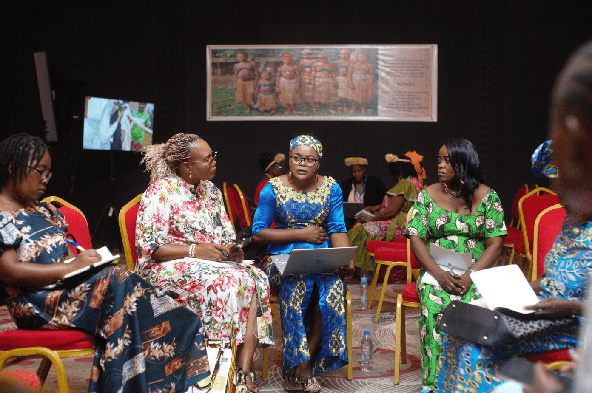
 Participants in the Brazzaville gathering of Indigenous and local community women in Central Africa and the Congo Basin participate in a roundtable discussion. (Photo courtesy of Victoire Douniama, Rights and Resources Initiative)
On a May morning in 2023, more than 200 Indigenous, local community, and Afro-descendant women from 20 countries on four continents bustled into a hotel meeting space in Brazzaville, the capital of the Republic of Congo, each with their own dreams for how the day would play out. Nervousness jostled alongside hope, as they wondered whether the group would align and fulfill their aims to secure greater funding and solidarity for women-led climate initiatives in the Congo Basin and beyond.
As the region’s first-ever forum of Indigenous and local community women, the gathering—which included international donors, African ministers and politicians, and other officials—provided an unparalleled opportunity for dialogue, relationship-building, and shared learning. By the end, the group had aligned on a declaration of priorities as well as a roadmap for mobilizing funding to directly support Indigenous and local community women in Central Africa in their conservation and climate resilience efforts.

Jointly organized by several networks of Indigenous and local communities from around the world, the meeting was a shining example of collective action.
It demonstrated that when innovative leaders empower proximate communities, orchestrate strategic collaboration across sectors and geographies, and unlock creative capital, they don’t just challenge the status quo—they leap past it, catapulting systemic change forward.
Their effort was not an outlier. The women who convened in Brazzaville are part of a growing international movement to secure land rights for Indigenous Peoples, local communities, and Afro-descendent Peoples as a supercharged strategy for curbing tropical deforestation and slowing climate change. Research consistently shows that Indigenous-managed lands have better climate outcomes than lands managed by other entities. Thus, Indigenous-centered and -led solutions are not only the most just pathway to honor the land’s original stewards (sometimes referred to as “rightsholders”)—they’re highly effective.
As partners in this work, we at Rights and Resources Initiative (RRI), the Climate and Land Use Alliance (CLUA), and the Skoll Foundation have been fortunate to collaborate with frontline organizations relentlessly pushing to realize a shared vision of a sustainable environmental and economic model that recognizes Indigenous communities as instrumental to global climate mitigation.
As a leader in the space, RRI plays a coordinating role as one of the field’s system orchestrators, and the Skoll Foundation has deepened our understanding of land tenure by supporting and learning from their work. CLUA (a group of six foundations with aligned funding goals) also provides essential expertise that has been instructive both for us at Skoll as well as the entire funding community.
Together, we’re offering this case study to provide a behind-the-scenes look at how collective action happens. We examine how coordinated, cross-sector efforts led by rightsholder networks created the conditions to reduce deforestation rates by returning ownership and management of ancestral lands to their rightful stewards.
A Collective, People-Centered Approach to Conservation
Until the early 2000s, “fortress conservation”—setting up private conservation areas, displacing local and Indigenous groups, and violating their human rights—was the predominant strategy in the environmental field. Though these violations continue, over the last 10 to 15 years, we have increasingly seen momentum among rightsholders, their allies, and civil society in advocating for rights-based and community-led conservation. This people-centered approach respects human rights and traditional customs while conserving habitat, arresting deforestation, and mitigating global warming.
Over the last decade, a constellation of groups and allies have made major gains in securing and enforcing their rights to their ancestral territories, especially in Earth’s three most ecologically significant carbon sinks: the Amazon, Indonesia, and the Congo Basin. Governments have returned ownership and management of millions of hectares of land in at least 39 countries. The results are clear: Over the last few years, for example, deforestation rates fell 36 percent in Brazil and 49 percent in Colombia.
So how do we replicate those wins in other regions? To us, the answer is clear: Collective action. And if collective action is the fundamental fuel that powers social innovation, the accelerants below enable it to spread and drive impact at exponential speed.
Build community power and weave together compelling stories. Organizing Indigenous and other rightsholder communities to unite behind a shared goal was the first essential step in cultivating the Indigenous land rights movement. Long before efforts like the Congo Basin women’s gathering, this fundamental coalition-building work was key.
About 10 years ago, the Global Alliance of Territorial Communities (GATC), a political platform of Indigenous Peoples and local community groups representing 35 million people in 24 countries, officially launched at the UN Climate Summit. A network of networks, GATC enhances its members’ capacity to engage in the fight for their land rights. It has enabled millions of Indigenous Peoples to coordinate across geographies, build aligned messaging, share research and lessons, launch joint financing efforts, and approach halls of power with one unified voice to fight for their right to manage their lands.
With that infrastructure in place, storytellers—such as Skoll partner If Not Us Then Who?—complemented GATC’s efforts by using film and photography to elevate the voices of Indigenous Peoples telling their own stories, thereby increasing awareness of land tenure’s potential impact, generating popular support for these policies, and building pressure on governments to resource them.
This short film by If Not Us Then Who? Showcases the power of youth voices in combating climate change.
Develop new financing streams to directly support Indigenous communities. Bringing half of the world’s tropical forests under the control of Indigenous Peoples and local communities (via mapping, drawing boundaries, and granting legal titles) will require at least $10 billion by 2030. Far more will be needed to build community capacity to manage that land.
But connecting global climate financing to local solutions remains a challenge: Only 1 percent of global climate funding has reached these communities over the last 10 years, even while they manage 36 percent of the world’s intact forests.
So why aren’t we financing their stewardship?
The principal reason has been access. Historically, there have been obstacles for philanthropists to connect with local organizations and directly provide funding. Thus, in the modern conservation space, the innovation lies not only in what gets funded, but how it gets funded. Emerging Indigenous-led or -focused funding streams that enable funders to get resources directly into the hands of local communities have breathed new oxygen into the movement (see sidebar).
These funds are led and managed by Indigenous Peoples and local communities who use their knowledge and proximity to channel funds directly into communities, affording these groups greater autonomy, agency, and self-determination. Direct funding mechanisms are already transforming how these solutions scale and are critical to advancing enduring systemic change led by those who know best how to deploy the resources.
Emergence of Indigenous-Led and -Focused Funding Mechanisms
In 2022, AMAN (a GATC member), the Consortium for Agrarian Reform (KPA), and the Indonesian Forum for the Environment (WALHI) created the Nusantara Fund to support Indonesian Indigenous, farmer, and local communities.
During New York Climate Week 2024, GATC members announced additional funds: The Articulation of Indigenous Peoples of Brazil (APIB) created the Jaguatá Fund in Brazil, and REPALEAC, with support from AMAN, announced the Congo Basin Fund as an outcome of the Brazzaville women’s gathering.
Other established mechanisms include the Mesoamerican Territorial Fund, the Pawanka Fund, the Indigenous Peoples of Asia Solidarity (IPAS) Fund.
One such fund is the Community Land Rights Conservation and Climate Finance Initiative (CLARIFI), a direct financing mechanism launched by RRI and the Campaign for Nature Fund in 2022. CLARIFI has so far committed $14 million in direct funding to 88 projects led by rightsholder organizations working to limit deforestation on lands often in the crosshairs of the mining, agriculture, and timber industries. This funding has supported advocacy, legal aid, strategic analysis, policy development, community and forest conservation activities, and more.
Another important example of collective action in funding is the Forest Tenure Funders Group, a coalition of philanthropic and governmental funders who together are organizing the Pledge: $1.7 billion for this work over five years to consolidate otherwise fragmented financing streams. By engaging across sectors, the Pledge mobilizes large amounts of funding in a more durable, long-term way. The group seeks to renew the Pledge at COP30 in November 2025, this time with a greater focus on ensuring more direct funding for communities.
Engage government in collective action to create conditions for favorable tenure rights policies. Intentional partnership with government officials has been essential to recent progress. RRI fosters unique opportunities for private, public, Indigenous, Afro-descendent, and community stakeholders to collaborate through national-level planning meetings. Focused on building buy-in, accountability, and relationships, these country-level meetings create credible pathways for diverse constituents to agree on and implement sustainable development solutions that respect communities’ rights. They also build trust—a crucial ingredient for collective action. As the 2023 Brazzaville gathering illustrated, stakeholders are more likely to find overlaps in their priorities when they have the time and space to look one another in the eye, learn about one another as individuals, and collaborate in workshop settings on potential solutions.
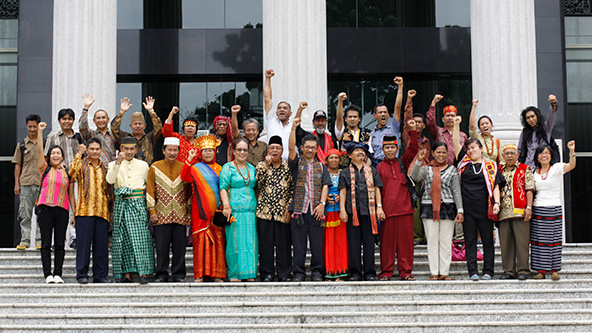 Indigenous-led advocacy resulted in a landmark 2013 decision in Indonesia that granted Indigenous Peoples the rights to their customary forests.
Another component of working effectively with government is meeting public-sector partners where they are. For example, in Indonesia organizations are working to shift their approach to better demonstrate how their work aligns with new governmental priorities, such as food security. This includes making the case for how protecting Indigenous land rights supports the cultivation of a strong food system.
Engage the private sector to change economic realities. True transformation requires all stakeholders paddling in the same direction, including those in the private sector. That, in turn, necessitates countering the economic forces that drive deforestation, including skyrocketing global demand for timber, land for agriculture and livestock, and other natural resources, as well as a lack of alternative livelihoods for forest communities.
To shift these systems, social innovators and local communities are collectively developing alternative economic models known as the socio-bioeconomy. These models place a fair value on natural resources and afford community members with opportunities for long-term, sustainable livelihoods while safeguarding their rights and traditions.
A leader in this space is Conexsus, which uses community business development, rural credit and financing, and an impact investing platform to scale organizations that provide economic and environmental benefits to forest communities in Brazil. It’s also working via partners to catalyze the model across the Pan-Amazon. Another emerging innovator to watch is Koalisi Ekonomi Membumi (KEM, or Earth-Centered Economy Coalition), which is catalyzing Indonesia’s transition to a restorative bioeconomy by influencing policy and connecting jurisdictions, businesses, and communities with significant new capital flows.
Additionally, social innovators are working to build companies’ understanding of and support for land tenure. For example, RRI and the International Finance Cooperation created the Interlaken Group, a network of companies, impact investors, development finance, civil society, and rightsholders, to increase private-sector action on securing land rights. Their goal is to accelerate the sector’s learning and build trusting relationships to secure buy-in and collaboration on responsible land rights practices.
Our takeaway? Reconfiguring the economic picture can take a movement to the next level. To shift to more just and sustainable economic models, it is paramount to create opportunities for companies and private investors to bring their resources—and their economic sway—to the table. Movement leaders can look for ways to do this that align with companies’ financial interests and incentives while also helping them see the bigger picture: that respecting land rights will secure their investments for the long term.
Magnify attention and mobilize resources through collaborative philanthropy. There is unquestionably a need for much more funding to support Indigenous communities’ climate solutions. But like many fields, this is a complicated one to navigate, posing barriers to filling that funding gap. Enter collaborative funding.
Overall, collaborative philanthropy’s ability to mobilize donors has contributed to a 20 percent increase in total philanthropic climate funding from 2022 to 2023, according to a ClimateWorks report.
Aligned funding partnerships like CLUA and Forests, People, Climate (FPC)—a global partnership of funders, civil society, and community-based organizations—curate rich learning opportunities that help funders understand where their dollars can have the greatest impact. Collaborative philanthropy can also encourage and hold other sectors accountable to their funding commitments.
CLUA serves as the host for FPC, providing governance and operational support. FPC aims to mobilize significant new funding, with a goal of raising $2 billion to protect tropical forests while ensuring the pledged funding flows to on-the-ground communities.
Achieve exponentially greater impact by supporting centralized dot-connecting. The best conductors elevate their orchestras to be greater than the sum of their parts. In the world of social change, that is the role of system orchestrators. RRI and GATC often play that role, as do others, in the people-centered movement fighting deforestation. As a solidarity network, RRI mobilizes collective action with government, facilitates direct funding through CLARIFI, convenes stakeholders to align on shared goals and actions (always including directly impacted communities), and influences decision-making by presenting compelling stories and research. They’ve done so for 20 years by listening to those closest to the challenge and connecting them to halls of power to help shape policy, rather than imposing an external set of goals.
Philanthropy Can Scale This Impact Globally
Despite some encouraging progress, the world is not on track to meet emissions-reduction targets by 2030, and global deforestation rates remain stubbornly high. Worryingly, global development aid is in decline at a moment when climate investment is needed more than ever. The time is now to leverage the momentum on the road to COP30 in November. There is a long menu of ways funders can help meet this planetary and economic imperative. It includes:
- Fund the coordination needed to fuel the movement. Collective action works, but it’s not free. Philanthropy—individual, institutional, and collaborative—can support social innovators in their crucial organizing and coalition-building work, which serves as scaffolding for the entire movement. At CLUA and the Skoll Foundation, we believe it’s essential for donors to get comfortable funding long-term, non-linear efforts to make progress, even when that progress is not attributable to one organization or investment. One way to do this is by supporting Indigenous and local community networks—particularly in forest communities in the Global South—that are engaged in advocacy and collective action. Many of these groups have set a specific goal this year to ensure significant representation of Indigenous Peoples, local communities, and Afro-descendent Peoples at COP30. That’s the kind of direct action we desperately need.
- Pledge to support land tenure through collaboratives, direct funding mechanisms, or strategic allies. Making (and keeping) a public pledge builds momentum and encourages other funders to follow suit. Philanthropies can support Indigenous Peoples and local communities directly through territorial funds like those mentioned above or through trusted partners like RRI or Tenure Facility. Joining collaborative funder groups like the Forest Tenure Funders Group or aligning funding through collaboratives like CLUA and FPC can ensure funding flows where it is most needed. Participation in collaboratives is a great way for newer funders to learn about the field and benefit from shared due diligence. These groups can also help funders who primarily support other issues—like livelihoods and economic mobility or equity and justice—to diversify their portfolios and tackle those problems from new angles.
- Protect the protectors. Defending the land takes a staggering toll on frontline communities. Four environmental defenders are killed every single week, on average, more than one-third of whom are Indigenous, according to watchdog Global Witness. Conflicts in the Congo Basin and mining, land invasions, and illicit activities in the Amazon and Indonesia increase the risks. Supporting organizations like Global Witness and Indigenous Peoples Rights International (IPRI), both Skoll partners that work to protect environmental defenders, can help mitigate threats and allow the work to continue.
- Advocate for larger country-level governmental contributions. To reach sustainable scale, national governments must commit more funding toward reducing emissions; these plans must include support for Indigenous land tenure and the development of alternative economic models. There is a need for greater advocacy at the country and bi- and multilateral levels—particularly given recent news of funding declines—to highlight Indigenous solutions as well as to create and publicize new frameworks suggesting how they will be funded and implemented going forward.
- Uplift Indigenous storytellers. A fast-acting accelerant to this work is to introduce Indigenous-centered solutions to deforestation to a broader audience. One way to do this is by leveraging youth as the prolific messengers and global trendsetters they are, harnessing their grasp of tech-driven media to help important stories reach critical mass. Supporting next-generation Indigenous leaders is also an effective strategy for ensuring the longevity of this work.
The Indigenous land rights movement has delivered early victories for forests and climate that improve the quality of life and livelihoods for millions. But beyond that, it provides a blueprint for how collective action can advance systemic change. By building power at the source and weaving together complex, cross-sector activities, the movement showcases what social innovators, government, and philanthropy can accomplish by working together.
Whether applied to health care, affordable housing, education, or any number of other fields, we believe these key insights hold true: When diverse stakeholders align behind shared goals and keep people and communities at the center, transformational change becomes possible.
This film from Rights and Resources Initiative explores how its direct financing mechanism, CLARIFI, has supported Indigenous communities to halt some activities of forestry, mining, and oil companies.
Read more stories by Solange Bandiaky-Badji, Lindsey Allen, Brittany Boettcher & Tanya Pham.