


Session Recordings and Resources
Thank you to everyone who joined us at Data on Purpose on May 6-7, 2025. Under the theme "Reimagining the Digital Future: Harnessing AI for Good," speakers examined the intersections of AI with civil society, ethics, governance, the public sector, and other key areas shaping our collective future. Below, you'll find the recordings for each session, along with any applicable resources to help deepen your learning.
Skip to a Session
- Opening Keynote: AI’s Promises
- AI Strategies for Nonprofits: Increasing Giving Impact
- AI Literacy: Separating Hype from Reality
- AI Governance in the U.S. and Europe
- AI Evaluation: Better Benchmarks and Beyond
- Impact Evaluations of AI in the Social Sector
- AI in the Workplace Now
- Design, Data, and Equity
- Open Source and AI Collaboration
- Interrogating Risks and Potentials of Emerging Innovation, AI, Data Sovereignty, and Agroecological Knowledge Systems
- Using Tech and AI to Preserve Indigenous Culture
- How Do We Stay Human in the Age of AI?
AI’s Promises
Session 1: Keynote conversation between Mike Kubzansky, CEO of Omidyar Network, and Priya Shanker, executive director of the Stanford Center on Philanthropy and Civil Society.
Resources:
- Omidyar Network’s strategy evolution and Our Vision for a Responsible Tech Future report
- SSIR article on how technology and society are linked, and how that should guide our development of AI and other advanced technologies
AI Strategies for Nonprofits: Increasing Giving Impact
Session 2: Tactical discussion on actionable strategies to leverage AI for fundraising. Panelists include Angela Aristidou, fellow at Stanford Institute for Human-Centered AI; Andrew Dunckelman, deputy director of the Gates Foundation; Sam Fankuchen, CEO and founder of Golden; and Suhani Jalota, founder of Myna Mahila Foundation.
AI Literacy: Separating Hype from Reality
Session 3: Lightning talk by Arvind Narayanan, co-author of AI Snake Oil: What Artificial Intelligence Can Do, What It Can’t, and How to Tell the Difference and director of the Center for Information Technology Policy at Princeton University.
Resources:
- Presentation slides
- AI Snake Oil blog by Arvind Narayanan and Sayash Kapoor
- Recent paper on AI as Normal Technology
- Essay arguing that diffusion—not just capabilities—should be a focus of policy makers
AI Governance in the U.S. and Europe
Session 4: Conversation between two AI governance policy experts from Stanford Cyber Policy Center, Marietje Schaake and Nate Persily.
Resources:
- The Tech Coup: How to Save Democracy from Silicon Valley by Marietje Schaake
- The Brussels Effect: How the European Union Rules the World by Anu Bradford
- Digitalist Papers series by Erik Brynjolfsson et al.
AI Evaluation: Better Benchmarks and Beyond
Session 5: Stanford researcher, Amelia Hardy, presented the AI benchmark assessment framework, repository, and paper, BetterBench, that she wrote with Anka Reuel.
Resources:
- Presentation slides
- More than Marketing? On the Information Value of AI Benchmarks for Practitioners by Amelia Hardy et al.
- The Leaderboard Illusion by Shivalika Singh et al.
Impact Evaluations of AI in the Social Sector
Session 6: Evidence-backed presentation by Iqbal Dhaliwal, global executive director of the Abdul Latif Jameel Poverty Action Lab (J-PAL) at MIT
Resources:
- Presentation slides
- SSIR article, AI for Social Good, written by Iqbal Dhaliwal and Michael Hou
- Generative AI at Work
- The Impact of Artificial Intelligence on Learning in Brazil
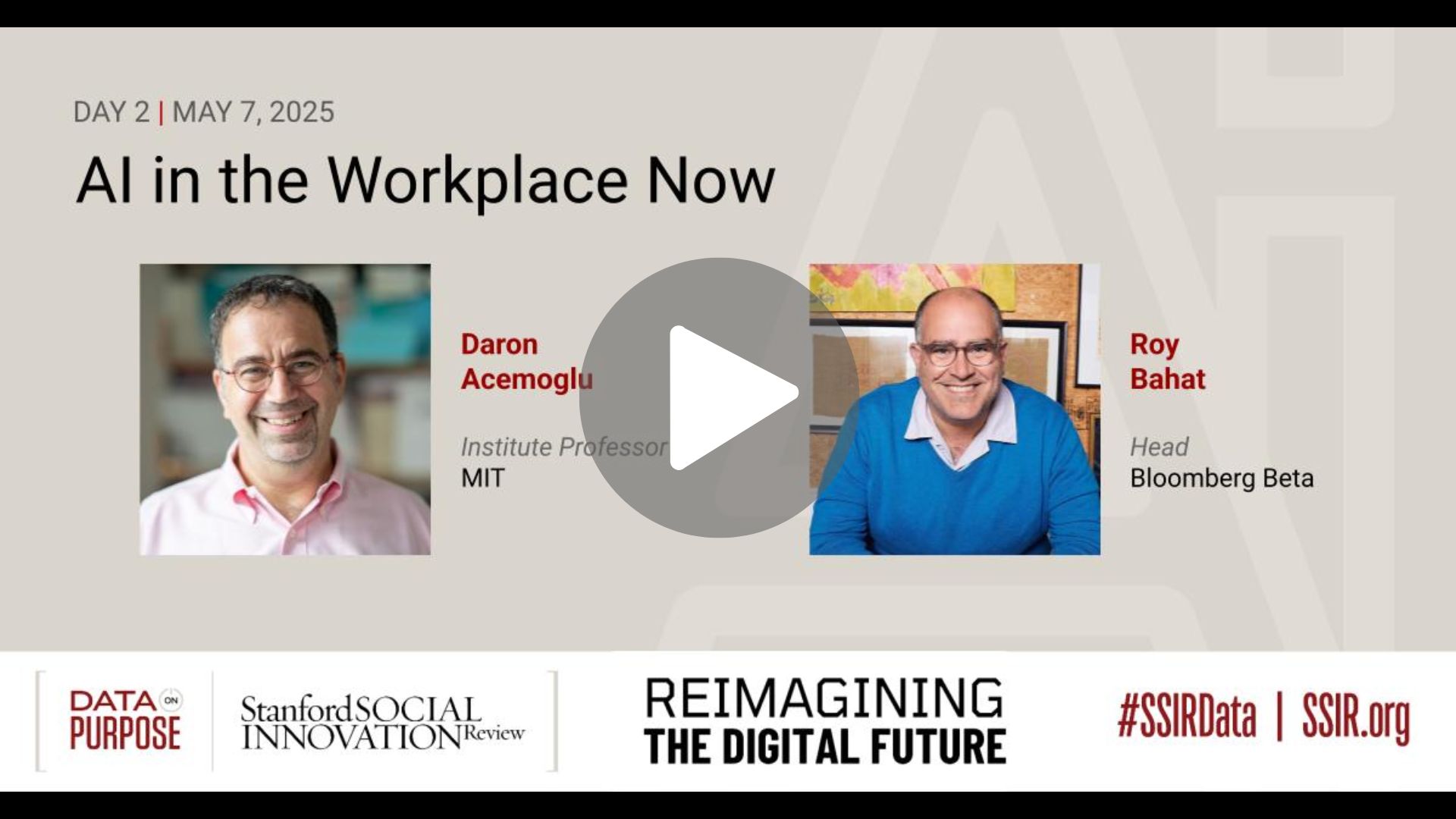
AI in the Workplace Now
Session 7: Dynamic fireside chat with Daron Acemoglu, 2024 Nobel laureate in economic sciences and of MIT’s Shaping the Future of Work Initiative, and Roy Bahat, head of Bloomberg Beta.
Resources:
Design, Data, and Equity
Session 8: Stanford d.school emerging tech design lead and lecturer, Ariam Mogos, led this engaging workshop.
Resources:
- Presentation slides
- I Love Algorithms: A Machineless Machine Learning Creation Kit and other d.school tools
- rep| magazine
Open Source and AI Collaboration
Session 9: Lightning talk by Jim Fruchterman, serial entrepreneur and Tech Matters CEO and founder.
Resources:
- AI Treasure Map, a tool to help decide whether to use AI for a specific task
- Glorious RAGs: A Safer Path to Using AI in the Social Sector by Jim Fruchterman
- SSIR articles, Gather, Share, Build and Exit to Open
Interrogating Risks and Potentials of Emerging Innovation, AI, Data Sovereignty, and Agroecological Knowledge Systems
Session 10: Panel conversation including Samuel Oslund of the 11th Hour Project; Barbara Ntambirweki, Ugandan legal scholar and researcher; Rikin Gandhi, founder of Digital Green; and Jim Thomas, civil society researcher and author at Scan the Horizon.
Using Tech and AI to Preserve Indigenous Culture
Session 11: Presentation by Michael Running Wolf, a Native American software engineer, AI researcher, and co-founder of IndigiGenius.
Resources:
- Presentation slides
- Indigenous Protocol and Artificial Intelligence Position Paper
- Related projects include Abundant Intelligences and the First Languages AI Reality Initiative
How Do We Stay Human in the Age of AI?
Session 12: Closing keynote with Terry Winograd, Professor Emeritus at Stanford University’s Computer Science Department.
Resources:
- Machines of Caring Grace article in Boston Review
- Computer Power and Human Reason: From Judgment to Calculation by Joseph Weizenbaum