


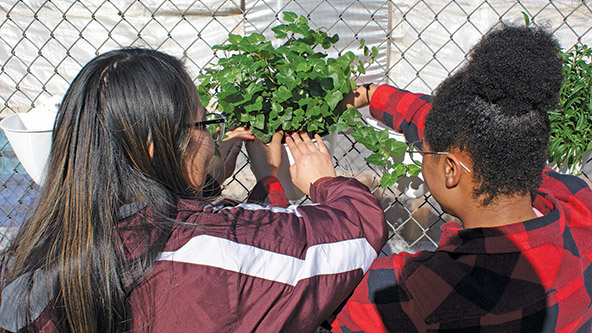
 Local students install SeadPods at the Kingston YMCA Farm Project in Kingston, New York. (Photo courtesy of Plant Seads)
The YMCA Farm Project in Kingston, New York, doses students, employees, volunteers, and buyers with a healthy shot of greenery. The farm’s greenhouse is brightened by a mural of plants held by a group of racially diverse hands.
Its appeal, however, is marred by a surrounding chain-link fence that “is the source of a lot of consternation,” farmer and project director KayCee Wimbish says. “It’s cold [and] doesn’t feel welcoming or alive. We have this beautiful farm and then this chain-link fence.”
Bryan Meador noticed the coldness of chain link, too, while attending the Parsons School of Design in New York City. Having grown up a Cherokee descendant in Oklahoma, he found himself craving nature in an urban setting. A few years later, living upriver in the Hudson Valley town of Kingston, he devised a solution. In 2019, Meador founded Plant Seads—“Seads” stands for its design principle, “Sustainable Ecology / Adaptive Design”—to transform chain-link fences into walls of greenery. “I’m interested in establishing large-scale vertical gardens for spaces that have been overlooked,” he says. “Not the brownstone backyard in Brooklyn, but an abandoned lot in the Bronx.”
Meador designed the low-cost planters made of BPA-free recycled milk jugs to be mounted on fences in large groups. Each planter is 8.5 inches wide by 8.5 inches deep and stands 10 inches tall, holding a gallon of soil. He hopes they can serve like hedgerows in the British Isles—as property-marking boundaries that are also alive and productive.
What we call “chain link” is actually steel mesh, first designed in England during the Industrial Revolution to mimic a cloth’s weave. It came to the United States in the late 19th century and gained popularity for being durable, see-through, and low-maintenance. But chain link also evokes cages and imprisonment, says Kenneth Helphand, a University of Oregon professor emeritus of landscape architecture. “It’s manufactured, it’s standardized, it’s not local, it’s industrial—all things that we have ambivalence about as a design material,” he explains.
The climate and human-health benefits of Plant Seads’ planters are many: Plants can produce local veggies, purify air, and through exposure alone, help lower blood pressure. A beekeeper’s son, Meador hopes his design can provide pollinator habitat when planted with flowers, too.
Initially, Meador raised $8,000 in pledges on Kickstarter last year. But he ended the public drive without taking any funds when he realized that the starting design—2 by 2 inches to fit in each diamond of chain link—needed reshaping to grow plants better. Since then, he has self-funded, estimating that his total personal investment will come to about $30,000, at which point he’ll seek outside funding.
Meador perfected the design with Dan Freedman, dean of the School of Science and Engineering at SUNY New Paltz and head of the Hudson Valley Additive Manufacturing Center. They first 3D-printed a run of 50-plus prototypes before they developed an injection mold and found custom plastics maker Usheco to manufacture the planter.
Freedman was struck by the practicality of the design: “I garden, so I kind of know what’s out there, and I’ve never seen anything like it.”
Meador often walked by the Kingston YMCA Farm Project and reached out to Wimbish with his idea. This spring they’ve installed 50 planters, at a wholesale cost of $5 each.
They have yet to determine what kinds of plantings will do best. On the one hand, Meador would like to see vines such as honeysuckle and morning glories. On the other hand, veggies and herbs would produce food. Wimbish likes edible growth and hopes to try out climbing green beans or peas. Not only should the plants improve the fence’s look, but also she can sell the veggies at market.
For Meador, success will entail large-scale municipal installations. He’s finalizing pilot projects with upstate New York utility companies, as well as community gardens in Harlem and beyond. The installations haven’t been made yet, but he’s certain the societal need for his fix will only grow.
“As cities become more dense, we really need to take advantage of every inch of space,” he says. “Injecting plant life into urban environments will be a major part of what makes the 21st-century city continue to be livable.”
Read more stories by Lynn Freehill-Maye.