


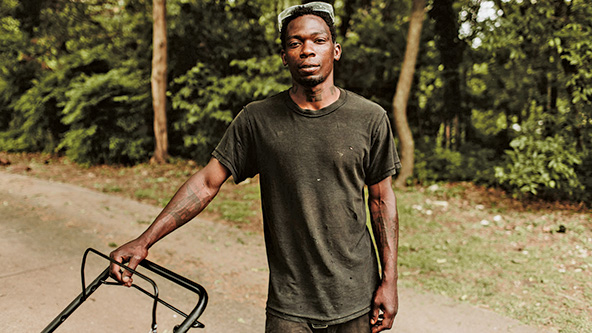
 Miles of Freedom, a Cycle beneficiary, employs and trains formerly incarcerated individuals through its lawn care social enterprise. (Photo courtesy of Haley Rynn Ringo)
Richard Miles was just 19 years old when he was thrown into prison for a murder he didn’t commit. Fifteen years later, in 2009, the state of Texas overturned his conviction and he was freed. In 2012, Miles was fully exonerated and paid restitution by the state. Those two-and-a-half years between release and restitution taught Miles about the daunting obstacles that face the formerly incarcerated.
“When you return home from prison, one barrier is that you don’t have a direct source of income,” Miles says, noting the challenge of securing employment with a criminal record, even one that is expunged. “But if you can employ someone right out of prison, recidivism rates drop to about 2 percent.” Texas’ current recidivism rate is 22.6 percent.
Miles used part of his restitution in 2013 to launch Miles of Freedom, a South Dallas-based nonprofit that helps formerly incarcerated people find employment and housing. As part of its mission, the organization employs the recently incarcerated to mow lawns for South Dallas residents. The business took off but hit a ceiling during the summer of 2018—their lawn mowers, which were donated, were too old to secure larger mowing contracts. Miles needed money to purchase better equipment, but “because of the demographic that we work with,” Miles says, “not a lot of people wanted to fund us or give us a loan.”
Miles of Freedom is not unique. There are countless worthy causes that deserve financial support in the form of a loan, but traditional banking systems are ill-equipped to serve many of them. The problem, says Kyle Lukianuk, president of the social enterprise Good Returns, is that so much capital never gets tapped. Large corporations have deep pockets, but a significant amount of that money is earmarked for philanthropic purposes and donated to highly visible nonprofits.
“We became very intrigued by the idea of trying to mobilize that capital,” Lukianuk says. He and his business partner, Good Returns cofounder and CEO Salah Boukadoum, decided to test an idea: Might corporations lend their profits interest-free instead of just giving them away? If you want a sustainable business model, “you can’t give away 100 percent of your profits, if you ever expect to have normal partners and investors,” Boukadoum observes. “But you can lend any amount of your profits up to 100 percent. It might require some unique financing, but you could do it, and anyone else could do it too.”
Based on his experience launching another social enterprise, Soap Hope, in 2008, Boukadoum felt that this plan could work. Soap Hope’s business model was deceptively simple: Forge relationships with soap makers and buy soap and body products from them at wholesale prices. Then, sell the soap and invest 100 percent of the profits in interest-free loans designed for organizations that empower women. Soap Hope flourished and today is managed by an organization that serves people with intellectual and developmental disabilities as a workforce training program.
Soap Hope’s proof-of-concept business model set the blueprint for what is now the Good Returns Cycle Program, established in 2014. While large corporations often have reserves of capital on hand, they are also notoriously risk averse. Good Returns’ mission is to help social causes and, at the same time, help corporations create sustainable impact by building a fund in which money is guaranteed to return to the corporation after a year of supporting social enterprises. With traditional philanthropy, there’s always a cap on the amount that a company can give to achieve its goal. But a loan “gives you so much more bandwidth for deploying capital,” Boukadoum says, “because you know for sure that with this program, every dollar is going to return.”
Good Returns built what they call a “funded guarantee” structure that enables impact investors and foundations to put capital into a fund that stays invested in the market, potentially earning a return while serving as a guarantee. In 2019, their guarantors received a net annual return on their capital. “It’s a way of eliminating all financial risk for the corporation,” says Lukianuk, “and that’s important because it allows the corporation to tap into other resources versus their philanthropic giving.” The goal of the Cycle Program is not to replace corporate philanthropy, but rather to supplement it, by freeing up financial resources that can be mobilized for social good in a risk-free way. Unlocking these resources is essential to getting more companies financing social impact. “This way, they get to meaningfully participate,” Lukianuk explains. “They get to receive return on their capital, and they also get to create impact.”
From Concept to Pilot
With the success of Soap Hope and a couple of other small tests with local businesses, the Good Returns team—Lukianuk, Boukadoum, and CFO Craig Tiritilli—had their proof of concept. To test the program’s viability with a larger sum of money, Returns struck a deal with Orix USA, a financial services company headquartered in Dallas, to run a pilot in 2019. The philanthropic branch of the corporation, the Orix Foundation, agreed to provide the total loan amount of $250,000.
“Before we figured out exactly what the return cycle was, we thought this was something that no other corporation was doing,” says Josh Mayfield, who at the time was president of the Orix Foundation board. (He left Orix in 2019 to start his own business.) “For the first time, a bunch of accountants and CPAs and Wall Street-deal guys could actually exercise their nine-to-five brains at the exact same time they exercised the volunteer side of their brains.”
Initially, Good Returns was uncertain about the number of nonprofits it would lend to and how to disperse the money among them. “I spent a lot of time with Richard Miles and was so blown away by what Miles of Freedom is doing, we wanted to give them all of the money,” Mayfield says. “But Kyle was like, ‘You can’t do that, because they can’t use it!’ ” This observation was important: Too much money could overwhelm smaller nonprofits like Miles of Freedom and be wasted.
So, Good Returns and the Orix Foundation agreed that the total sum would be distributed among three Dallas-based nonprofits that Orix employees would vote on, based on the nonprofits’ respective sizes and goals. The three nonprofits selected in 2019 were Miles of Freedom; Akola, a public benefit corporation and nonprofit hybrid that trains and employs impoverished Ugandan women to make jewelry; and PeopleFund, which provides loans and other resources to underserved people so that they can build small businesses.
Miles of Freedom especially needed two things: commercial-grade mowing equipment and one more staff person. Through the Good Returns Cycle Program, Miles of Freedom received $3,000 as a one-year zero-interest loan, which was enough to help purchase the new equipment and hire a new staff person. Because this opened them up to new, larger lawn contracts, they were able to provide daily stipends to 21 more people from Miles of Freedom’s “transition to employment” program, designed for the recently incarcerated. The nonprofit’s bottom line also increased, and they were able to pay back the loan by the end of the year.
Another recipient, Akola, received $100,000 as a one-year, interest-free loan. With those funds, Akola was able to finance the expansion of their business, get their products into high-end retailers, and hire and train more women as full-time employees with paid benefits and social services. “Without the loan, we would have had to say no to those retailers,” says Brittany Merrill Underwood, Akola’s founder and executive chairman. “And we would’ve run out of cash.”
While many enterprises participate in impact investing, Good Returns has pioneered using the corporate market and aligning corporate goals with social goals. For example, the third 2019 loan recipient, PeopleFund, used their $147,000 loan to help fund veteran entrepreneurs throughout Texas. “The Cycle model allows the corporate sector to leverage the resources they have,” says Andrea Levere, president emerita of Prosperity Now, a Washington, DC-based nonprofit dedicated to expanding economic opportunities for low-income families, who is familiar with, but not connected to, Good Returns’ work. “What’s really exciting about Good Returns is they’re engaging corporations in a way that really links leads to scalable solutions.”
The Power of Partnership
The Good Returns team believes that the Orix pilot proves it’s time for more companies to provide capital and more impact investors and foundations to step into the “guarantee” role. COVID-19 also has exposed other opportunities for short-term capital to be deployed effectively—namely, through Community Development Financial Institutions (CDFIs), which provide financial services to underserved markets.
“CDFIs lend to small businesses, small nonprofits, and entrepreneurs that might not be able to access capital from traditional banks,” Lukianuk says of how they are playing a crucial role in COVID-19 relief efforts. “We are finalizing a partnership to use our guarantee structure and capacity for a CDFI that provides crucial financial and business resources for women entrepreneurs.”
The Good Returns team planned to attend the conference and forum circuit with Orix representatives, sharing results and promoting ideas for how such cycles could easily scale. But after internal changes at the Orix Foundation, the Cycle Program was no longer a foundation priority. “It was a missed opportunity,” Lukianuk says. “Much like Whole Foods promotes ‘conscious capitalism’ and Patagonia ‘1 percent for the planet,’ we want to recruit a corporate partner to join us.”
When the COVID-19 crisis finally ebbs, Lukianuk hopes the benefits of the Cycle Program will come into focus. In the wake of the virus and concomitant global financial crisis, foundations will likely encounter greater needs but possess fewer resources to meet those needs. “According to conversations we’ve been having,” Lukianuk says, “foundations are starting to think more creatively about how they deploy capital other than just grants, and I think that’s where this type of program is really built to thrive.”
Read more stories by Adrienne Day.