


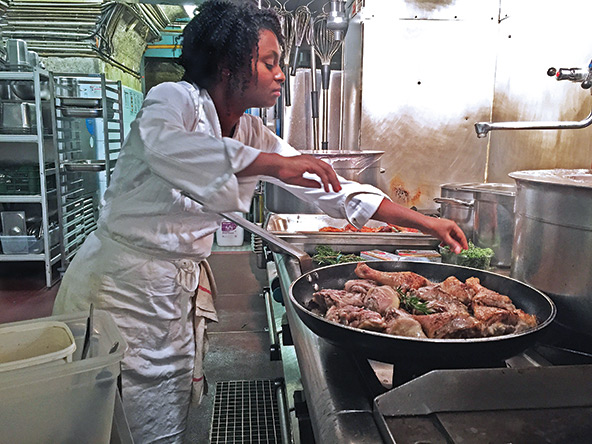
 Chef Solène Gallard prepares pan-seared duck for guests at Food for Soul’s Refettorio Paris. (Photo courtesy of John Laurenson)
On a typical night, Refettorio Paris chef Solène Gallard prepares gourmet meals, like duck pan-seared in butter, garlic, and herbs, for guests.
This, however, is no Michelin-starred restaurant; it could instead be called the classiest soup kitchen in the world. Refettorio Paris sources all its food from donations, from which it prepares its daily menus. Gallard and her colleagues turn food deemed “waste” by markets, because it is close to its expiration date, into free meals for low-income people.
Refettorio Paris offers a novel solution to the complex social problem of food scarcity for the food insecure—poor, dislocated, and homeless communities. According to 2014 data published by France’s National Institute of Statistics and Economic Studies, nearly 3,000 people live on the streets in Paris, and more than 16 percent live below the poverty line—a number that has increased not only in the capital city but also nationwide since the 2008 global financial crisis. These figures correlate with the steady increase of both global homelessness and lack of adequate housing, as well as figures reporting the surge of hunger and undernutrition worldwide.
Like global hunger trends, the amount of food waste is on the rise, too. The United Nations’ Food and Agriculture Organization estimates that “approximately one-third of all food produced for human consumption in the world is lost or wasted” annually.
“Every day we have delivery of food surplus,” says Deborah Beilet, Refettorio Paris’ manager. “It comes from the food bank but also from different partners. For example, every night Fauchon [one of France’s most exclusive grocers] gives us pains au chocolat and croissants. It’s really cool because at the end of the dinner our guests can leave with some breakfast,” she says.
Refettorio Paris is unique because of a 2016 nationwide law that requires all supermarkets to give all unsold, near-sell-by-date food to charity rather than destroy or trash it. Before the law, markets would pour chlorine on food they didn’t sell to make sure that poor people didn’t get their hands on it for nothing. Since the law passed, there has been a 22 percent increase in food bank donations, and Refettorio Paris has greatly benefited from it.
Each night, the maître d’ greets about 80 guests, often by name. Charities working with the homeless and migrants, such as Emmaüs Solidarité, Ozanam, Aurore, and Singa, help Refettorio Paris identify and invite the guests—a mix of low-income individuals, many of whom are homeless. The restaurant provides the charities with referral cards to distribute to those in need, and once on the list, a guest can come every evening.
“This community is so special,” one guest (name withheld) says. “It is like a family now, because we see each other so often. You care for everybody. If someone doesn’t turn up, we get worried and we look after them.”
Another guest (name withheld) adds, “I’ve been coming here for nearly two years. It’s fantastic—the staff are so friendly, the people who come have so much in common, and the staff and volunteers understand what we’ve been through, which is a lot.”
This communal spirit is integral to the project’s mission. “It is more than a bridge between hunger and waste; it is a chance to build more inclusive communities,” says Cristina Reni, executive director of Food for Soul, the nonprofit piloting this effort to promote social awareness about food waste.
Cooking for Change
Refettorio, in Latin, means to “remake” and “re-store.” It is with the latter meaning in mind that Italian chef Massimo Bottura launched the initiative after participating at the 2015 World Expo in Milan. As part of the themed program “Feeding the Planet, Energy for Life,” he created a restaurant inspired by the big refectories (in Italian, refettorio means “refectory”) reminiscent of Italy’s ancient monasteries, but where famous chefs would cook gourmet meals using food destined for the trash.
“I wanted to show that cooking can be a powerful tool for change and that chefs are more than just the sum of their recipes,” Bottura says. He understood that the power and privilege of his position as a celebrated chef could “encourage people to adopt more sustainable eating habits and create a healthier food system.”
Although Bottura originally envisioned the endeavor as a pop-up, he decided to make it permanent. He established a nonprofit called Food for Soul to develop the refettorio concept in Italy and around the world.
Bottura set up the first refettorio in Milan—Refettorio Ambrosiano—in partnership with Caritas Ambrosiana, a Catholic charity. “They are in charge of the everyday operations, from collecting the surplus food to managing the volunteers or welcoming the guests,” Reni says.
But before the launch, they hit a problem.
“The people of the neighborhood … were strongly against the opening of a community kitchen there,” Reni says, because they feared that it would “bring more vulnerable people and potentially risky situations to [the] area.” Food for Soul didn’t anticipate the local resistance. However, they found a solution before the opening by getting the local community “to join the project and experience the positive impact that the restaurant had on the neighborhood,” Reni explains. Refettorio Ambrosiano established a working group of locals in charge of organizing events and activities open to the whole community. In 2018, they hosted more than 50 events, from concerts and readings to art exhibitions. They also work with local schools to teach students about food waste and social vulnerability.
In Milan, Bottura and Caritas Ambrosiana oversaw the restoration of an abandoned theater on the outskirts of the city to house the refettorio. Bottura made it into something beautiful. “A place where vulnerable men and women could catch their breath and start believing in their future again,” he says. After the site’s renovation, “new cafés and shops opened around it; the community developed new spaces in which to gather, and the community as a whole gained a project in which ownership was felt by all,” Reni explains. Refettorio Ambrosiano soon became an example of a contemporary refectory and a source of pride for the community.
Food for Soul has now opened refettorios in three additional cities—Refettorio Gastromotiva in Rio de Janeiro, in 2016; Refettorio Felix in London, in 2017; and Refettorio Paris, in 2018. Under the auspices of the refettorio mission, it has also established “social tables,” which serve guests once a week, in the Italian cities of Modena, Bologna, and Naples.
Each refettorio works with local partners. In Paris, for example, the homeless charities Aurore and Emmaüs, as well as the NGOs Secours Catholique and Secours Populaire, collect the surplus food, manage the volunteers, and help choose guests. The French supermarket chain Carrefour has been a significant financial contributor to the Refettorio Paris.
“We had different generous partners who have given us vital support over the years,” says Reni, because “they shared our vision and mission.” Businesses in the food and drink sector—Lavazza, Parmigiano Reggiano, Eataly, and San Pellegrino—have been especially generous. Designers and manufacturers of household goods such as Artemide, Alessi, Richard Ginori, Bormioli Rocco, Riva 1920, and Kartell also stepped in to help design and equip the refettorios.
Extending the Table
From that first experience in Milan, each project has been designed to involve the local community from the outset. During the COVID-19 lockdown, for example, volunteer chefs and staff of London’s Refettorio Felix are preparing approximately 500 meal packages per day for its unhoused and other low-income guests, as well as for medical staff at the Royal London Hospital and community organizations including Age UK and Smart.
“In a world where people feel isolated from their community and from their neighbors and where inequalities grow as a result, the meal that we serve to the guests of the refettorios becomes more than just food,” Bottura says. “It’s a way to invite people to sit at the same table, to form human connections, to explore empathy. Places where everyone can feel welcome, cared for, and part of a whole. We want to feed the soul as well as the body.”
Rio de Janeiro’s Refettorio Gastromotiva closed during the COVID-19 crisis and reopened as a food bank and distribution center. A daily grocery drop-off and pick-up has provided more than 1,600 food items for meals per day. Locals who have volunteered at Gastromotiva have also opened solidarity kitchens inside their own homes in the outskirts of Rio, where they cook and deliver meals to go.
Similarly, while Refettorio Paris was closed like all other Parisian restaurants for the coronavirus lockdown, it switched its operations to takeout, delivering meals daily to associations and community organizations around the city.
Recently, the sense of community giving has expanded beyond meals. Each refettorio has developed a training program that offers a way back to employment for its guests.
Johnny (last name withheld) was one of the regular guests at the social table in Bologna. Born in Peru, he went to Italy to start a new life but struggled to find stable employment. Thanks to the support of Food for Soul, Johnny got an unpaid internship with one of the guest chefs. When the internship ended, Bologna’s social table hired him.
“The staff and Food for Soul saved my life,” he says. “Now I am a chef. The perception I have of myself has changed.”
Despite the pandemic, Food for Soul has its sights set on North America, with four sites currently in the planning stages: Refettorio Mérida in Yucatán, Mexico; Refettorio San Francisco, in California; Refettorio Harlem, in New York City; and Refettorio Montréal, in Québec.
“We are really looking forward to spreading our model and sharing our vision, to demonstrate that a sustainable future is possible,” Reni says. “Right now, we are focusing on our next big opening in Mérida, but we are always looking for the right opportunities and right partners all over the world. We hope our efforts contribute to creating a more sustainable system and inspire a real global change.”
Read more stories by John Laurenson.