


 (Illustration by iStock/erhui1979)
“We’re just trying to survive,” a social enterprise leader told us recently. “We’re doing things here and there with AI but haven’t made sense of it across the organization. I know we need to spend more time thinking about it.”
As funders, advisors, and board members of social impact organizations, we hear versions of this often. Funders are asking about AI strategy, boards are pushing for pilots, and staff are experimenting without direction, but many leaders understandably feel unsure how to begin more strategic, comprehensive conversations.
A good place to start is by asking four foundational questions that clarify opportunities, assess organizational readiness, and help determine the right boundaries and pacing. While not comprehensive, these offer a practical, board-ready agenda to establish shared framing and serve as an anchor for early strategy discussions.
Question 1: AI for What?
The first questions many boards ask about AI are: How are we using AI? Which tools should we adopt? That is almost always the wrong place to begin.
Before discussing tools, risks, or investments, leaders need to help their board or executive team clarify AI’s relevance: What problems are we trying to solve? What opportunities are we hoping to unlock? Framed this way, AI becomes a strategy conversation, not a technology one.
To make this conversation concrete, it’s important to step back and consider the kinds of challenges and ambitions the organization commonly faces and how they vary in scale. A simple way to structure that thinking is by positioning the organization’s opportunities along a spectrum, with more incremental, productivity-oriented needs (such as improving internal efficiency or reducing administrative burden) on one end and transformational, mission-centric ambitions (such as expanding reach or improving outcomes at scale) on the other. Other categorizing frameworks include FastForward’s AI-Powered Nonprofits use case categories, Tech Matters’ Nonprofit AI Treasure Map, and NIST AI Use Taxonomy: A Human Centered-Approach.
From there, it’s helpful to consider specific AI use cases as illustrative models for pursuing those needs and ambitions. Including both incremental and more ambitious possibilities makes options tangible without committing to action. A few good sources of cases are Patrick J. McGovern Foundation's (PJMF) AI Use Case Library and AI for Good's Impact Report.
The aim of these exercises is to develop some shared language and structure for evaluating where AI might meaningfully advance the organization’s goals before deciding if and how it should proceed. If the goal is to strengthen internal capacity (on the productivity end of the spectrum), for example, the question to ask might be: How can we reduce administrative burden and free up time for higher-value work? Use cases might include examples of organizations using AI to draft communications, summarize meetings, or automate repetitive workflows. For instance, Generation.org, which provides job training and placement, created a custom GPT based on its own data to streamline curriculum design and review, significantly reducing time spent on both tasks.
If the goal is to expand access to a service or resource (on the transformational side of the spectrum), the question might be: How can we enable our services or resources to reach people who can’t currently access them? Organizations that use AI to shift tasks to non-specialists, unlock access to capital through improved systems, or connect with previously unreachable markets might serve as use cases. Apollo Agriculture, for example, uses a predictive AI credit risk assessment tool to sustainably extend loans to smallholder farmers who lack credit histories. (See Table 1 for more examples.)
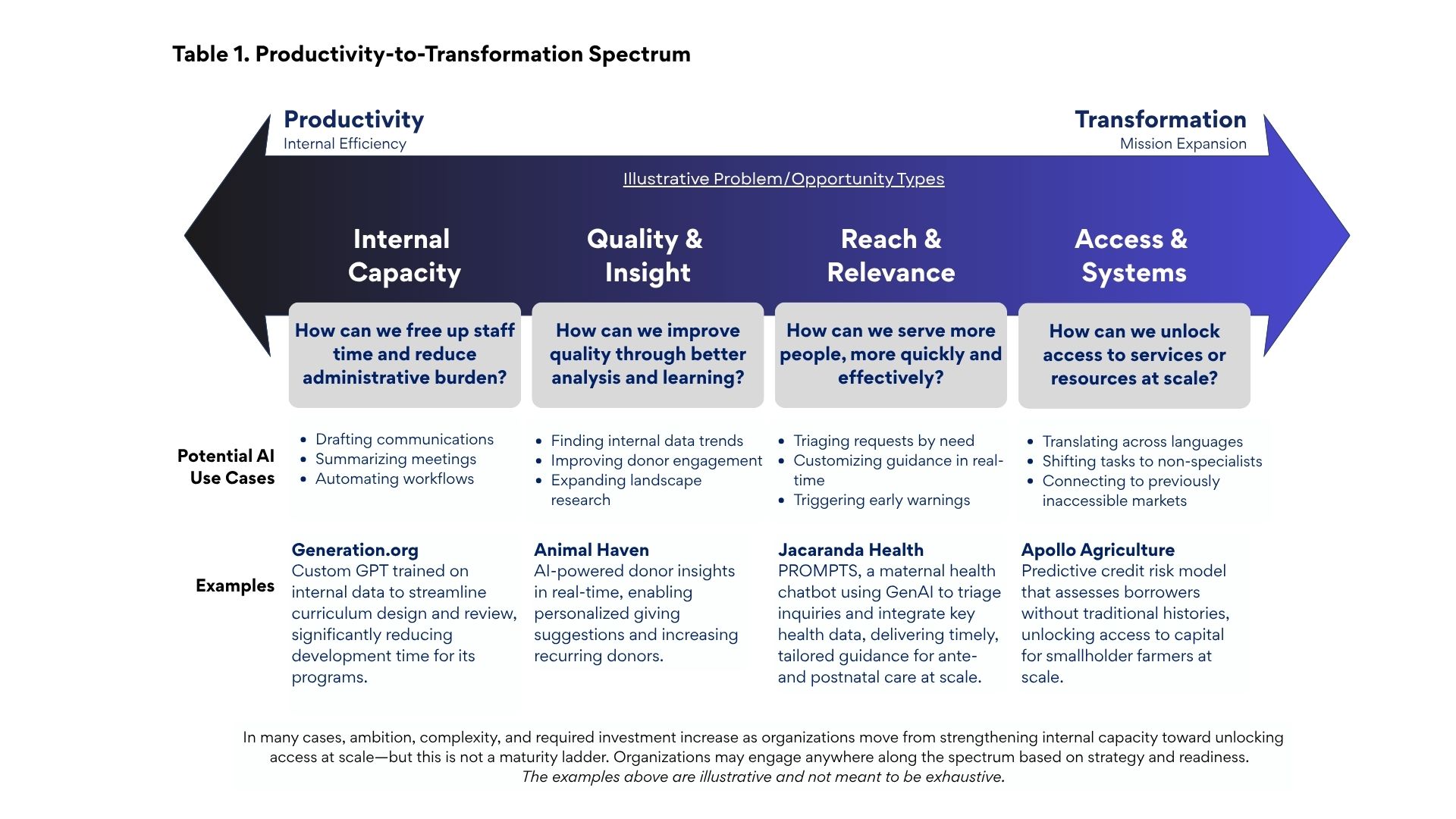 (Click to enlarge)
Question 2: What Will It Take?
If the first question clarifies AI’s purpose, the second grounds it in reality: What will it take for us to do this well? AI adoption, especially for more transformative ambitions, begins with readiness, and some foundational components can take years and significant resources to build. From our research, three dimensions most strongly shape the length and slope of an organization’s AI adoption curve: its relationship with technology, its learning culture, and the domain in which it operates. Here’s a look at each.
Technology: Effective AI projects depend on high-quality data, robust data infrastructure, and technical talent. Organizations where technology is not already central to strategy and delivery must assess whether building this capacity is a near-term priority, a longer-term aspiration, or outside their strategic path altogether.
While “AI-native” organizations are emerging and face their own challenges, particularly around trust and implementation, in broad terms and for the purposes of this article, most organizations fall into one of three profiles:
- Tech-lite: Makes limited use of technology across operations and programs; data systems may be fragmented or minimal
- Tech-using: Effectively uses general technology (such as CRM systems and digital tools) as a supportive layer, but technology is not core to the model
- Tech-forward: Embeds technology as a central pillar to the organization’s strategy or delivery model, often accompanied by staffing, structured data systems, and analytic capability
Honest assessment can help organizations understand where their climb may be steeper, and anchor strategy discussions in the realities of data, systems, and talent investment.
A note re: hiring. Boards can gravitate quickly toward hiring technical talent, but that’s rarely the best first step. Organizations should consider a staged “dosing strategy” that builds broad AI literacy internally first, then invests in targeted expertise (internal or external) that aligns with priorities. External expertise can include consultants, board members, or tech volunteer programs such as Mapbox, Tech to the Rescue, and Moving Worlds.
Learning culture: AI adoption is rarely linear; it requires experimentation, iteration, and a willingness to pivot when assumptions prove wrong. Organizations with strong learning cultures use data to question, refine, and improve, and are better positioned to explore AI responsibly. Leaders should ask: Do we use data primarily as a tool for reporting and upward accountability, or do we encourage the use of data for surfacing uncomfortable truths and adapting in real time?
When discussing this dimension with the board or leadership team, the goal is not critique but clarity. If experimentation and shared learning are informal or inconsistent, investing in cultural or internal system shifts may be as important as investing in new technology.
Domain: Context shapes readiness. Some fields, such as climate and agriculture, may benefit from relatively rich datasets, fewer individual privacy constraints, and a history of digital experimentation. Others—such as health, land rights, or gender-based violence—operate in highly regulated and deeply sensitive environments where risks to vulnerable populations are significant.
Leaders need to consider how their organization’s context shapes opportunity, regulation, and risk, and bring examples from comparable organizations to illustrate how others have navigated these trade-offs. Where are datasets abundant and risks manageable? How do regulation and compliance shape what data they can collect or use? What level of complexity and potential harm does the context introduce to different AI applications?
These questions are not theoretical. In practice, different domains yield very different AI pathways depending on how organizations assess and manage risk. For example, in agriculture, organizations such as Digital Green have found that direct-to-user tools like agronomy chatbots can be both effective and relatively low-risk, supported by abundant localized data and clear use cases. In more sensitive domains, the same approach may not be appropriate. In the gender-based violence field, the nonprofit tech organization Chayn discontinued an AI-enabled chatbot pilot supporting survivors after determining that the risks, particularly around unintended use, were too great given the context. This does not mean AI has no role to play. Rather, it may be better suited to more indirect applications of AI, for example, DataGénero’s use of AI to help criminal courts collect and make legal data on gender violence publicly available. (For more insights on domain, see AI Access Initiative’s paper, “AI for Good: Cross-Sector Analysis.”)
Question 3: How Do We Lead Through This?
Levels of excitement and apprehension about AI vary widely across organizations; among mission-driven professionals working to address market and systemic failures, skepticism is both common and justified. Concerns include environmental and labor costs; bias; privacy violations; and broader societal impacts on employment, democracy, and sustainability. At the same time, AI offers real potential to advance social and environmental progress, particularly as organizations confront complexity and resource constraints. Vilas Dhar, president of PJMF, reflected to us, "The loudest voices on AI are selling hype or warning of collapse. Neither is a strategy. True leadership in this moment means holding challenge and possibility at once, moving together with the hope of AI."
The task for leaders isn’t to resolve these tensions immediately but to acknowledge them openly, hold them constructively, and create space for informed, principled exploration within that hopeful middle ground. One practical way to do this is to establish guardrails early on, first inviting board and staff to identify the risks that matter most in the organization’s context, and then translating those into a set of responsible AI principles, or shared commitments, that shape the evaluation, deployment, and governance of AI. Responsible AI principles consider fairness, transparency, human centeredness, data privacy and security, inclusion, and sustainability.
This process grounds the exploration of AI in ethics and aligns it with the organization’s mission, providing clarity that helps everyone move forward with greater confidence and balance. Again here, it’s helpful to draw on examples from organizations working with similar opportunities and constraints. In the case of Jacaranda Health, for instance, applying AI in maternal health means prioritizing clear user consent, designing for the most vulnerable people, ensuring that trained professionals vet AI-generated responses, and maintaining affordability to enable scale. PJMF’s Responsible AI module can support the development of principles, and questions from FastForward’s Nonprofit AI Policy Builder can help guide discussion on appropriate internal AI use.
Question 4: What Pace Is Right for Us?
The private sector often frames AI adoption as a race to deploy faster, automate more, and “fail fast” to reduce costs and capture market share. But social impact organizations operate under a different mandate, with different stakes. A flawed chatbot can give pregnant women dangerous advice. A biased credit scoring model can deepen exclusion. As a result, organizations must move at the speed of trust. Operational commitments to inclusion, safeguarding, and compliance—often based on responsible AI principles—must shape the pacing and scope of adoption.
Leaders need to outline what those commitments require in terms of process, resources, and timelines. For example, as Jacaranda Health expands access to its AI-powered maternal health chatbot, PROMPTS, it must form partnerships with local health systems and providers, rigorously validate messaging accuracy, adapt to different regulatory environments, and build trust with frontline workers and patients. This diligence takes time and resources, and as AI adoption accelerates globally, funders and partners may push for speed. Clearly articulating why pace is a strategic decision rooted in impact, ethics, and trust—not a reaction to fear or inertia—helps set realistic expectations with boards, partners, and funders. This ensures that innovation strengthens rather than detracts from the mission. (PJMF’s operationalization of AI principles throughout the development of its financial due diligence tool, and NetHope’s case studies across health, education, and agriculture offer inspiration.)
Taking the Next Step
No matter what the starting point or how steep the path, the development of any AI strategy should be iterative. By clarifying “AI for what?,” assessing readiness across technology, learning culture, and domain, holding skepticism and hope in constructive tension, and letting impact imperatives set the pace, leaders can equip their board and team with something more valuable than quick answers: a shared understanding. And from there, they can move forward deliberately, setting strategy and milestones, identifying partners, testing, investing, or pausing as readiness and alignment dictate.
Read more stories by Kimberly Bardy Langsam, Jacqueline Watts & Erin Worsham.