

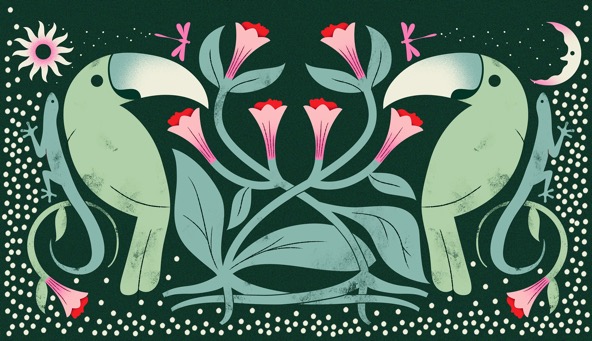
 (Illustration by Vicki Turner)
An Indigenous woman returns to the land when her problems become overwhelming. There, she observes crops, talks with the wind, and stands on living soil, sensing that the land responds to her. She says that while she tends the crops with her children, her worries begin to fade. For her, peace comes through communion with the land.
This experience is common in the Ecuadorian highlands, and it challenges mainstream models of well-being. What if well-being is not just an individual state but something that emerges through relationships among people, communities, and the living world? Such an understanding extends beyond personal experience to shape how people connect with rivers, forests, and the social institutions that govern them. It invites us to rethink well-being not as an individual condition, but as the quality of the relationships that connect people, culture, and the planet—and to understand how these relationships are cultivated in practice.
A lawyer arrives at court carrying a small flask of polluted water from the Machángara River, once vital to Quito, Ecuador’s capital. As the city expanded, waste contaminated the river. Holding the flask before the court, he argues that the Machángara is seriously ill and, as a living entity, has the right to health, ecological integrity, and the capacity to support and regenerate life. The case succeeds, and the municipality is ordered to restore the river.
The idea that a river can have rights may seem unusual from a human-centered perspective. Yet in Andean worldviews, well-being is inseparable from relationships: My well-being depends on my neighbors, the ecosystems around me, and the lands that sustain life and culture. Humans, nonhumans, and landscapes form a community of life. Emerging transdisciplinary fields and global movements are recognizing this same interdependence. Planetary Health, which takes a systems perspective on the interdependence of ecosystems and society, and One Health, which grew from efforts to address zoonotic diseases, both hold that disrupting these interconnections harms humans and ecosystems alike.
Western concepts of well-being tend to focus on the individual, from the roots of the words “well” and “being” to eudaimonic well-being, with its emphasis on a meaningful, fulfilling life. In Andean cosmology, by contrast, the self is profoundly connected to the collective. Even linguistically, in Kichwa—the northern variety of Quechua—there is no “I” (ñuka) without the “we” (ñukanchi). Well-being is thus a communal experience, shaped by communal ways of understanding and relating to the world. People are embedded in a living, multidimensional network that sustains existence: Pacha-mama, or Mother Earth.
Alli Kawsay in Kichwa, Buen Vivir in Spanish, or Good Living—also called the Good Way of Living or Good Coexistence—is an Andean philosophy of well-being that offers an alternative to individual-centered models. Rather than centering the person, Good Living understands well-being as emerging through relationships among people, nonhuman beings, ancestors, land, and the forces that sustain life. It seeks harmony across this larger community of life.
Expanding How We Understand Well-Being
Amid displacement, urban expansion, and cultural loss, it is increasingly important to understand how traditional Andean agroecological landscapes and practices affect mental and physical well-being. Research in rural Andean communities has shown that Indigenous mental health is closely connected to broader social and cultural conditions1. Agroecology supports sustainable food systems by enabling dignified livelihoods, promoting food sovereignty, and fostering the health of land, people, and planetary systems. Our previous research in the Bolivian Altiplano also illustrates how collective action can support agroecological transitions and strengthen relationships among communities, territories, and food systems2.
This is the context for our research, supported by the Mind & Life Institute, which explores the interconnections among Indigenous contemplative practices, relationships with the more-than-human world, and well-being in rural Andean communities. By situating these relationships within Andean knowledge systems, we seek to foster new understandings of both contemplative science and Indigenous wisdom and to examine how different environments influence emotional, physiological, cultural, and spiritual experiences.
To that end, we conducted a mixed-methods pilot study with 54 Kichwa participants living in three different environments in Ecuador’s central highlands, exploring how relationships with land, culture, and community shape experiences of well-being. This study builds on our broader work, the Symphony Project, which examines Indigenous well-being, agroecology, and health in Ecuador. It shows that perceptions of well-being are closely tied to the land, that a sense of belonging to the land is closely tied to Indigenous identity, and that connections with nature are as psychological as they are practical and spiritual.
The concept of pacharuna is central to our study. It describes an awareness of the deep interconnectedness between humans and nonhuman nature, a way of experiencing reality in which people see themselves as part of a larger living community rather than apart from it. This awareness entails respect for the sacred: Life is sacred, and responsibility begins with caring for the community. It contrasts with many dominant Western approaches, which tend to distinguish mind from body and spirit, self from other, and people from nature.
In Ecuador’s highlands, loneliness is rare because relationships with mountains, animals, crops, and landscapes foster connection and belonging. Being fully present in relationship with the land can also be understood as a form of mindfulness or conscious awareness. As William Van Gordon, Edo Shonin, and Miles Richardson explain in their 2018 Mindfulness article “Mindfulness and Nature,” mindfulness can strengthen people’s connection with the natural world. As one elder put it, to live in pacha is to live in harmony with the Earth, mind, body, spirit, and community. Human health and the health of Pachamama are inseparable.
That inseparability is evident in how people treat the land itself. One participant told us that whenever she visits the fields with her family, she picks up trash left by others. She sees the land not only as a source of well-being but as something that deserves care. Through the lens of Alli Kawsay, agroecological landscapes are more than places where food is produced, and Planetary Health is more than environmental stewardship. Both are ways of nurturing the relationships that sustain the well-being of humans, nonhuman beings, and Mother Earth.
Beyond Individual Well-Being
Ecuador was the first nation to embed Alli Kawsay, or Buen Vivir, in its constitution, recognizing Nature as a legal subject with rights that protect rivers, plants, and animals. This Andean worldview has shaped Ecuadorian governance by framing well-being as a relationship among humans, nonhumans, and the Earth. It also invites us to reconsider assumptions rooted in individualism, consumerism, and separation—from one another and from the living world. In her 2026 article for the Journal of Awareness-Based Systems Change “The Seeds We Sow,” Christine Wamsler identifies these patterns of separation as underlying drivers of today’s interconnected social and ecological crises and emphasizes interbeing as a foundation for societal transformation.
The perspective of the trash-collecting participant offers a broader lesson: Addressing these crises may require redefining what it means to thrive, not as an individual achievement, but as the cultivation of healthy relationships with communities, territories, and the living world.
Policymaking should reflect that shift. Planetary Health provides one framework, recognizing that human health is inseparable from the health of the ecosystems on which we depend. The Rights of Nature offer another tool for protecting these relationships. In Ecuador, these ideas have already informed successful litigation, bringing Indigenous worldviews into conversation with emerging approaches to Planetary Health. Ecuador’s constitutional recognition of the Rights of Nature reflects the same conviction that runs through the highlands: The well-being of one depends on the well-being of all.
The woman tending carrots with her children is not simply escaping stress. She is participating in a web of relationships that, in the Andean tradition, is the foundation of well-being. That offers a lesson not only for Ecuador, but for societies everywhere. Perhaps living well means not only caring for ourselves, but also learning how to live in relationship with one another and with the living world.
Read more stories by Amaya Carrasco-Torrontegui & Carlos Andres Gallegos-Riofrío.