


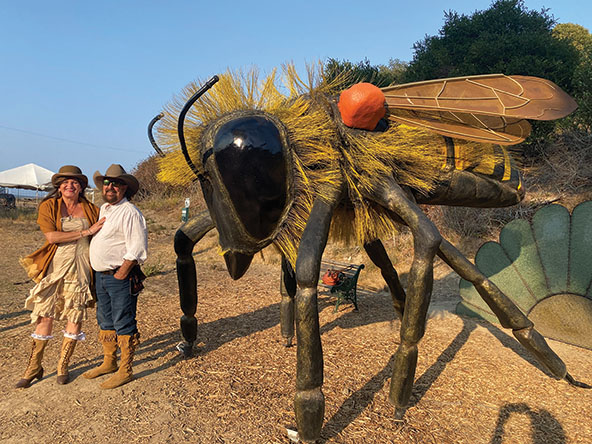
 Artists Lisa Ferguson (L) and Robert Ferguson pose with their Bee or Not to Bee sculpture that is installed at Point San Pablo Harbor, California. (Photo courtesy of Candace Locklear)
“Art can change people’s lives,” says Yomi Ayeni, a visual artist and the founder of the nonprofit We Are From Dust (WAFD).
His belief in the transformative power of art compelled him to find a way to repurpose the artwork from Burning Man, the annual arts-centered festival that draws thousands of people to Nevada’s Black Rock Desert each year to create Black Rock City, a massive encampment filled with artistic installations. Ayeni is a Burning Man devotee who has attended and volunteered on its media team for more than two decades. The festival is remote and expensive, with ticket costs ranging in the hundreds to thousands of dollars, so he saw an opportunity to benefit both artists and the public who cannot attend.
In 2015, he launched WAFD to bring the inspiring artwork into public spaces to make it available to all. The universality of the nonprofit’s social mission reflects the nonprofit’s name, which refers to the idea that all humans are made of the same single substance: dust. The name is also a nod to the Burning Man desert experience, where both the people and the art get covered in dust.
Before WAFD, art built for Burning Man was either burned or placed into storage at the end of the weeklong festival. “You won’t get at least an indication of the scale of it, or the immense nature of this thing, by looking at it folded up in a container somewhere,” Ayeni says. Now, with WAFD, the artwork has found life post-Burning Man in public displays that aim to change how people engage with art and how they value its relevance in their daily lives.
“We’re basically transforming public spaces into sculpture parks,” says Candace Locklear, a WAFD team member. “People who probably will never go to Burning Man, especially children, can see this art.”
WAFD currently is running public installations at three sites around the world: one at the Point San Pablo Harbor, just north of the Richmond-San Rafael Bridge in Contra Costa County, California; the second at the Artspace Ashton Court in Bristol, England; and the third in downtown Salt Lake City, Utah.
The Point San Pablo Harbor installation is of artist Paige Tashner’s two large steel cat sculptures that purr when you pet them and light up at night. “The Purr Pods get to be part of [WAFD’s] great plan of encouraging people to interact with art in public spaces,” Tashner says. “[WAFD] has hosted art tours as well, so people can learn about their mission, Point San Pablo Harbor, the art, and artists.”
There are a total of five WAFD art installations at Point San Pablo Harbor. One, in addition to the Purr Pods, is Bee or Not to Bee, which was created for Burning Man 2019 by Robert and Lisa Ferguson.
“The goal of the project was to highlight the importance of honeybees,” Lisa Ferguson says. “This is a larger-than-life bee. It is more than 13 feet long and 8 feet high. Impressive, yet passive. It can be touched and examined. It will not sting.”
The nonprofit’s effort has taken shape at a time when government funding and support for public art has waned. WAFD pays artists up to $10,000 to lease their work for the public installations. It holds fundraisers as well as accepts donations from visitors to the installation sites. WAFD also has benefactors, according to Locklear, and it has raised approximately $250,000 since its inception. Funding goes directly to the artists’ honorariums and to the cost of installing the pieces. WAFD relies on the Burning Man community to volunteer their time, currently a team of five, ensuring that all funds raised go fully to the artists.
The COVID-19 pandemic did not deter WAFD from its mission or the public from viewing its installations. In fact, it is actively working on changing and expanding its offerings. Locklear notes that the WAFD volunteer team has been assisting documentary photographer Erin Douglas prepare her artwork from her Black Burner Project, which showcases images and stories of Black Burning Man attendees, for public installation. “We will help her art piece ... find a good home as part of the WAFD mission,” Locklear says.
WAFD is also planning to secure two new sites for its public installations in Northern California, home to many Burning Man artists: American Canyon, in Napa County, and Petaluma, in Sonoma County. Locklear adds that the focus will be to continue to scale their work in more cities in the United States and abroad in the spirit of realizing the value of art as a public good.
Read more stories by Kristi Eaton.